


Antique Japanned Floor Clock
These antique japanned floor clock pieces are tall case timepieces finished in decorative lacquerwork, desired for their striking hand-painted oriental scenes and period presence.
Antique Japanned Floor Clock
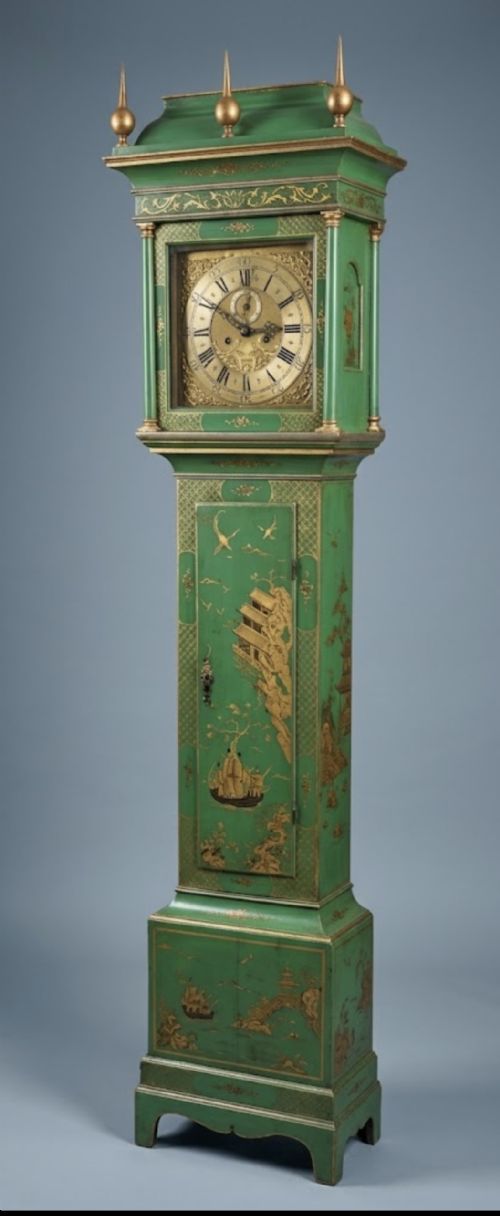
An antique japanned floor clock stands as a monumental timekeeper, typically taking the form of a longcase or grandfather clock housing a mechanical movement. These tall wooden cases rise upright to display elaborate painted decoration across the trunk, door and hood.
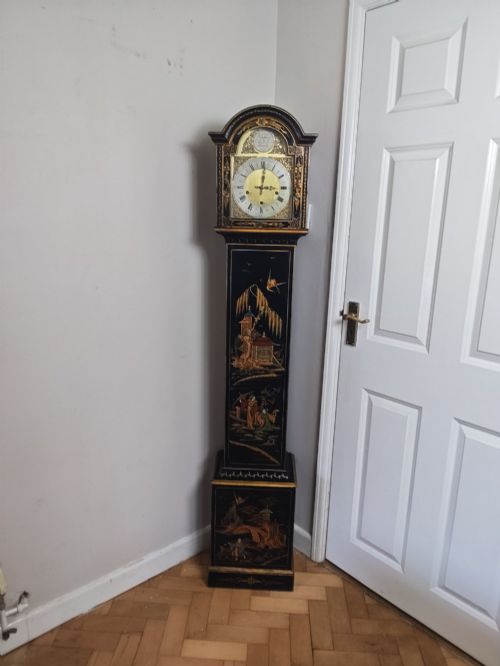
Buyers on this page encounter variations ranging from full-scale 18th century longcase examples by named makers to smaller 20th century grandmother clocks. Styles span early Georgian chinoiserie interpretations alongside revival pieces produced around 1930.
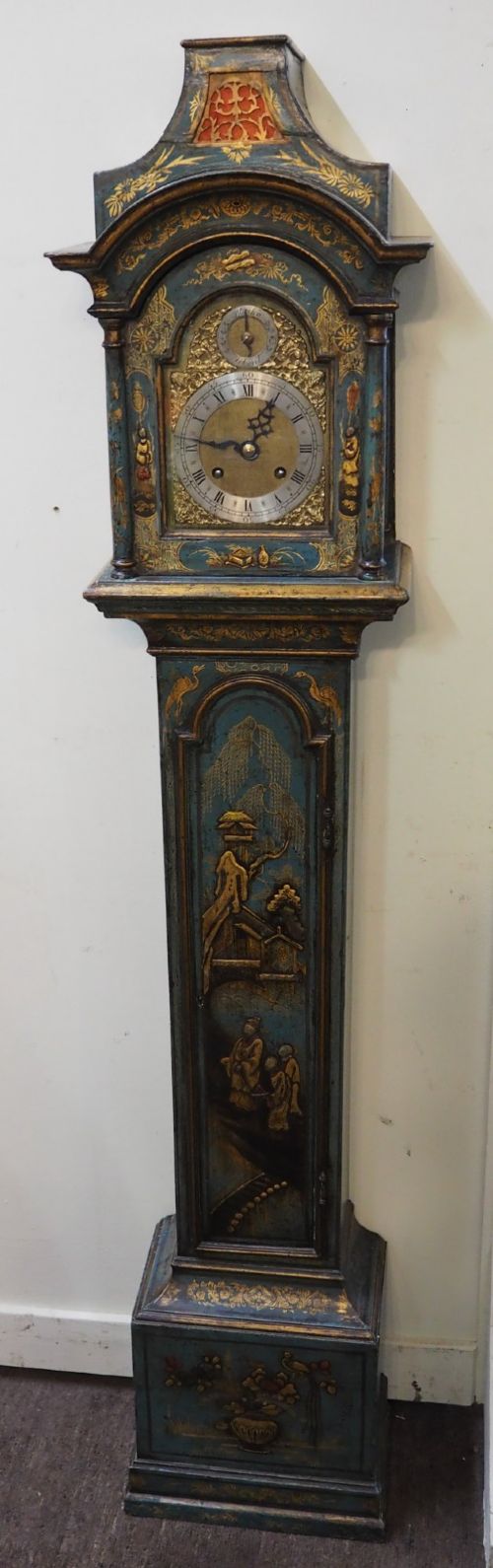
The decorative schemes draw heavily on Oriental motifs, depicting figures, pagodas and landscapes in raised gilt and colour upon grounds of green, blue, cream or dark lacquer. These tall objects dominate a hallway or reception room much as they did in Georgian interiors.
Materials and construction methods
Cabinetmakers constructed the tall wooden carcases using timber suitable for receiving layers of gesso and lacquer. Artisans then applied successive coats of varnish and pigment, building up smooth or textured surfaces.
Decoration relied on applied gold leaf and gilt work to shape the characteristic chinoiserie scenes, complemented by brass dials and movements. Specialised horologists engineered the internal brass gear trains, often incorporating musical cylinders or automata mechanisms.
Listings feature green, blue, and cream lacquer finishes alongside natural wood variations across Georgian and 1930 periods.
Distinctions in quality
The refinement of the painted chinoiserie decoration separates standard examples from exceptional ones, with superior pieces showing delicate brushwork, deep relief in the gilt work and well-preserved ground colours. The complexity of the internal movement, such as musical capabilities or rocking automata figures, further elevates a piece.
The proportion and architectural integrity of the wooden case, alongside the original state of the lacquer surface, determine the overall desirability. Master horologists signing the dial add historical weight to the clockwork housed within.
John fielder of Alton·William Kipling London·Wise of Reading·Thomas Utting of Yarmouth·Gardner of London·Robert Berry
The Antique Japanned Floor Clock Glossary
- Japannning
- European imitation of East Asian lacquerwork using resin varnishes and metallic powders. This technique created the glossy decorative surfaces seen on these tall clock cases.
- Chinoiserie
- European artistic style reflecting Chinese and East Asian motifs. It forms the primary decorative vocabulary painted onto these clock surfaces.
- Longcase clock
- Tall pendulum clock enclosed in a wooden case standing directly on the floor. These items are also frequently termed grandfather clocks.
- Grandmother clock
- Smaller version of the traditional longcase clock produced in later periods. They offer a reduced scale suitable for lower ceilings.
- Automaton
- Moving mechanical device designed to mimic human or animal action. Some advanced examples include rocking figures like Father Time on the dial.
Antique Japanned Floor Clock: Frequently Asked Questions
What is a japanned floor clock?
A japanned floor clock is a tall timepiece housed in a wooden case decorated with European lacquerwork imitating Asian designs. These pieces combine horology with decorative painted panels.
They serve as prominent furniture items designed to keep accurate time while adding height and colour to an interior space.
How do I tell an 18th century clock from a 1930 revival?
Eighteenth century examples display the patina of age, hand-forged internal components and traditional joinery typical of early Georgian cabinetmaking. Maker signatures on the dial often correspond to known historical horologists.
Nineteenth and twentieth century pieces, including those from 1930, generally feature cleaner internal machinery and distinct timber ageing characteristics that mark them as later interpretations.
What is the difference between a grandfather and a grandmother clock?
A grandfather clock is a full-scale longcase timekeeper that stands over six feet tall. These large proportions demand substantial floor space and high ceilings.
A grandmother clock is a scaled-down version produced in the 20th century, offering the same general form in a shorter body suitable for compact rooms.
How do I care for a lacquered clock case?
Keep the lacquered wood away from direct sunlight and steady temperature fluctuations to prevent the finish from cracking or fading. Dust the surface gently with a dry, soft cloth.
Avoid using modern chemical polishes or water on the japanned panels, as moisture damages the historic varnishes and gilt decorations.