
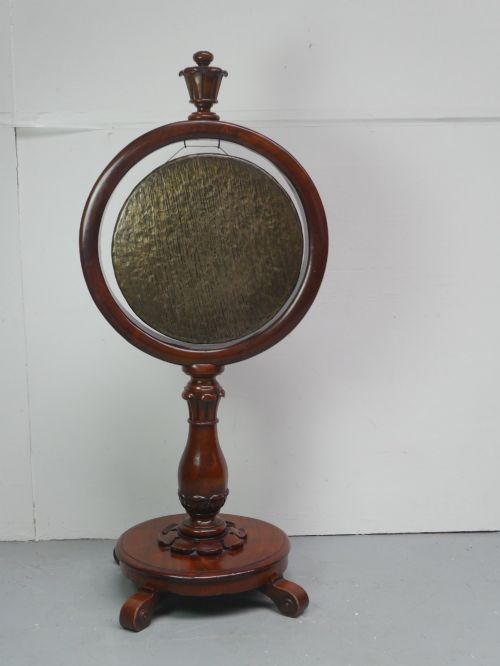
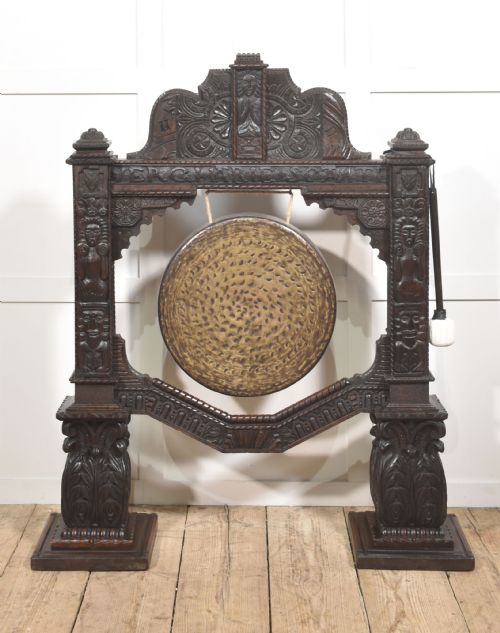
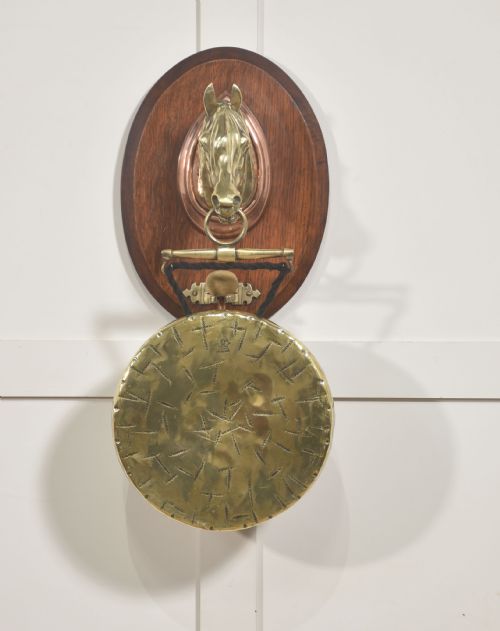


Antique House Gong
An antique house gong brings a resonant Victorian summons to the hall, pairing brass and bronze chimes with carved timber frames.
Antique House Gong
An antique house gong is a substantial household summons designed to call residents to the dining table from across large country rooms. These pieces combine a suspended metal chime with a sturdy wooden or iron structure meant for wall hanging or floor standing placement.
You are most likely to meet 19th-century and 1900 examples built around carved oak frames and brass or bronze discs. Styles lean towards Victorian, Gothic Revival, and Arts & Crafts aesthetics, often featuring robust timber mounts.
The form ranges from simple bobbin-turned oak frames to monumental carved pieces incorporating horse head mounts or cattle horn. Each version serves the dual purpose of a functional signaling device and an imposing hallway ornament.
How they were made
Makers constructed the primary support structures using dense native timbers like oak and mahogany, often shaping them with deep relief carving or simple bobbin-turning. Metalworkers cast the hanging gongs in brass, copper, or bronze to ensure a resonant, lingering tone when struck.
Suspension relied on durable materials such as leather, rope, and cord to support the heavy metal discs securely within their wooden or wrought iron frames. These utilitarian fastenings were chosen for strength to withstand the constant vibration of daily use.
One unexpected country house variation incorporates cattle horn alongside the carved oak frame.
What varies in quality
The distinction between standard examples and superior pieces rests on the ambition of the timber carving and the weight of the metal chime. Heavier cast bronze or brass discs produce a richer, deeper tone than thin sheet metal, while finely carved oak frames indicate higher workshop skill.
Design flourishes also elevate certain items above plain utility, such as specialised equestrian mounts, cattle horn details, or intricate Gothic Revival tracery. The integration of robust wrought iron work similarly marks out more substantial country house commissions.
The Antique House Gong Glossary
- Dinner Gong
- A hanging metal disc struck with a mallet to announce meals in large residences. It forms the central acoustic element of the piece.
- Bobbin-Turned
- Woodwork shaped on a lathe into a series of rounded, spool-like spheres. This decorative technique appears frequently on 19th-century frames.
- Gothic Revival
- An architectural and decorative style drawing on medieval forms. Pieces in this manner display pointed arches, heavy mouldings, and ecclesiastical motifs.
- Arts & Crafts
- A design movement valuing honest construction and visible handcraft. These gongs emphasise plain oak framing and straightforward joinery.
- Wall-Hanging
- Designed to be fixed securely to a vertical surface rather than standing on the floor. This configuration saves space while projecting sound through hallways.
Antique House Gong: Frequently Asked Questions
How do you strike a house gong?
You use a dedicated mallet with a padded or leather-wrapped head to hit the centre of the metal disc. This produces a clear, resonant tone without damaging the brass or bronze surface.
Striking it firmly near the middle allows the full vibration to carry through timber hallways without harsh metallic clanging.
Where were these placed in houses?
Country house gongs hung predominantly in entrance halls, corridors, or near dining room entrances where sound could travel freely. Their prominent placement ensured family members and guests heard the summons from distant rooms.
Wall-hanging versions required sturdy masonry or heavy timber studs to bear the considerable weight of the frame and metal disc.
What metals are used for the chimes?
The hanging discs consist primarily of brass, bronze, or copper cast to heavy thicknesses. These alloys were selected specifically for their acoustic properties and ability to hold a sustained tone.
Over time, these metals develop a dark natural patina that reflects their age and handling.
How do I date an oak gong?
Dating relies on stylistic clues within the woodwork, such as heavy Gothic Revival motifs or bobbin-turning characteristic of the 19th century. Hardware construction and the method of suspension also provide clear indicators of period manufacture.
Victorian pieces often display denser carving compared to simpler 1900 variants.