
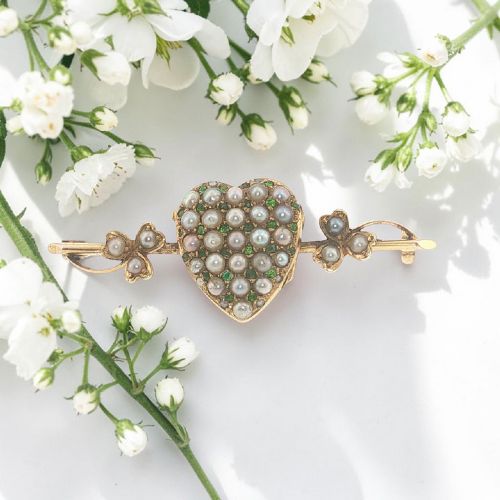
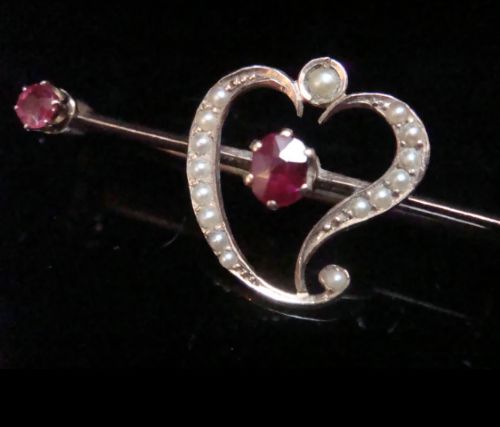


Antique Gold Heart Pin
These antique gold heart pin designs range from Victorian romantic jewels to mid-century gold work, offering enduring sentiment and fine craftsmanship.
Antique Gold Heart Pin
An antique gold heart pin brings together sentimental forms and precious metals from the Victorian, Edwardian, and later periods. These pieces serve primarily as brooches, lockets, and stick pins designed to fasten clothing while displaying devotional motifs.
The materials paired with the central heart motif include seed pearls, diamonds, turquoise, rubies, and garnets, often set within fifteen-carat or eighteen-carat yellow gold. Versions span straightforward cabochon stones to winged designs and intricate plique-à-jour enamel work.
How they were made
The metalwork relies predominantly on cast or pierced gold frames in nine-carat, fifteen-carat, and eighteen-carat purities. Jewellers shaped the precious metal by hand to form symmetrical lobes and apexes, occasionally incorporating hinged locket compartments or pin stems soldered to the reverse.
Gemstones such as turquoise, seed pearls, rubies, and diamonds were flush-set, claw-set, or bead-set directly into the gold body. Enamelling techniques like plique-à-jour also appear, suspending translucent coloured glass within delicate wire cells without a backing.
Gold purities across the recorded items include nine-carat, fifteen-carat, and eighteen-carat variations, frequently accompanied by pearls, turquoise, and diamonds.
What varies in quality
The standard of execution depends heavily on the crispness of the gold piercing and the uniformity of the stone matching. Finer pieces demonstrate precise claw work and well-matched seed pearls or calibre-cut gemstones that follow the contours of the heart without awkward gaps.
Design complexity marks the upper tier of production, where multi-gem arrangements, intricate bow drops, or enamel work demand advanced technical skill. Simpler specimens rely entirely on the natural warmth of the gold and the polish of a single central stone.
The Antique Gold Heart Pin Glossary
- Plique-à-jour
- An enamelling technique where the enamel is applied without a backing, resembling miniature stained glass. It allows light to pass directly through the translucent coloured material.
- Seed pearl
- A very small, naturally formed or early cultured pearl, frequently drilled and threaded onto tiny gold wires or glued into clusters. They are characteristic of late-nineteenth-century romantic jewellery.
- Cabochon
- A gemstone shaped and polished with a smooth, convex domed surface rather than faceted edges. This cut is common for opaque stones like turquoise, agate, and chalcedony.
- Stick pin
- A long pin with a decorative terminal head, originally designed to secure cravats, scarves, or lapels in place. The head often incorporates the same heart motifs found on larger brooches.
Antique Gold Heart Pin: Frequently Asked Questions
How do I wear an antique heart pin?
These pieces pin securely onto jacket lapels, heavy scarves, or silk blouses using the original pin stem and safety catch where fitted.
Because many carry delicate stones or hollow gold backs, avoid wearing them on thick, coarse fabrics that strain the pin mechanism.
Are these pins made of solid gold?
The records show metal purities predominantly in nine-carat, fifteen-carat, and eighteen-carat yellow and white gold. Solid construction was standard for these sentimental pieces during the Victorian and Edwardian eras.
Hallmarks or metal purity stamps frequently appear on the reverse of the frame or along the pin stem itself.
What is the difference between a Victorian and Edwardian heart pin?
Victorian examples often feature heavier gold weights, closed-back settings, and deeply symbolic arrangements involving seed pearls, garnets, or turquoise cabochons. Romantic motifs frequently emphasise mourning or deep sentiment.
Edwardian pieces tend to display lighter, airier platinum or high-karat gold wirework, often incorporating diamonds and pearls for a brighter, more lace-like aesthetic.
Can I use a stick pin as a brooch?
Stick pins feature a long, straight stem intended to slide through woven cloth and secure with a small cap or guard at the end. While they can sit in a lapel, they lack the hinged pin and roller catch typical of dedicated brooches.