

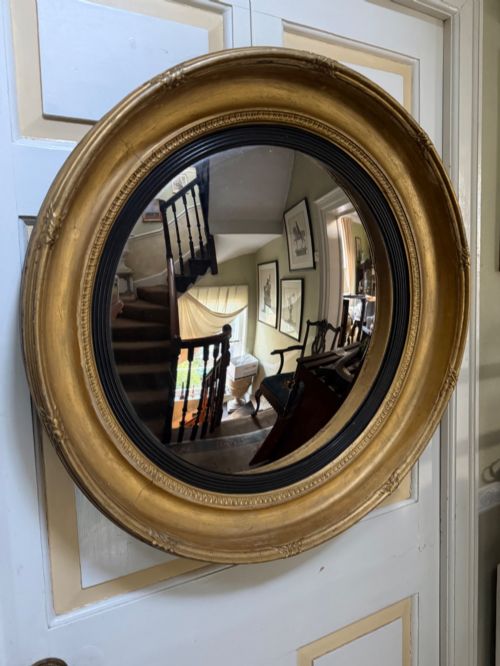
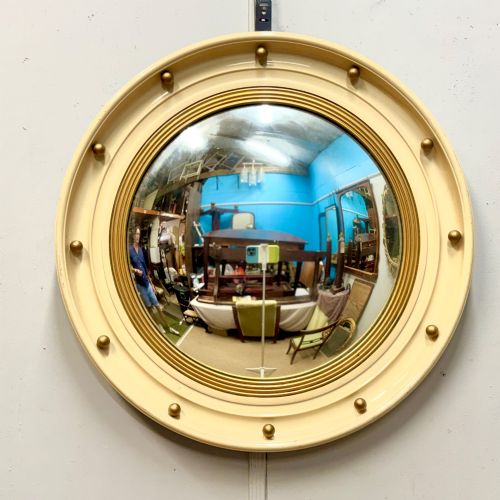
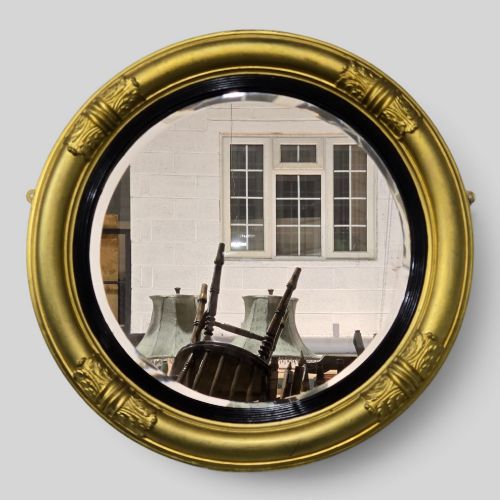
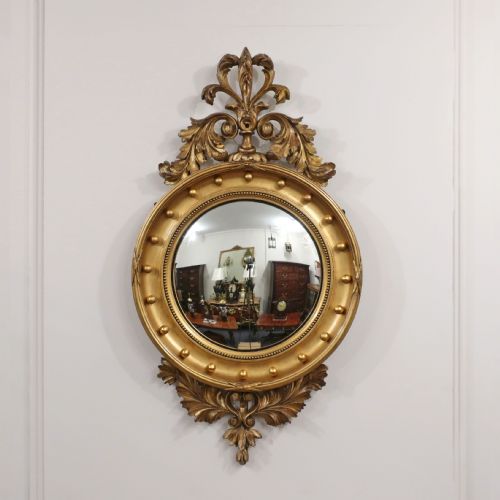




Antique Gold Fisheye Mirror
An antique gold fisheye mirror brings concentrated light and deep perspective into a room through its curved glass plate.
Antique Gold Fisheye Mirror
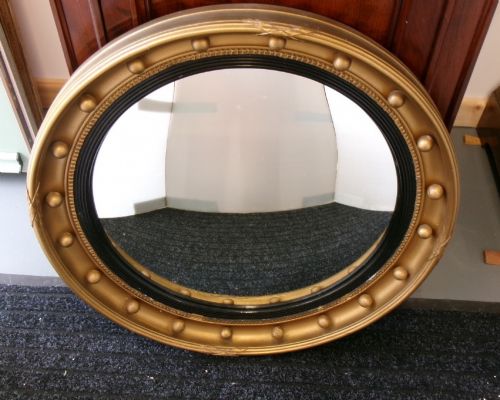
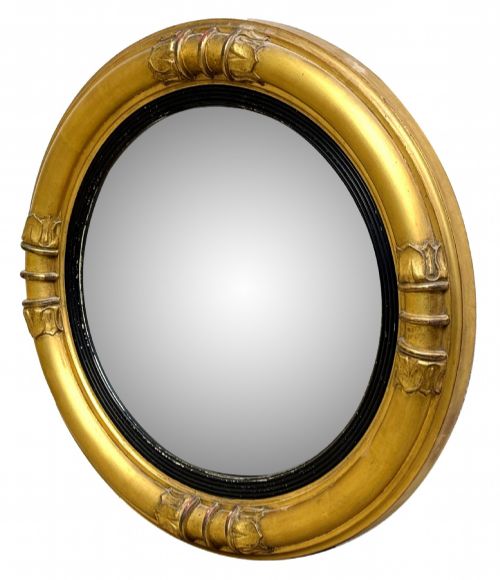
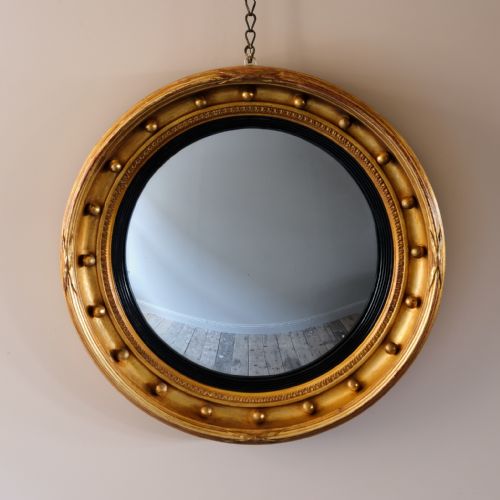
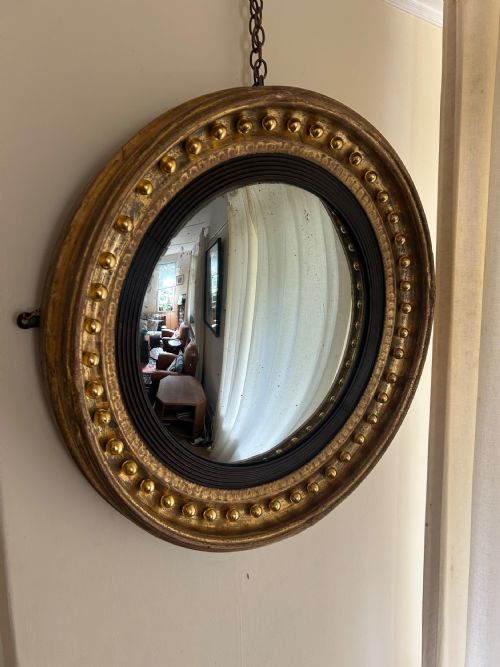
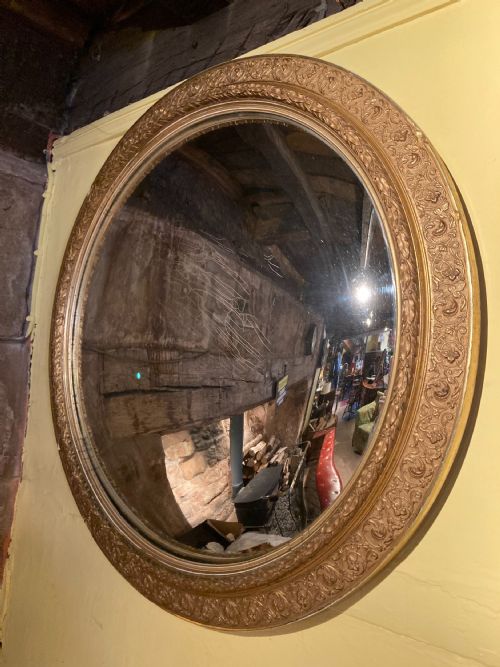
When searching for an antique gold fisheye mirror, buyers encounter round convex wall mirrors designed to reflect a wide, distorted field of an interior space. These circular glasses sit within ornate circular frames that project outward from the wall.
The selection on this page centres heavily on the Regency period and the nineteenth century, alongside later revivals from the end of the Victorian era and the early twentieth century. Examples range from small boudoir pieces to grand wall hangings spanning several feet.
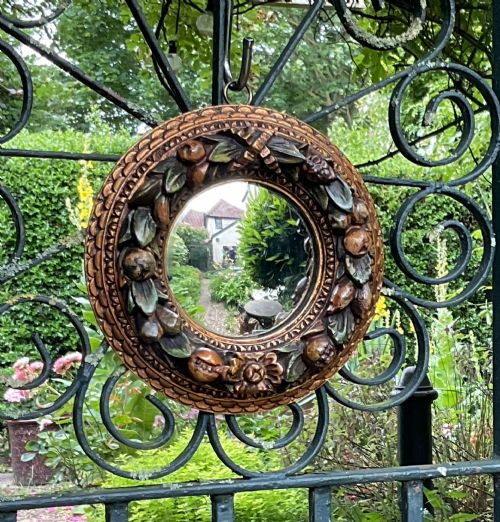
Many variants incorporate decorative crests such as spread eagles, dragons or carved foliage at the top and bottom of the gilt frame. Simpler models rely purely on reeded ebonised inner rings and moulded gesso borders to frame the reflective sphere.
How they were made
Makers constructed the circular frames using carved wood, composition and gesso built up over a wooden base to hold the heavy curved glass securely. Artisans then applied thin layers of gold leaf or gilt finish across the moulded details.
The convex glass plates were blown or shaped to create the characteristic fisheye distortion that allowed servants to monitor entire dining rooms from a single vantage point. Ebonised wood details frequently appeared alongside the gilding to create sharp visual contrast on the inner rims.
Antique Gold Fisheye Mirror Retail Price Guide 2026
Typical asking prices for gold fisheye mirror among the pieces listed under this phrase on Sellingantiques today, from the lower quarter to the upper quarter. They describe what is for sale here now, not the wider market.
Listings feature periods spanning from the Regency era through the nineteenth century, 1890, 1900, and up to 1920.
What varies in quality
Quality in these mirrors rests upon the crispness of the carved woodwork and the depth of the gilding applied to the gesso surface. Finer examples display masterly hand-carved details on eagle crests and delicate floral motifs rather than heavy, uniform composition mouldings.
The condition and clarity of the original convex glass plate heavily influence the desirability of the piece. Superior items retain their authentic silvering and distortion without excessive foxing or modern mirror replacements.
The Antique Gold Fisheye Mirror Glossary
- Convex mirror
- A round mirror with an outward-curving glass surface that captures a wide-angle reflection of the room. These are frequently known historically as butler's mirrors.
- Giltwood
- Timber that has been coated with a thin layer of gold leaf. This material forms the primary golden framing seen on the majority of these pieces.
- Gesso
- A plaster-like mixture applied to wooden frame bases and carved before gilding. It allows intricate decorative relief work around the mirror border.
- Ebonised wood
- Timber treated with a dark finish to resemble ebony. It appears as contrasting dark rings within the gilded frames.
- Regency
- An architectural and decorative style dating from the early nineteenth century. Pieces from this era often feature classical motifs and bold circular forms.
Antique Gold Fisheye Mirror: Frequently Asked Questions
Where should I hang a convex mirror?
These mirrors work best on principal walls in dining rooms, hallways or sitting rooms where they can capture light from multiple angles and reflect the entire interior space.
Because of their curved glass, they create an illusion of greater depth and space in smaller rooms when hung at eye level.
How do I clean an antique gilt frame?
Dust the gilded wood gently with a soft, dry brush to prevent any damage to the delicate gold leaf surfaces over time. Avoid using liquid cleaners or abrasive cloths entirely.
Moisture can lift old gesso and gilding from the wooden base, so dry maintenance remains essential for preservation.
Why are some mirrors called butler's mirrors?
The wide-angle reflection allowed domestic staff to monitor activity across a large dining room or hall from a single stationary point. This practical utility gave rise to the traditional name.
Over the nineteenth century, the functional object evolved into a purely decorative status symbol for grand homes.
How can I tell a Regency mirror from a later revival?
Original Regency pieces exhibit hand-carved wooden details, heavier construction and distinct signs of age in the gesso and glass plates. Later nineteenth-century and twentieth-century revivals often utilise machine-moulded composition ornament.
Examining the backboards, fixings and construction methods helps confirm whether a piece dates to the early nineteenth century or a later revival.