





Antique French Secretary
An antique French secretary brings refined concealed writing space and intricate marquetry into a room.
Antique French Secretary
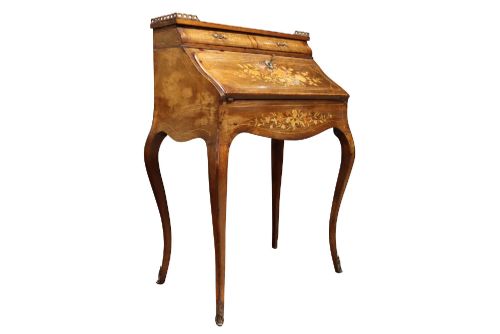
An antique French secretary encompasses writing desks, drop-front cabinets known as secrétaire à abattants, and delicate ladies' writing tables such as the bonheur-du-jour. These pieces span from the eighteenth century through the nineteenth century and into the early twentieth century, reflecting shifting domestic habits.
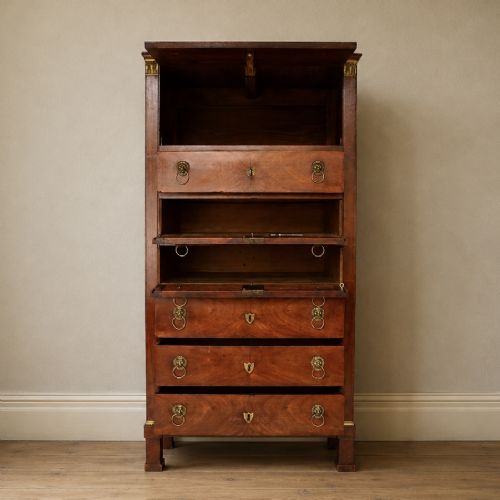
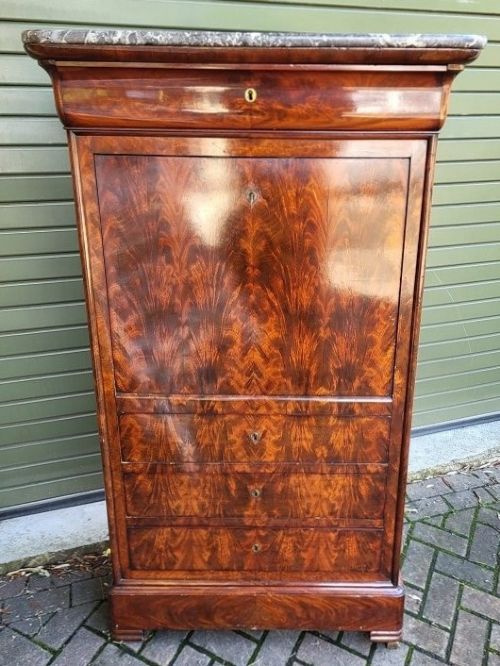
The version most commonly met on this page is the nineteenth-century walnut or mahogany secretaire à abattant, featuring a fall-front writing surface concealing fitted internal drawers and pigeonholes. Alongside these, various inlaid bonheur-du-jour desks appear frequently, often appointed with decorative mounts.
Makers and designers drew on Louis XV Revival, Louis XVI Style, and French Empire aesthetics, resulting in forms that balance architectural presence with surface decoration.
Materials and construction
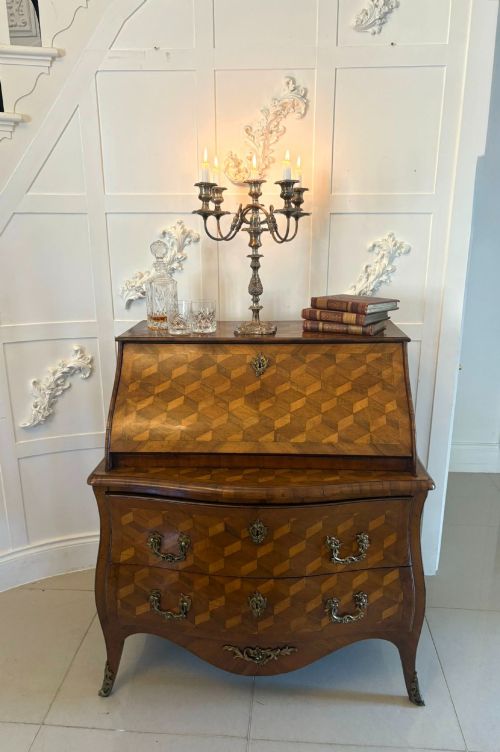
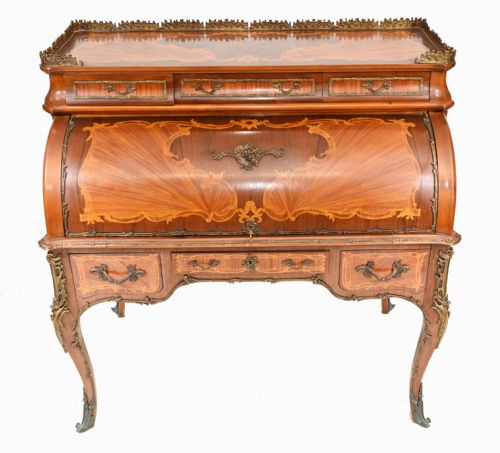
Cabinet makers utilised dense hardwoods including walnut, mahogany, rosewood, kingwood, and tulipwood as foundational timbers, frequently applying geometric parquetry or floral marquetry veneers across the exterior surfaces.
Structural elements incorporated brass, ormolu, and gilt bronze mounts, which framed corners, key escutcheons, and drawers, while heavy marble slabs provided durable tops for secretaire cabinets.
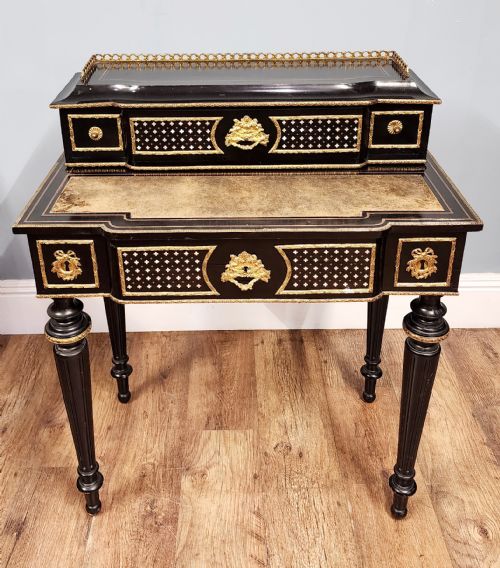
Specialised variations integrated porcelain plaques or ebonised finishes, combining joinery techniques with decorative arts to achieve ornate finishes.
Walnut, mahogany, and kingwood dominate the timber selections across these nineteenth-century writing desks and cabinets.
Assessing craftsmanship
The distinction between standard production and exceptional work lies in the precision of the veneer work and the crispness of cast bronze mounts. Fine parquetry aligns seamlessly across panel joins without gaps.
Internal secondary timbers and drawer linings indicate the care taken during construction, where hand-cut dovetails and matched grain patterns distinguish superior pieces from utilitarian items.
Edwards And Roberts·Gamichon A Paris
The Antique French Secretary Glossary
- Secrétaire à abattant
- An upright tall cabinet featuring a hinged fall-front writing flap that conceals inner compartments. This vertical format preserves floor space while offering a dedicated writing surface.
- Bonheur-du-jour
- A light-standing lady's writing desk originating in the eighteenth century, usually fitted with a small cabinet or shelving superstructure on the desktop. It functions primarily for correspondence and display.
- Ormolu
- Gilded bronze ornamentation applied to furniture mounts and feet during the eighteenth and nineteenth centuries. The technique involves a mercury gilding process on cast brass or bronze.
- Marquetry
- Decorative patterns formed by fitting together thin slices of various coloured veneers onto a structural carcase. Artisans utilise contrasting timbers to create floral or geometric pictorial scenes.
- Parquetry
- Geometric wood inlay work arranged in repeating patterns such as cubes, chequered squares, or herringbone designs. It creates a structured surface texture across tabletops and fall fronts.
Antique French Secretary: Frequently Asked Questions
What is a secretaire a abattant?
A secretaire a abattant is a tall, upright cabinet with a hinged door or flap that pulls down to serve as a writing desk. It typically conceals a fitted interior of small drawers and pigeonholes.
When closed, the piece presents a clean architectural front that occupies minimal floor space while offering substantial storage capacity.
How do I use a bonheur-du-jour?
A bonheur-du-jour serves as a compact writing table, traditionally used for handling correspondence and keeping small stationery items close at hand. The upper tier provides display space for letters or decorative objects.
In modern interiors, these lighter desks function well as vanity tables or secondary workspace desks in smaller rooms.
How do I identify French Empire style?
French Empire pieces display classical architectural influences, dark woods, and bold symmetry. They often feature restrained carving paired with prominent gilt bronze or ormolu mounts.
This aesthetic emerged in the early nineteenth century, drawing inspiration from ancient Roman and Greek design motifs.
What distinguishes Louis XV revival furniture?
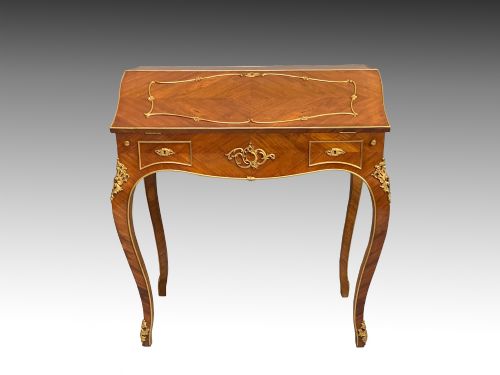
Louis XV revival pieces are characterised by flowing serpentine lines, cabriole legs, and asymmetrical floral marquetry. Makers of the nineteenth century embraced these curved profiles to create decorative warmth.
Surfaces often feature extensive parquetry work and elaborate bronze mounts that soften the overall silhouette of the desk.