



Antique French Fireplace Clock
An antique french fireplace clock brings heavy marble, polished ormolu, and measured striking bells to the mantelpiece.
Antique French Fireplace Clock
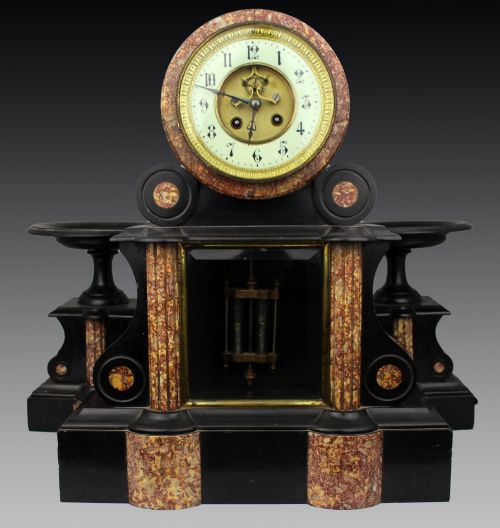
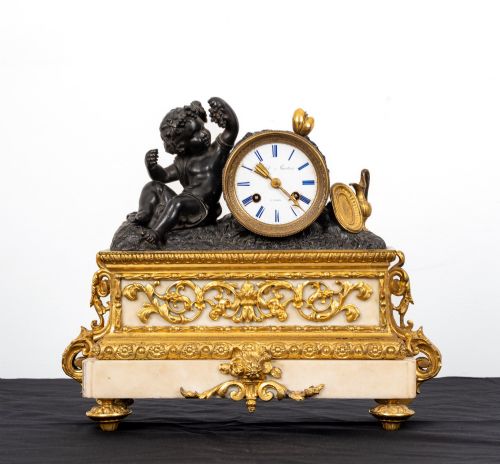
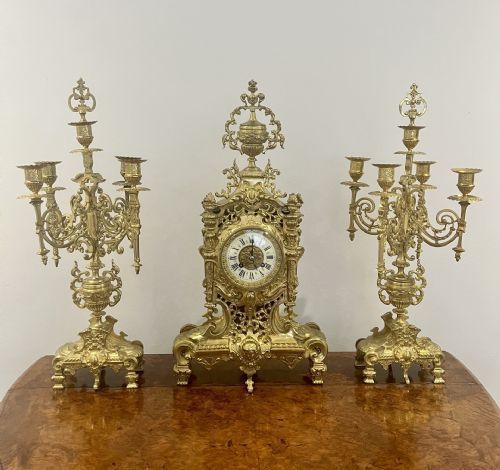
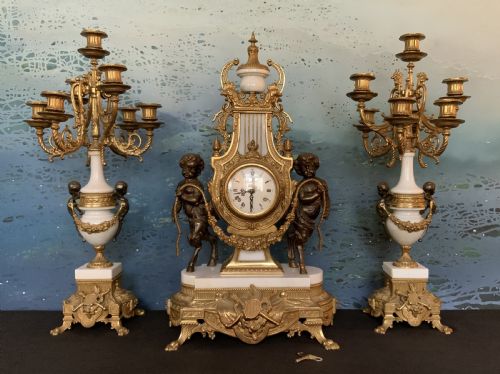
An antique french fireplace clock stands as a substantial centrepiece, most frequently encountered in nineteenth-century incarnations shaped by Victorian, Napoleon III, or Louis XVI aesthetics. These pieces often arrive accompanied by matching garnitures, such as side candelabra or urns, forming a tripartite display designed for the hearth. Formats range from austere portico designs in black slate to sculptural figural works cast in bronze and gilt metal.
Makers and houses recorded in these pieces include Japy Frères, Siffel & Cartier, PH Mourey, Lemerle Charpentier, Deniere and Cailleaux, and Vincenti. The predominant materials span red and white marble, black slate, ormolu, bronze, and porcelain, frequently housing eight-day movements that strike the hours and half-hours.
Materials and Construction
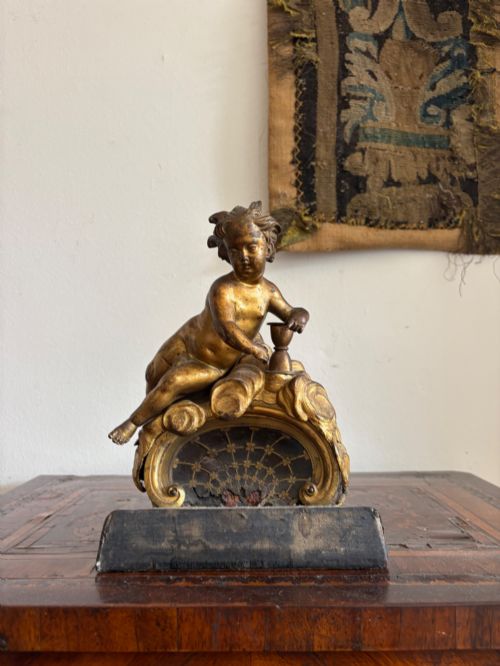
Foundries and workshops relied heavily on cast bronze and ormolu, applying mercury or electroplate gilding to create metallic mounts, figural putti, and rococo scrollwork. These metallic elements were then fastened to heavy stone bodies carved from black slate, rouge marble, or white marble.
Dial faces integrated white enamel plates with Roman or Arabic numerals, protected behind curved glass doors and sometimes sheltered beneath glass domes. Movements utilised brass gear trains and pendulum regulation to drive the eight-day striking mechanisms.
Listings for this phrase feature nineteenth-century pieces constructed from black slate, white and red marble, and gilt bronze or ormolu.
Assessing Quality and Execution
Distinction across these clocks rests primarily in the crispness of the bronze casting and the depth of the gilding. Finer examples display hand-chased details on ormolu mounts and sculptural figures with expressive anatomical definition, whereas lesser pieces rely on softer, unchased castings.
The integration of the materials dictates visual success, seen in how cleanly the marble is polished and how securely the architectural mounts align with the stone body. The reputation of the movement maker, such as Japy Frères or Vincenti, also separates standard production from superior workshop output.
Japy Frères·Siffel & Cartier·PH Mourey·Lemerle Charpentier·Deniere and Cailleaux·Vincenti·James Ritchie & Son
The Antique French Fireplace Clock Glossary
- Garniture
- A set of matching decorative objects designed to be displayed together on a mantelpiece, usually comprising a central clock flanked by two candelabra or urns.
- Ormolu
- Gilded bronze produced by applying a mixture of gold and mercury to a bronze base, or through later electroplating methods. It provides a bright, durable metallic finish characteristic of decorative French clocks.
- Portico Clock
- A clock built within an architectural frame supported by four or more columns, resembling a miniature classical portico. These often feature visible pendulums swinging between the pillars.
- Drumhead Clock
- A clock whose movement is housed within a circular metal case mounted atop a rectangular marble or slate plinth. This style is common in Victorian library and mantel pieces.
- Striking Movement
- A clock mechanism that sounds bells or gongs to mark the passage of hours and half-hours. Most quality pieces utilise an eight-day duration between windings.
Antique French Fireplace Clock: Frequently Asked Questions
How do I wind an antique french fireplace clock?
Most of these clocks use an eight-day movement wound by inserting a key into designated winding holes on the enamel dial face. Turning the key clockwise tensions the mainspring until resistance is felt.
Care should be taken not to overwind the spring. Hands must only be moved clockwise when setting the time to avoid damaging the striking gear train.
What is a clock garniture set?
A garniture set includes a central mantel clock accompanied by two matching side pieces, typically candelabra, vases, or urns. These items were manufactured as a unified decorative ensemble for a fireplace.
When arranged on a mantelpiece, the flanking pieces balance the visual weight of the central clock. They share identical styling, materials, and cast bronze or marble motifs.
How do I identify the period of a clock?
Dating relies on stylistic markers such as the symmetry of Louis XVI designs, the ornate scrollwork of Rococo and Napoleon III pieces, or the austere geometry of Empire portico clocks. Materials like black slate and white marble frequently point to Victorian production.
Inscribed signatures on the enamel dial or backplate often name the maker or foundry. This provides a direct link to operational dates and manufacturing eras.
Are glass domes original to these clocks?
Glass domes with wooden bases were frequently supplied to protect delicate ormolu surfaces and enamel dials from dust and coal smoke. They were common accessories in nineteenth-century parlours.
While many clocks retain their original blown glass covers, others lost them over time through accidental breakage. Finding a clock with its period dome remains a desirable attribute.