
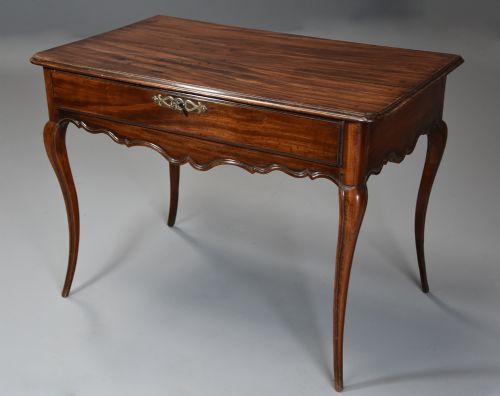


Antique French Console Lamp
An antique french console lamp brings continental elegance to a room, combining rich woods and gilded mounts to light a corner.
Antique French Console Lamp
When you search for an antique french console lamp, you are looking at small tables and light stands originating from continental workshops during the eighteenth and nineteenth centuries. These pieces encompass side tables, occasional tables, and specific lamp stands designed to fit against a wall or in compact spaces.
You are most likely to meet side tables and occasional tables adapted or utilised for lighting, alongside specific bronze and glass pieces from the Napoleon III period. Materials range from walnut and mahogany to satinwood, marble, and ormolu.
Stylistic influences span from French Provincial and Rococo Revival to Louis XVI and Empire, reflecting the shifting tastes of French cabinet makers across the decades.
How they were made
Cabinet makers constructed these pieces using solid timbers like walnut, mahogany, fruitwood, and chestnut, often applying elaborate veneers such as satinwood and parquetry. Marquetry inlays and hand-painted finishes appear frequently across the period examples.
Metal ornamentation played a crucial role, with cast ormolu and bronze mounts secured to the timber frames. Marble tops were cut and polished to fit snugly within carved wooden or gilded surrounds.
Periods represented across the items span the eighteenth century, the nineteenth century, Regency, and Victorian eras.
What varies in quality
The standard of timber selection and the precision of the parquetry or marquetry inlay dictate much of the initial value. Finely figured walnut and satinwood sit at the upper end of the scale compared to simpler fruitwoods.
The crispness of the cast ormolu mounts and the depth of the original patina separate standard pieces from exceptional ones. Heavier bronze work and genuine marble inserts indicate superior workshop output.
The Antique French Console Lamp Glossary
- Ormolu
- Gilded bronze applied as a decorative mount to furniture. This technique was widely utilised by French makers during the eighteenth and nineteenth centuries to accent rich timbers.
- Marquetry
- The art of applying pieces of veneer to a structure to form decorative patterns. Craftsmen used various tinted woods to create elaborate floral or geometric designs on tabletops.
- Gueridon
- A small French table, often round, supported by a central column or pillar. The form originated in the seventeenth century and remained popular through the nineteenth century.
- Parquetry
- Geometric wood mosaic work used for flooring and furniture surfaces. It creates a repeating pattern of triangles, squares, or other shapes across the tabletop.
- Console
- A table designed to stand against a wall, frequently supported by brackets or legs at the front only. These pieces often featured marble tops and ornate gilt frames.
Antique French Console Lamp: Frequently Asked Questions
What is a console lamp?
A console lamp typically refers to a small table or stand placed against a wall, holding a light source, or a combined light fixture and stand from periods like the Napoleon III era.
These pieces served functional and decorative roles in nineteenth-century interiors, providing both illumination and a surface for small objects.
How do I date these tables?
Dating relies on examining the timber species, construction methods, and stylistic markers such as Rococo revival curves or Empire symmetry.
Secondary woods and the wear of the original patina offer further clues to whether a piece originates in the eighteenth century or later.
Where should I place one?
These compact tables suit hallways, alcoves, or living rooms where floor space is limited yet a decorative surface is required.
Their shallow depth allows them to sit neatly against walls without obstructing pathways.
Are marble tops original?
Many nineteenth-century French tables feature fitted marble tops designed specifically for the wooden frame.
Checking the fit and the edge bevelling helps determine if the marble corresponds to the period of the base.