

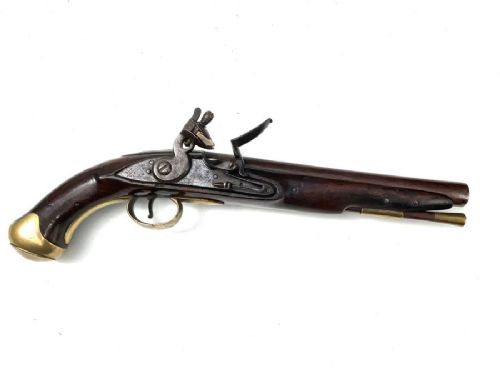


Antique Flintlock Handgun
When you handle an antique flintlock handgun, you hold the mechanical ingenuity of personal defence and military service from centuries past.

Antique Flintlock Handgun
An antique flintlock handgun represents the primary form of portable firearms used throughout the seventeenth, eighteenth, and early nineteenth centuries.
Buyers will encounter various incarnations on this page, ranging from rugged military service arms issued to cavalry and dragoon units to elegant civilian pocket pistols and duelling pieces.
Geographic origins span domestic British makers from London and Birmingham alongside continental European examples and elaborate Ottoman Balkan firearms.
Materials and construction methods
Makers forged barrels and locks from steel and iron, frequently pairing them with brass furniture and mounts for structural integrity and decorative contrast.
Stocks utilised dense woods such as walnut, often shaped with scroll butts or carved grips and ornamented with silver wire inlay or mother-of-pearl.
Lock mechanisms relied on the flint striking a steel frizzen to generate sparks into a priming pan, igniting the main powder charge within the barrel.
Antique Flintlock Handgun Retail Price Guide 2026
Typical asking prices for flintlock handgun among the pieces listed under this phrase on Sellingantiques today, from the lower quarter to the upper quarter. They describe what is for sale here now, not the wider market.
Mail coach inspectors carried specialised overcoat pistols to safeguard the mailbags along hazardous eighteenth-century routes.
Distinctions in craftsmanship and survival
Superior examples exhibit crisp maker signatures on lock plates, refined engraving on brass mounts, and well-executed silver wire inlays on the wooden stock.
The degree of original finish, legibility of proof marks, and the mechanical crispness of the flintlock action separate workshop standards.
Condition ranges from untouched service wear retaining original patination to heavily cleaned or restored specimens.
Harrison of London·T. Potts, London·John Campbell of Doune·Henry Nock·La Motte·James Barber, London·Timothy Hughes, Cork·H.W. Mortimer & Son, London·Thomas Anelli·R. Willoughby, Birmingham·John Rimes, London·Barber of Newark·Dutton·Wilson
The Antique Flintlock Handgun Glossary
- Flintlock
- Ignition mechanism using a flint held in a cock to strike a steel frizzen, creating sparks to fire the powder charge. This system dominated personal firearms technology for over two centuries.
- Snaphaunce
- An early precursor to the flintlock featuring a manually operated pan cover. It represents a transitional stage in the evolution of firearms locking mechanisms.
- Miquelet
- A distinctive form of snaplock originating in Spain and widely adopted across the Ottoman Empire and Mediterranean regions. It uses an external mainspring and a combined steel and frizzen.
- Holster pistol
- A large handgun designed to be carried in a saddle holster by cavalry or travellers. These pieces typically feature robust construction and substantial barrel lengths.
- Cannon barrel
- A barrel shaped like a small cannon, tapering from the breech to the muzzle. This design allowed the barrel and breech to be forged as a single unified component.
Antique Flintlock Handgun: Frequently Asked Questions
How do I care for an antique flintlock handgun?
Keep the piece in a stable environment away from excess moisture and extreme temperature fluctuations to protect the wood and metal.
Apply a light microcrystalline wax or specialist oil to metal surfaces periodically to prevent active corrosion without altering the historical patina.
Can these pistols still be fired today?
While many mechanisms remain in working order, historical firearms require professional inspection by a qualified gunsmith before any attempt at loading or firing takes place.
Most collectors treat these pieces as historical artefacts rather than operational weapons to preserve their structural integrity.
What is the difference between a pocket pistol and a holster pistol?
Pocket pistols were built with shorter barrels and concealed grips for discreet personal carry by civilians in pockets or overcoats.
Holster pistols were substantially larger and heavier, intended for mounted cavalry use or roadside travel tucked into saddle furniture.
How can I tell a British military pistol from a civilian one?
Military examples typically bear government ownership stamps, broad arrow marks, or maker names associated with the Tower Armoury alongside official proof marks.
Civilian pieces often display finer decorative engraving, silver wire inlays, and private maker signatures intended to appeal to affluent private buyers.