


Antique English Firearms
Antique English firearms are historic mechanical pieces of craftsmanship, offering collectors tactile links to military campaigns and personal defence centuries ago.
Antique English Firearms
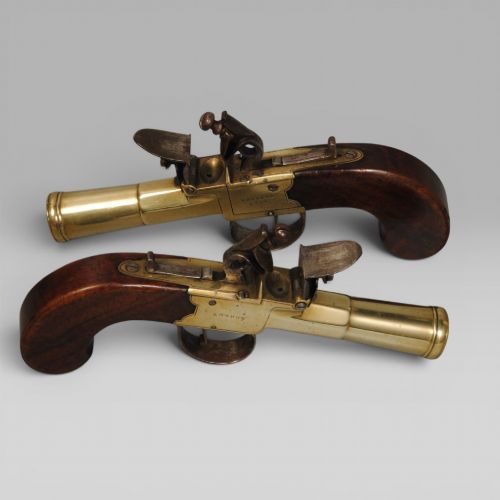
You meet flintlock and percussion ignition systems most frequently on this page, housed in forms ranging from Queen Anne type turn-off pistols to pepper pot revolvers. Makers imprint their names alongside proof marks, establishing traceable lineages for military and civilian pieces alike.
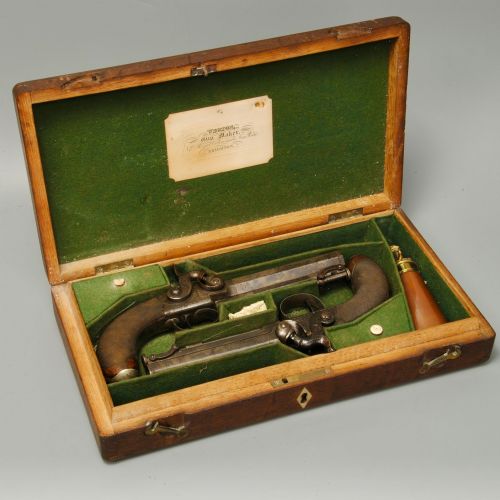
The objects combine functional utility from past conflicts or travel with domestic protection, preserved alongside original wooden cases and baize linings. Buyers encounter both single arms and matched pairs intended for duels, pocket carry, or naval service.
How they were made
Gunsmiths shaped stocks from walnut and hardwood, frequently embellishing grips with silver wire inlay and cast silver grotesque butt caps. Metal components relied on forged steel, iron, and brass, forming lockplates, barrels, and furniture that withstood black powder ignition.
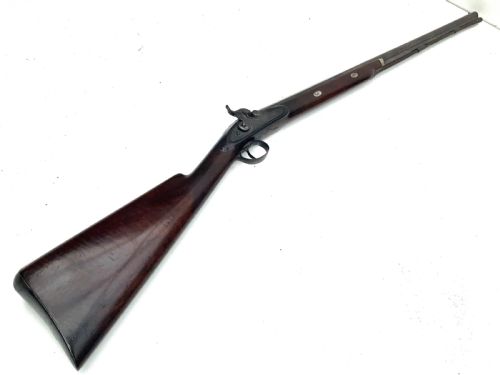
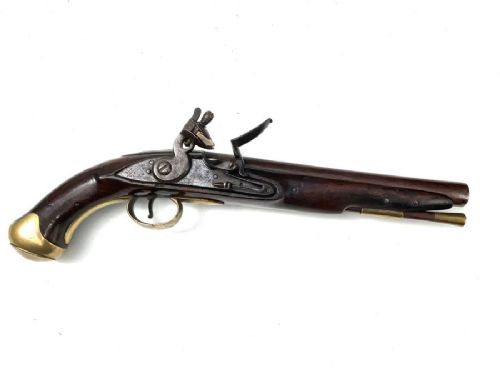
Mechanisms combined precise spring-driven flintlocks and percussion locks, requiring skilled filing and fitting of internal parts to ensure reliable firing sequences. Makers also incorporated folding sprung bayonets and multi-shot pepper pot barrels into the metal assemblies.
Object types span pocket pistols, blunderbusses, muskets, and transitional revolvers.
What varies in quality
Quality rests in the crispness of maker signatures, proof marks, and the precision of metal-to-wood fit across the frame and lockplate. Finer pieces demonstrate superior engraving on steel and brass, alongside intact silver-wire inlay on the walnut grips.
The presence of original fitted cases with matching accessories distinguishes exceptional specimens from standard utility arms. Maker reputation also elevates standing, as prominent London and provincial gunsmiths achieved superior mechanical tolerances.
John Manton & Son·Harrison of London·Mortimer·Twigg·Sargant & Son·James Barber·Thomas Henshaw·H.W. Mortimer & Son·R. Willoughby·John Rimes·J. Robinson·George Sherwood·Dutton·A.W Spires
The Antique English Firearms Glossary
- Flintlock
- An ignition mechanism utilising a flint held in a cock to strike a steel frizzen, creating sparks to ignite priming powder. This system dominated firearms production through the eighteenth century.
- Percussion
- A later ignition system employing a hammer striking a percussion cap containing fulminate of mercury over a nipple. This method superseded the flintlock during the nineteenth century.
- Boxlock
- A firearm design where the breech and lock action are forged as an integral single housing. This configuration appeared frequently on pocket pistols and blunderbusses.
- Turn-off
- A barrel design that unscrews from the breech for front-loading with powder and ball. It allows a tighter fit at the breech upon reassembly.
- Grotesque butt cap
- A decorative metal terminal shaped in an exaggerated human or mythical face, fitted to the base of pistol grips. They appeared frequently on eighteenth-century holster and pocket pistols.
Antique English Firearms: Frequently Asked Questions
How do I date an antique English firearm?
Examine the lockplate for maker signatures, town proof marks, and stylistic indicators such as flintlock versus percussion ignition systems. Periods span from the early eighteenth century through the Victorian era.
Assessing barrel shapes, silver mounts, and stock configurations like Queen Anne styles further narrows the production window. Birmingham and London proof marks provide additional chronological context.
What is the difference between flintlock and percussion?
Flintlocks rely on a piece of flint striking a steel frizzen to generate sparks into an exposed pan of gunpowder. This older seventeenth and eighteenth-century technology preceded the percussion cap system.
Percussion arms utilise a hammer striking a small metal cap placed on a hollow nipple, directing flame straight to the charge. This nineteenth-century innovation offered superior reliability in wet weather.
Were these pistols used for duelling?
Certain pieces, particularly matched sets by makers like Mortimer, were specifically manufactured as duelling pistols for settling disputes. They featured precise rifled or smooth-bore barrels and balanced wooden stocks.
Other arms listed served civilian self-defence, naval operations, or military campaigns rather than formal duels. Pocket pistols and sea service arms filled those everyday operational roles.
How should I display or store them?
Store antique firearms in stable environments away from high humidity and direct sunlight to protect the walnut stocks and steel components. Original wooden cases with baize linings provide ideal preservation housing.
Keep metal surfaces lightly oiled to prevent active oxidation without altering the historic patina. Avoid handling iron parts excessively with bare hands.