

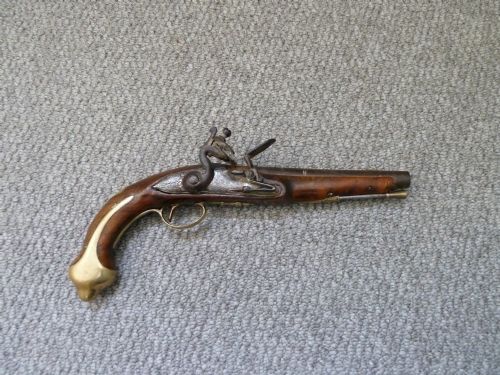


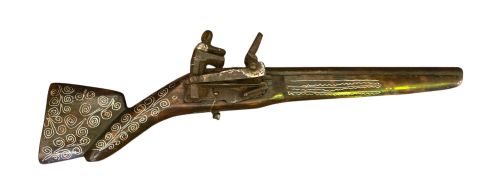


Collectable Flintlock Gun
These pieces of collectable flintlock gun history are the functional arms and pocket pistols that shaped military defence and private security.
Collectable Flintlock Gun
A collectable flintlock gun spans a period from the eighteenth century through to the nineteenth century, covering military regulation examples and civilian pocket pieces. Buyers searching this phrase encounter flintlock pistols, blunderbusses, and sporting guns originating from English, Irish, Scottish, Belgian, and Ottoman makers.
The selection ranges from grand Georgian military pieces and Queen Anne style pocket pistols to Ottoman snaphaunce long pistols and revolving barrel designs. Walnut stocks and silver mountings often feature alongside standard iron and steel mechanisms.
How They Were Made
Gunsmiths shaped stocks from figured walnut and other timbers, frequently embellishing the wood with intricate silver wire inlay or decorative metal mounts. Barrels and locks relied on forged steel, iron, and brass components built to withstand the percussion of the flint striking the frizzen.
Makers utilised specialised techniques for specialised forms, such as cannon barrels on pocket pistols or grooved frizzens on Ottoman snaphaunce arms. Craftsmanship extended to the mechanical timing of the flintlock mechanism and the precise boring of barrels.
Collectable Flintlock Gun Retail Price Guide 2026
Typical asking prices for collectable flintlock gun among the pieces listed under this phrase on Sellingantiques today, from the lower quarter to the upper quarter. They describe what is for sale here now, not the wider market.
Geographic origins span English, Irish, Scottish, Belgian, and Ottoman workshops.
What Varies in Quality
The distinction between standard military issue and elite civilian pieces rests on the intricacy of the maker's hand and the quality of the materials. Master gunsmiths working in London, Cork, or Newark produced arms with refined silver mounts and superior metal engraving.
Condition and originality dictate the standing of a piece within its period, separating untouched service arms from heavily restored examples. The presence of signed locks by recognised makers elevates the historical standing of the firearm.
Henry Nock·James Barber·Timothy Hughes·Meyer & Mortimer·Barber of Newark
The Collectable Flintlock Gun Glossary
- Flintlock
- A firearm ignition mechanism that uses a flint struck against a steel frizzen to create sparks for igniting gunpowder. This system dominated military and civilian arms for centuries.
- Frizzen
- The vertical steel plate struck by the flint to produce sparks and expose the priming powder in the pan. Its grooved surface is essential for proper ignition.
- Snaphaunce
- An early type of flintlock mechanism using a manually primed pan cover and a separate sear system. It represents a transitional stage in firearm development.
- Bore
- The interior diameter of the gun barrel, often measured in standardised ball sizes such as twelve-bore or eighteen-bore. This measurement determined the ammunition used.
Collectable Flintlock Gun: Frequently Asked Questions
How do I identify the period?
Dating relies on stylistic clues such as the form of the stock, barrel shape, and mechanical configuration associated with Georgian or Regency eras.
Maker signatures and hallmarks on silver components also provide specific chronological markers for attribution.
Were these guns used in military service?
Many examples on offer are regulation military pieces issued to cavalry or sea service units during the eighteenth and nineteenth centuries.
Others served as private civilian protection, reflected in the pocket-sized proportions and decorative silver wire inlay.
How should I care for an antique flintlock?
Preservation involves maintaining a stable environment away from excess moisture to protect the historic walnut stocks and steel components.
Regular light oiling helps stabilise iron and brass surfaces without altering the original surface patina.