

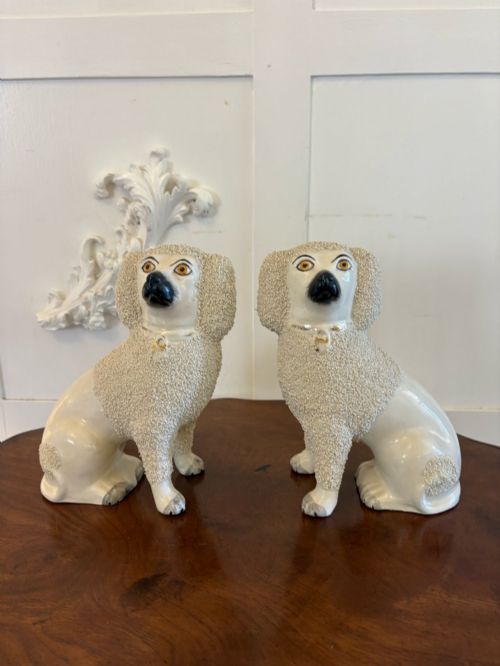
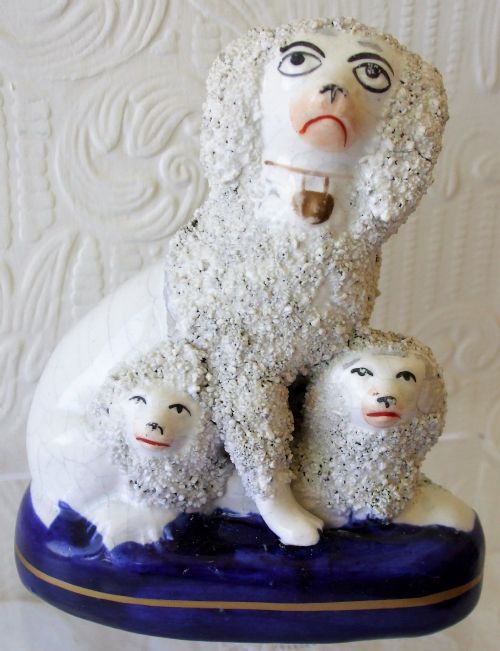


Antique Earthenware Poodle Figure
These antique earthenware poodle figure examples bring Victorian character to a room, offering the charm of Staffordshire pottery modelled as pairs, groups, and quill holders.
Antique Earthenware Poodle Figure
An antique earthenware poodle figure represents the Victorian taste for domestic animal ceramics, most frequently appearing as pairs or figure groups modelled with textured coats. Buyers seeking this phrase encounter Staffordshire pottery pieces from the nineteenth century, including miniature versions and examples incorporating baskets or clock groups.
The objects take several functional and decorative forms, ranging from standard standing dogs and mothers with pups to specialised desk accessories like quill holders. Dating typically spans the Victorian era around eighteen-forty-five up to nineteen hundred, reflecting robust domestic production in English potteries.
Materials and construction
Potters shaped these earthenware bodies using local clays before applying lead glaze and enamel colours to render the distinctive woolly coats. Artisans occasionally added gold leaf details to enhance the collars and baskets of the figures.
Moulding processes allowed workshops to produce matching pairs and complex figure groups, capturing fine textural details in the clay before kiln firing and glazing.
Antique Earthenware Poodle Figure Retail Price Guide 2026
Typical asking prices for earthenware poodle figure among the pieces listed under this phrase on Sellingantiques today, from the lower quarter to the upper quarter. They describe what is for sale here now, not the wider market.
Some nineteenth-century poodles double as desk assistants, holding quills in their little ceramic baskets.
Judging the standard
The application of glaze and any gold leaf detailing distinguishes standard decorative objects from finer miniature and clock group productions. Superior pieces maintain clean surfaces and retain their original decorative harmony.
James Dudson
The Antique Earthenware Poodle Figure Glossary
- Earthenware
- Porous pottery fired at lower temperatures than stoneware or porcelain. It requires a glaze to remain watertight and forms the primary body for these figures.
- Staffordshire pottery
- Ceramics produced in the English county of Staffordshire during the industrial era. The region dominated the manufacture of popular animal figures and mantle ornaments.
- Lead glaze
- A glossy coating containing lead oxide applied to pottery before firing. It provides a shiny protective finish over the coloured enamel paints.
- Quill holder
- A desk accessory featuring a hollow section or attached basket designed to hold writing feathers. These combine practical utility with decorative animal modelling.
- Figure group
- A ceramic composition containing multiple subjects, such as a pair of poodles accompanied by pups or integrated into a clock surround.
Antique Earthenware Poodle Figure: Frequently Asked Questions
What periods do these poodle figures date from?
These ceramic pieces date primarily from the nineteenth century, specifically spanning the Victorian era from the mid-nineteenth century up to nineteen hundred. English potteries produced them steadily across this timeframe.
The listings show specific chronological markers such as eighteen-forty-five and eighteen-sixty alongside broader Victorian and nineteenth-century designations.
Were these figures meant for display only?
While many served purely as decorative mantel ornaments and paired figures, some incorporated functional elements. Certain examples functioned as quill holders on writing desks or formed part of clock groups.
Buyers find both decorative figurines and objects with secondary uses among the nineteenth-century Staffordshire pottery.
How do I identify miniature poodle figures?
Miniature versions replicate the form of standard Staffordshire poodles on a smaller scale, often maintaining the characteristic woolly texture and paired arrangement. They reflect the same Victorian moulding techniques used for larger mantle pieces.
These smaller earthenware objects retain the lead glaze and enamel decoration characteristic of the period's output.
What variations exist in poodle groupings?
Poodle figures appear as single pairs, groups incorporating pups, and complex assemblies involving baskets or clock surrounds. Some pieces feature specialised additions like quill holders.
Potters varied the compositions to serve different domestic display purposes within Victorian homes.