



Antique Dutch Tallboy
An antique dutch tallboy brings deep mahogany, walnut, and floral marquetry into a room, offering substantial storage with distinct continental proportions.
Antique Dutch Tallboy
An antique dutch tallboy is a commanding storage piece combining chests of drawers, linen presses, and cabinets originating across the seventeenth, eighteenth, and nineteenth centuries. These pieces typically take the form of tall chests of drawers or linen press cupboards built with generous proportions for domestic utility.
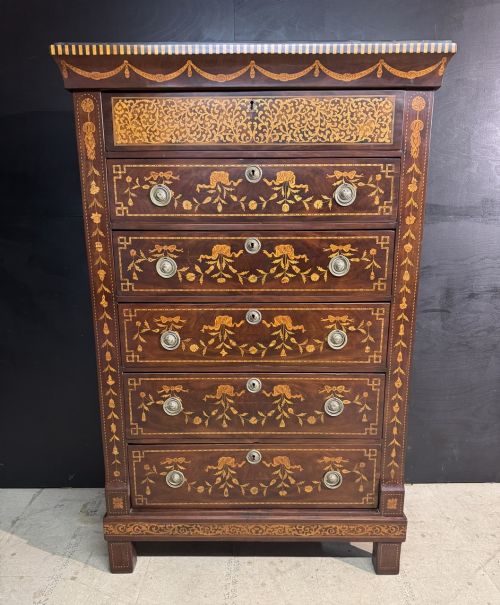
The versions most commonly met on this page date from the eighteenth century, frequently displaying elaborate marquetry and floral inlay across walnut, mahogany, or fruitwood surfaces. Alongside these, nineteenth-century examples reflect shifts toward Dutch neoclassical and rococo revival styles.
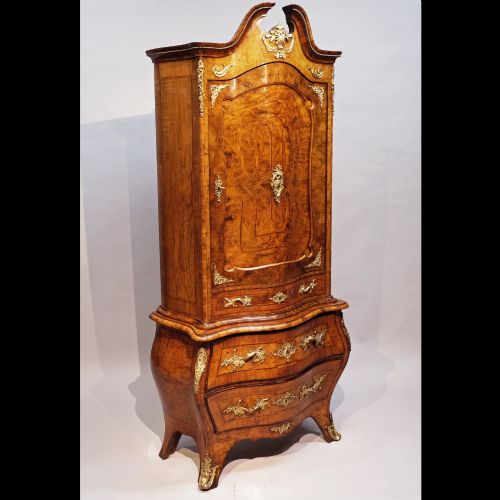
Makers utilised various object types including secretaire cabinets and cabinet on chest configurations, often featuring distinct brass hardware and rich burr walnut grains. Each piece demonstrates the heavy, architectural presence characteristic of traditional Dutch cabinetry.
How they were made
Cabinetmakers constructed these pieces primarily using solid carcases of walnut, mahogany, and fruitwood, veneered with figured burr walnut or detailed fruitwood inlay. Elaborate marquetry panels display intricate floral patterns created by meticulously fitting contrasting timbers together.
Brass fittings, handles, and occasional ormolu mounts provide structural contrast and functional hardware to the heavy timber doors and drawer fronts. Boxwood and fruitwood stringing frequently delineates the borders of drawer fronts and panels, adding geometric precision to the floral designs.
Listings span from the seventeenth century through the nineteenth century, uniting Dutch baroque, neoclassical, and marquetry styles.
What varies in quality
Quality in these pieces rests upon the precision of the marquetry and the choice of timbers used for the veneer. Finer examples display crisp, densely detailed floral inlay across the entire front, whilst simpler pieces rely on plain walnut or mahogany grain without decorative motifs.
The architectural integrity of the cornices and the proportion of the stacked drawers define the upper tier of craftsmanship. Superior construction involves seamless integration of secondary woods and well-preserved brass hardware that complements the scale of the cabinet.
The Antique Dutch Tallboy Glossary
- Marquetry
- Decorative veneer work forming pictures or patterns from different woods. Craftsmen assemble tiny pieces of fruitwood and boxwood to create elaborate floral designs on the drawer fronts.
- Tallboy
- A tall chest of drawers or a chest mounted upon another base. This form provides substantial vertical storage while maintaining a manageable footprint in a room.
- Linen Press
- A large cabinet designed specifically to store household textiles and bedsheets. These pieces often feature upper cupboard doors enclosing sliding trays above lower drawers.
- Ormolu
- Gilt bronze mounted onto furniture as decorative hardware or feet. This technique adds metallic highlights to the rich walnut and mahogany surfaces.
- Burr Walnut
- Timber taken from the abnormal growth of a walnut tree, yielding swirling grain patterns. Cabinetmakers prize this material for its highly decorative surface figure.
Antique Dutch Tallboy: Frequently Asked Questions
What is an antique dutch tallboy?
An antique dutch tallboy is a tall storage furniture piece, encompassing chests of drawers and linen presses originating from the seventeenth to the nineteenth centuries.
These pieces are typically characterised by substantial proportions, walnut or mahogany construction, and intricate floral marquetry inlays.
How were these cabinets used?
These tall chests and presses served primarily to store garments, household linens, and valuables securely within domestic chambers.
The deep drawers and upper cupboard sections provided versatile organisation for textiles before the widespread use of built-in wardrobes.
How do I live with one?
Living with a tallboy requires appreciating its considerable physical presence and vertical scale within a room. Position the piece against a sturdy wall where its deep walnut or mahogany tones can anchor the surrounding interior space.
How do I tell periods apart?
Earlier seventeenth and eighteenth-century examples lean towards Dutch baroque forms and heavy walnut grains, whilst eighteenth-century pieces often showcase elaborate floral marquetry.
Nineteenth-century items introduce neoclassical and rococo revival influences, sometimes featuring painted finishes or altered mahogany proportions.