


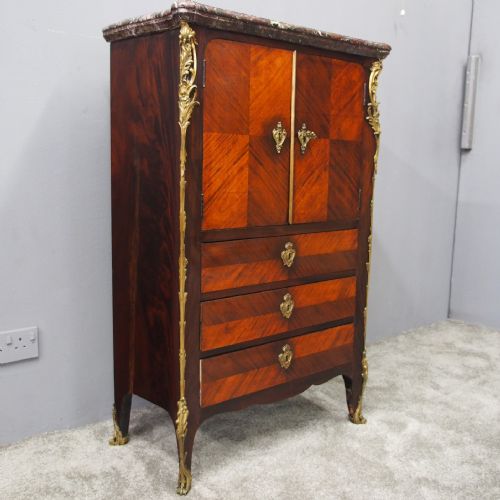
Antique Marquetry Semainier
An antique marquetry semainier is a slender seven-drawer chest designed for the bedroom, offering tall storage with intricate wood inlay.
Antique Marquetry Semainier
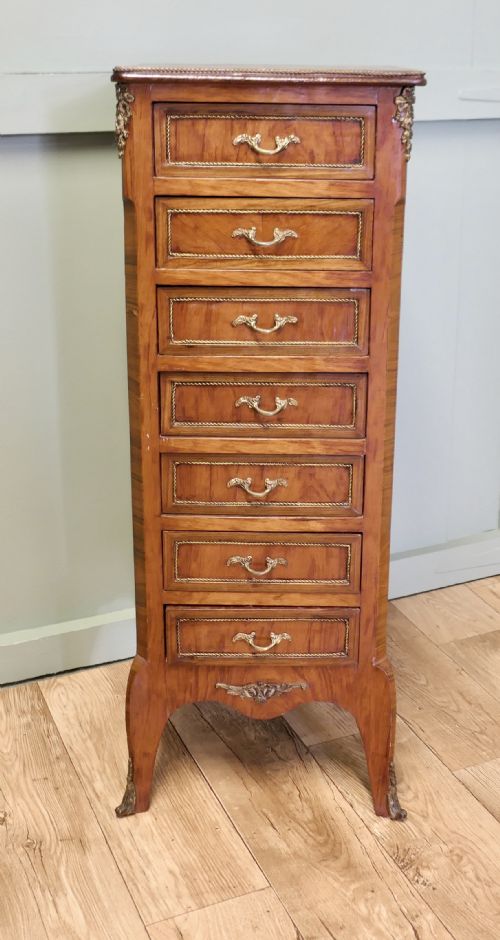
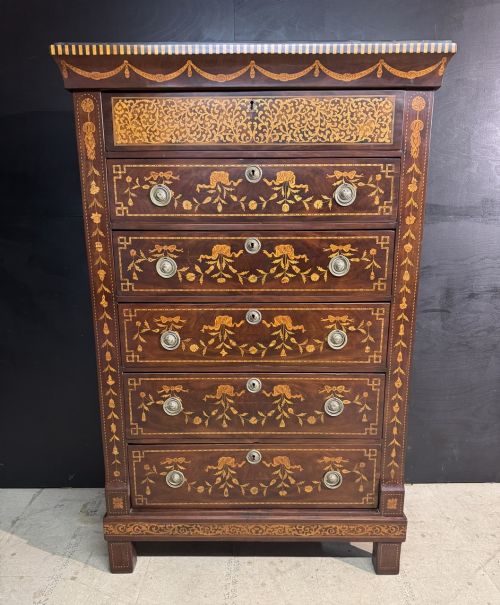
When you search for an antique marquetry semainier, you are looking at tall, narrow drawer chests designed to provide ample storage while taking up minimal floor space. These pieces most commonly appear as French or Dutch creations from the eighteenth and nineteenth centuries, often styled after the Louis periods or Dutch neoclassical designs.
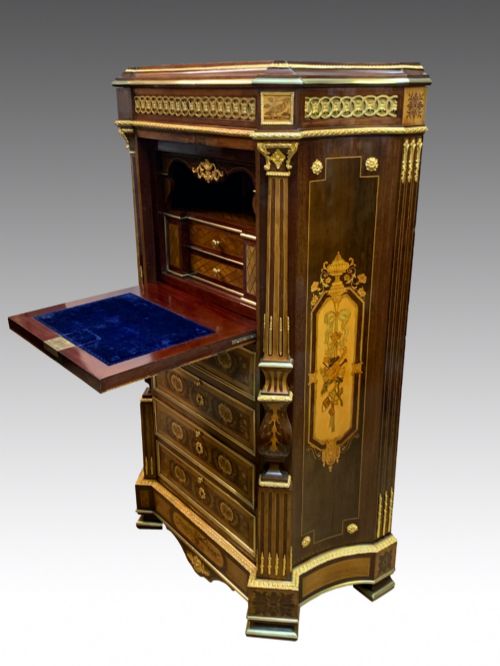
The form typically incorporates seven drawers, one for each day of the week, topped with marble and finished with detailed wood inlay. You will frequently encounter tall chests of drawers, secretaire desks, and Wellington chests fulfilling this same tall, narrow function across the listings.
Materials and construction methods
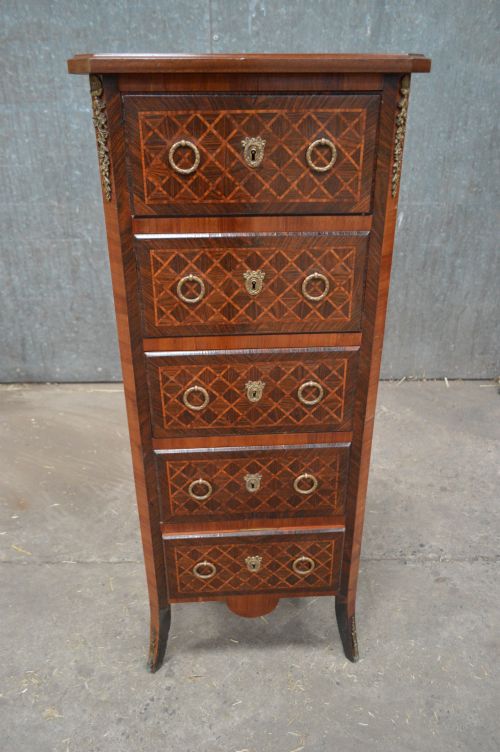
Cabinet makers built these pieces using foundational carcases of mahogany, walnut, or fruitwood, overlaid with decorative veneers of rosewood, kingwood, and satinwood. The surface decoration relies on intricate marquetry and fruitwood inlay to create floral, pictorial, or geometric patterns across the drawers and sides.
Metal details such as brass, ormolu, and gilt bronze mounts frame the drawers and corners, while polished marble slabs finish the top surface of French examples.
Listings feature pieces spanning the 18th century through the Edwardian era, predominantly built in walnut, rosewood, and mahogany with marble and ormolu.
Judging quality and craftsmanship
The standard of an antique marquetry semainier rests upon the precision of the wood inlay and the complexity of the timber selection, such as figured kingwood or rosewood. Finer examples display seamless alignment of the marquetry patterns across drawer divisions and incorporate heavier, chased gilt bronze or ormolu mounts rather than plain brass.
The choice of a substantial marble top and the crispness of the carving on Louis XV or Dutch neoclassical styles further distinguish the upper tier of these tall chests from standard production.
Maison Krieger·Leonard Boudin
The Antique Marquetry Semainier Glossary
- Semainier
- A tall seven-drawer chest traditionally used to hold a week's supply of undergarments or linens. This slender vertical format originated in France during the eighteenth century.
- Marquetry
- Decorative patterns formed by fitting together thin slices of various coloured woods, veneers, and sometimes ivory or metal onto a structural carcase. This technique differs from inlay by covering the entire surface in a pictorial mosaic.
- Ormolu
- Gilded bronze mounts and decorative hardware applied to furniture, particularly popular in French cabinet-making. The technique involves coating cast bronze with a mercury and gold amalgam.
- Kingwood
- A dense, heavy cabinet wood featuring rich brown colouring with dark violet and golden stripes. Makers prized this timber for high-status veneering during the eighteenth and nineteenth centuries.
- Wellington chest
- A tall, narrow locking chest of drawers secured by a hinged pilaster bar on one side. This British form shares the vertical proportions of the semainier.
Antique Marquetry Semainier: Frequently Asked Questions
What is a semainier used for?
A semainier provides high-capacity vertical storage within a narrow footprint, traditionally holding personal items or daily garments across its seven stacked drawers.
Today, buyers use these pieces in bedrooms, hallways, or living spaces where floor space is limited but vertical presence is desired.
How do I tell French from Dutch styles?
French semainiers often feature curved Louis XV or neoclassical lines, rosewood or kingwood veneers, ormolu mounts, and marble tops. Dutch versions typically display more exuberant floral marquetry and straighter architectural outlines.
Examining the wood species and the character of the inlay helps identify the regional workshop tradition.
Are all semainiers fitted with marble?
Marble tops appear frequently on French nineteenth-century examples to provide a durable and decorative upper surface. Many other pieces feature finished wood tops constructed from mahogany, walnut, or satinwood instead.
The presence of marble usually depends on the specific regional style and period of manufacture.
How do I care for antique marquetry?
Keep wooden furniture away from direct sunlight and sudden temperature changes to prevent the delicate veneer and marquetry from lifting. Regular dusting with a dry cloth and occasional application of appropriate furniture wax maintains the finish.
Avoid excessive moisture and harsh chemical cleaners on both the wood and the metal mounts.