






Antique Diamond Starburst
An antique diamond starburst captures the enduring fascination with celestial jewellery, offering intricate cluster work that transforms old-cut stones into rays of light.
Antique Diamond Starburst
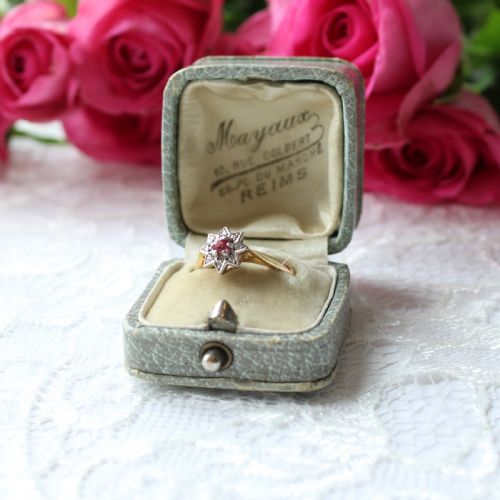
When searching for an antique diamond starburst, buyers encounter a distinct range of jewellery formats spanning rings, brooches, and convertible pendants from the nineteenth and early twentieth centuries. These pieces translate the romantic Victorian and Edwardian obsession with astronomy and naturalism into wearable forms dominated by multi-stone clustered motifs.
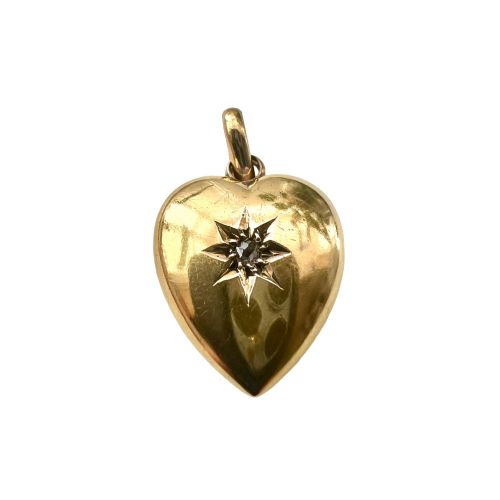
Originating primarily across Victorian and Edwardian workshops, these items rely heavily on symbolic celestial designs where individual diamond rays radiate outward from a central stone. Whether configured as a tiara starburst conversion or a puffy heart pendant, the category unites diverse forms through the shared visual language of sparkling stellar points.
How they were made
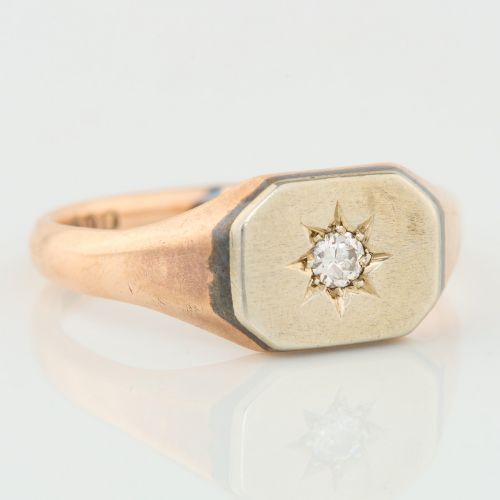
Craftsmen of the nineteenth century frequently employed a dual-metal technique for starburst settings, mounting old-cut diamonds in silver to enhance their bright white brilliance while backing the structure in yellow gold to protect clothing and skin from tarnishing. This traditional method highlights the transitional phase of goldsmithing before platinum gained widespread favour for fine diamond mounting.
Stones within these starbursts are typically secured using claw settings or delicate grain settings that emphasise the tapering form of each ray. Alongside silver and gold combinations, makers utilised 9ct, 15ct, and 18ct yellow gold for solid bands and pendants, often incorporating foiled backs or closed-back settings in earlier pieces to intensify the light reflected through rose-cut and old European-cut diamonds.
Victorian jewellers occasionally used natural ruby eyes alongside diamond starbursts to bring tiny celestial insects to life.
What varies in quality
Quality in these celestial jewels rests principally on the precision of the stone arrangement and the symmetry of the radiating rays. Superior examples display harmonious proportions where each diamond is closely matched in cut, colour, and lively performance, ensuring the star pattern appears balanced rather than disjointed.
The sophistication of the metalwork further distinguishes finer specimens from standard production. Expert hand-workmanship reveals itself in crisp relief work around the settings, secure convertible mechanisms on multi-use brooch pendants, and the careful retention of original clasps and pins without modern replacements.
Hirsch and Oppenheimer
The Antique Diamond Starburst Glossary
- Old European Cut
- An early round brilliant diamond cut characterised by a small table, high crown, and large culet, designed to catch candlelight and gaslight. These stones display distinct hand-faceted patterns unique to the nineteenth century.
- Gypsy Setting
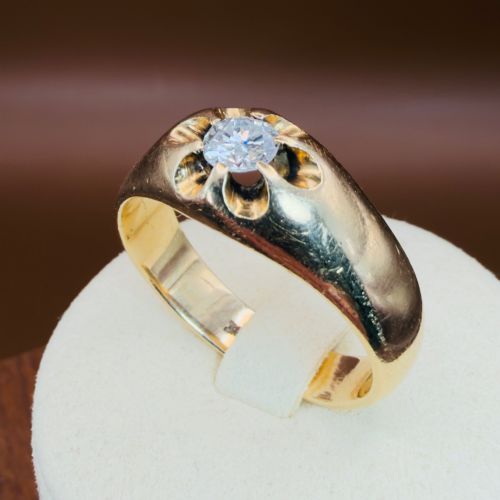
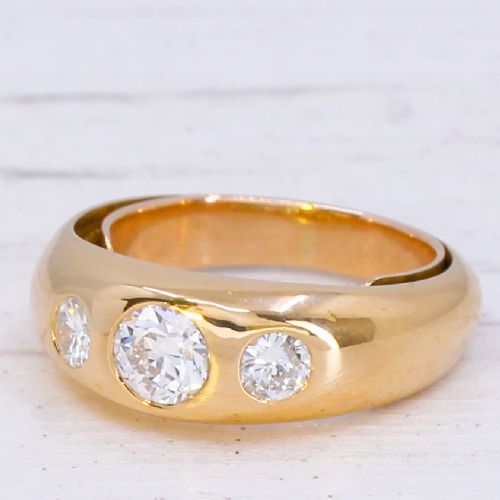
- A style of ring where stones are flush-set directly into the thick solid metal band, creating a smooth, rounded profile popular during the Victorian period. This technique protects the girdle of the diamond within the gold.
- Convertible Brooch
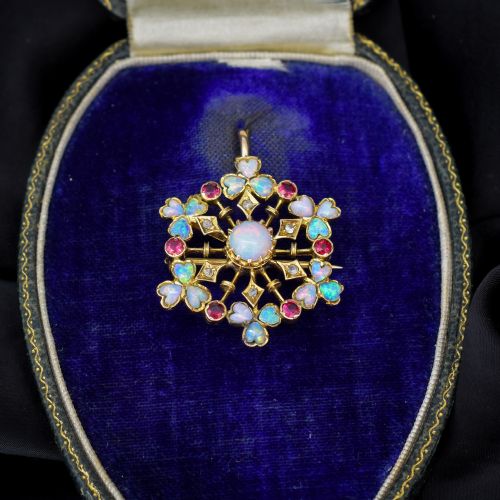
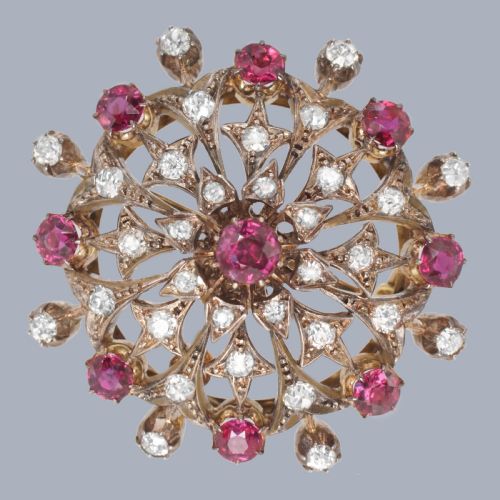
- A versatile piece of jewellery engineered with removable pins, bails, or screw fittings that allow the ornament to transform between a hair ornament, a pendant, and a brooch. Such adaptability was highly prized by Victorian wearers.
- Rose Cut
- An antique diamond cut featuring a flat base and a domed crown faceted with triangular planes, resembling an unopened rosebud. This cut produces a soft, translucent glow rather than modern brilliance.
- Trilogy Ring
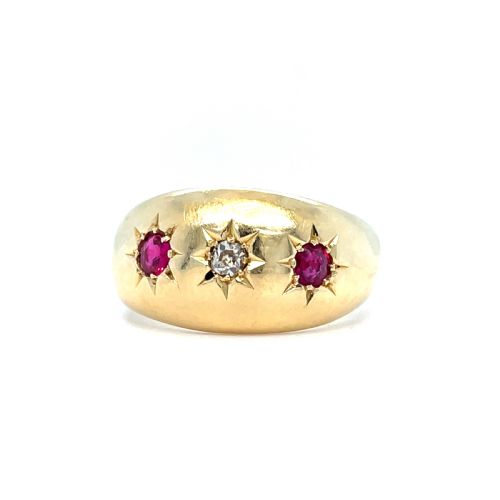
- A ring featuring three principal gemstones set in a row, often interpreted to represent the past, present, and future. In antique examples, these stones are frequently interspersed with starburst engravings or diamond accents.
Antique Diamond Starburst: Frequently Asked Questions
How do I wear a convertible starburst?
Many Victorian starbursts feature detachable brooch fittings and hidden loops that accommodate a chain. This engineering allows the piece to transition seamlessly from a lapel pin to a pendant.
Securing the safety catch is essential when wearing these items as brooches due to their age. Pairing a pendant version with a fine antique gold chain preserves the historical aesthetic.
What is a celestial gypsy ring?
A celestial gypsy ring embeds star-shaped engravings and flush-set diamonds directly into a heavy tapered gold band. This design offered durability for everyday Victorian wear while embracing romantic themes.
The smooth profile makes these rings comfortable for daily use, though the surrounding gold starburst engraving requires gentle cleaning to maintain its crisp lines.
How do I tell Victorian from Edwardian starbursts?
Victorian starbursts often utilise silver-topped gold settings with warm yellow gold backs, paired with deep old European or rose-cut diamonds. The overall feel tends to be rich, heavy, and romantic.
Edwardian pieces frequently introduce lighter platinum settings and airier open-work designs. This later period favoured high brilliance and delicate garland motifs surrounding the central star.