
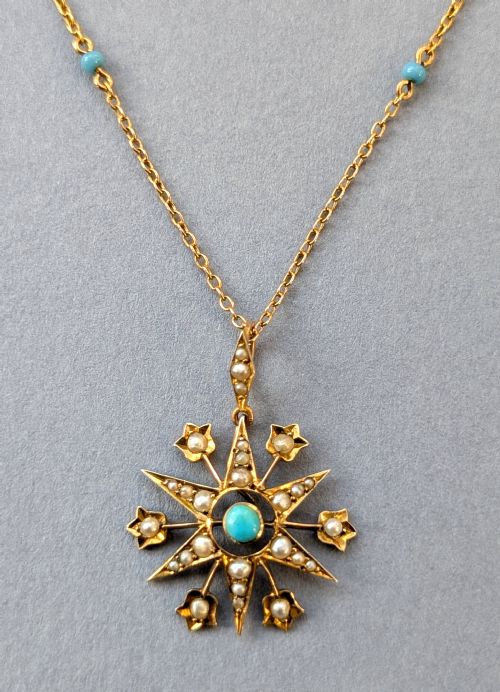


Seed Pearl Star Pendant
A seed pearl star pendant captures the night sky in miniature, offering delicate Victorian and Edwardian craftsmanship that collectors treasure for its celestial charm.
Seed Pearl Star Pendant
A seed pearl star pendant represents a specific jewellery form focusing on tiny, natural pearls arranged in celestial motifs. These pieces date principally from the Victorian and Edwardian eras, spanning the nineteenth and early twentieth centuries.
The objects take several forms on this page, including traditional pendants, convertible pendant brooches, and lockets. Celestial starbursts and swirling star designs dominate the selection, often accompanied by secondary gems.
Buyers encounter materials such as nine carat gold, fifteen carat gold, eighteen carat gold, and occasionally silver or platinum foundations. The seed pearls themselves form the central texture of these shimmering stellar clusters.
Materials and construction
Goldsmiths constructed these pieces using yellow, rose, and high-carat gold alloys to form hollow or solid mounts. Fine wirework and collet settings secure each tiny pearl individually by hand.
Makers integrated natural seed pearls alongside accent stones like turquoise, peridot, sapphires, garnets, and old cut diamonds. Enamel work and glazed locket compartments occasionally appear on reverse sides to add depth and sentiment.
Victorian star jewellery allowed quiet romantics to wear the entire cosmos against their collarbones without needing a telescope.
Assessing quality in celestial jewels
Quality rests on the uniformity and lustre of the seed pearls, alongside the complexity of the gold mount. Superior examples display intact pearls with matching orient and secure bead or prong settings.
The precision of the starburst geometry dictates the overall refinement of the piece. Lesser examples suffer from mismatched replacement pearls or heavy-handed soldering that obscures the delicate gold wirework.
The Seed Pearl Star Pendant Glossary
- Seed pearl
- A very small natural pearl, typically under two grains, often drilled and threaded onto silk or held with tiny pins. These tiny gems provide the shimmering texture characteristic of Victorian celestial jewellery.
- Starburst
- A design motif radiating outward from a central point to emulate a shining star. This configuration became immensely popular during the Victorian period due to a cultural fascination with astronomy.
- Celestial
- A stylistic category encompassing stars, moons, sunbursts, and comets. These heavenly themes frequently incorporate diamonds and seed pearls to represent the night sky.
- Convertible pendant brooch
- A versatile item of jewellery featuring a hidden bail and a pin finding on the reverse. This dual functionality allowed the wearer to pin the star to a bodice or suspend it from a chain.
Seed Pearl Star Pendant: Frequently Asked Questions
How do I wear a convertible pendant brooch safely?
Utilise a secure safety chain when suspending the piece from a necklace to prevent accidental loss if the pin catches on clothing.
Ensure the pin stem on the reverse remains securely latched within its C-clasp or safety roller when worn as a brooch.
Are seed pearls fragile?
Seed pearls are organic gems that require gentle care and protection from harsh chemicals, perfumes, and prolonged moisture.
The original silk threading inside older pieces can degrade over time, meaning professional restringing may be necessary for regular wear.
How do I distinguish Victorian from Edwardian pieces?
Victorian star pendants often feature deeper yellow gold alloys, closed-back settings, and heavier garnet or turquoise accents.
Edwardian pieces generally shift towards lighter gold colours, platinum tops, and airier openwork designs framing diamonds and seed pearls.
What causes pearl discolouration?
Exposure to body oils, cosmetics, and environmental pollutants can cause organic seed pearls to lose their natural lustre and yellow over time.
Stored pieces benefit from breathable containers away from direct heat and strong light sources to preserve their nacre.