




Antique Diamond Dress Brooch
An antique diamond dress brooch brings geometric elegance and bright sparkle to a lapel, spanning styles from Victorian foliate motifs to crisp Art Deco geometry.
Antique Diamond Dress Brooch
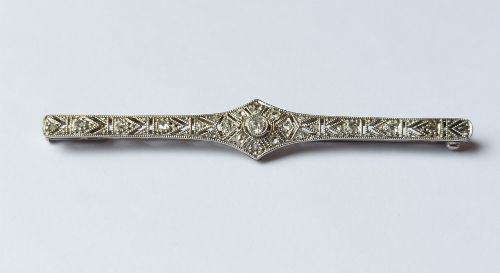
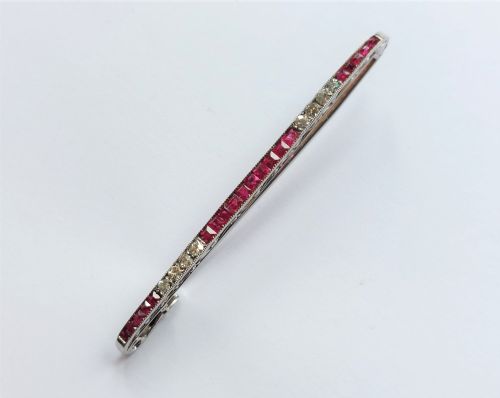
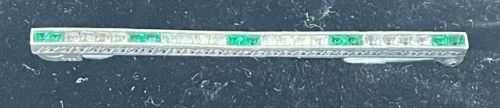
When searching for an antique diamond dress brooch, you encounter pieces spanning from the late nineteenth century through to the mid-twentieth century. The selection ranges from modest gold pin brooches set with single stones to substantial platinum geometric creations glistening with dozens of diamonds.
The most common form on this page is the Art Deco bar brooch or plaque, constructed in platinum or white gold and set with diamonds alongside calibré-cut rubies, sapphires, or onyx. These pieces were designed to fasten securely to evening wear, coats, and heavy fabrics during periods when ornamentation was essential to fashion.
Earlier examples lean towards Victorian and Edwardian aesthetics, featuring yellow gold settings, natural pearls, and softer foliate or cluster motifs. Later mid-century designs continue the tradition of combining white metals with old-cut diamonds in structured pin configurations.
Materials and construction methods
Makers utilised platinum alongside yellow, white, and rose gold, often pairing metals to highlight the stones. Platinum gained popularity during the Edwardian and Art Deco periods because its strength allowed workshops to fashion intricate, lace-like settings and knife-edge bars with minimal visible metal.
Stones are typically set by hand, employing bead, channel, or millegrain techniques to secure diamonds, sapphires, rubies, and pearls. Old-cut and single-cut diamonds predominate in these pieces, displaying hand-cut facets that catch candle and gas light differently from modern brilliant cuts.
Listings feature periods spanning from Victorian and Edwardian eras through Art Deco up to mid-century modern design.
Judging quality and execution
Quality rests upon the precision of the metalwork and the matching of the stones. Finer pieces demonstrate meticulous piercing and hand-carved millegrain edges that remain crisp under magnification.
The choice of secondary gems and the integration of contrasting materials like onyx, rock crystal, or natural pearls also define the tier of the piece. Master workshops balanced substantial stone weight with architectural lightness, ensuring the brooch sat flat and secure upon fabric without sagging.
Paillette
The Antique Diamond Dress Brooch Glossary
- Millegrain
- A decorative technique featuring a row of tiny raised metal beads along the edge of a setting. This softens the transition between metal and stone.
- Bar brooch
- A horizontal pin configuration often featuring a central cluster or linear arrangement of gems. These pins were widely worn on lapels and collars.
- Old-cut diamond
- A hand-faceted diamond cut before modern machine precision was standardised. These stones typically possess smaller tables and higher crowns.
- Calibré-cut
- Small gemstones cut specifically to fit a precise geometric setting, often forming continuous borders of colour around larger diamonds.
- Double clip brooch
- An ornamental dress pin composed of two detachable components that function independently as dress clips or lock together into a single large brooch.
Antique Diamond Dress Brooch: Frequently Asked Questions
How do I wear an antique brooch today?
These pieces pin securely to the lapel of a tailored blazer, the shoulder of a dress, or the knot of a silk scarf. Their substantial settings require structured fabrics to support the weight properly without pulling.
For evening wear, larger plaque and double clip brooches transform a simple dress into a statement ensemble. They also anchor stoles and heavy winter coats effectively.
What is the difference between Edwardian and Art Deco brooches?
Edwardian pieces rely on platinum and yellow gold to create garland styles, floral motifs, and delicate lace patterns incorporating pearls and softer coloured gems. They project an organic, flowing aesthetic.
Art Deco brooches shift sharply toward geometry, symmetry, and high-contrast combinations of diamonds with onyx, rock crystal, or sapphires. Platinum dominates these later designs to support rigid, architectural lines.
How do I clean an antique diamond brooch?
Gentle cleaning involves warm water with a mild dish detergent and a very soft-bristled brush to remove dust from behind the stone settings. Avoid harsh chemical dips, particularly if the piece contains pearls, emeralds, or porous gems.
Allow the brooch to dry completely on a soft cloth before storing it in a lined box. Periodic checks by a specialist ensure the old-cut stones remain secure in their prongs.
Can a brooch be converted into a pendant?
Many bar brooches and plaque designs feature hidden loops or fold-down bails at the back that allow them to be suspended from a chain. A jeweller can also add a discreet loop without altering the original pin mechanism.
This versatility lets you alternate between wearing the piece pinned to clothing or hung around the neck as a necklace.