


Antique Chess Set
An antique chess set is a tactile survivor of parlor strategy, combining dense woods or bone into functional pieces designed for enduring play.
Antique Chess Set
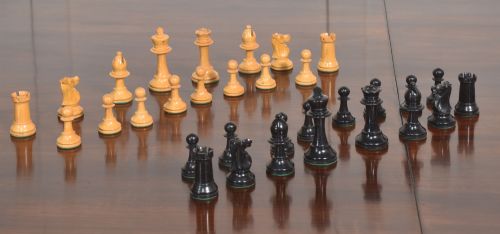
When you search for an antique chess set, you encounter everything from full-sized library sets housed in mahogany boxes to folding travelling boards fitted with pegs or miniature pieces. The standard form seen most often on this page is the Staunton pattern, carved in boxwood and ebonised wood or left natural, originating in the Victorian era and running through the Edwardian period.
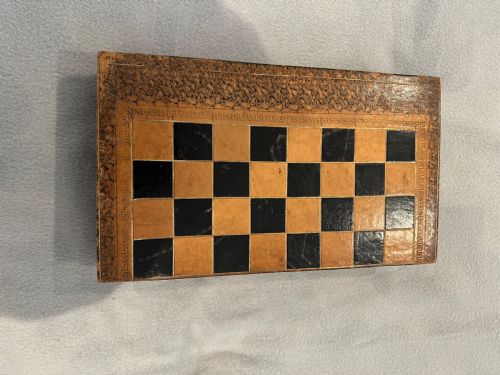
Alongside complete sets, the evidence includes games compendiums, folding boards, and backgammon combinations constructed from rosewood, walnut, and leather. These pieces span the nineteenth century and the early decades of the twentieth century, originating from English workshops as well as continental makers.
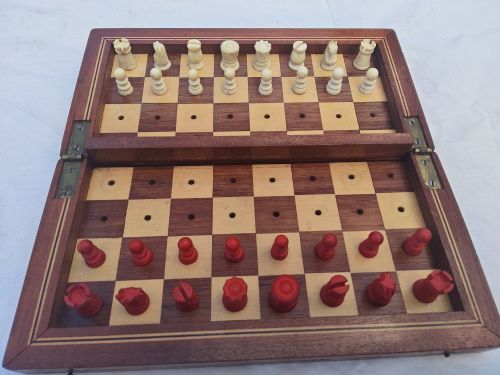
Travelling variants demonstrate clever engineering for movement, utilising pegged boards or sliding compartments. Whether housed within a faux book or a burr walnut box, these objects reflect the Victorian appetite for domestic recreation and portable leisure.
Materials and Construction
Makers relied primarily on boxwood paired with ebony or ebonised wood to achieve the crisp contrast required for play. Bone and ivory provided alternative materials for carved pieces, particularly in regional patterns like the Edinburgh upright or Calvert styles.
Lead weighting was frequently added to the bases of nineteenth-century pieces to improve stability during matches, often secured with green felt or baize underneath. Boards were constructed from mahogany, walnut, or rosewood, sometimes inlaid with mother of pearl or painted glass, and paired with leather or wooden storage cases.
The archive records regional English and European forms including the Edinburgh upright, Selenus pattern, and Calvert style.
Standards of Craftsmanship
Quality rests upon the precision of the turning and the depth of the carving, particularly visible in the intricate knights and the symmetry of the rook turrets. Maker attribution, such as pieces bearing stamps or labels from recognised makers, elevates a set significantly above anonymous workshop production.
The choice of materials and the preservation of original weighted bases, felt underpads, and matching fitted boxes determine the standing of a set. Finer examples maintain crisp detailing without excessive wear to the vulnerable points of the pieces, such as the crowns and finials.
Jaques·F. H. Ayres·British Chess Company·Whitty·Lund
The Antique Chess Set Glossary
- Staunton pattern
- The standard design for chess pieces introduced in the mid-nineteenth century, characterised by architectural king and queen crowns and a realistic horse knight.
- In Statu Quo
- A patented travelling chess set design utilising a pegged board mechanism to hold pieces securely in place during movement.
- Compendium
- A multi-game box housing chess alongside boards for backgammon, draughts, and sometimes cribbage or dominoes within a single fitted cabinet.
- Edinburgh upright
- A nineteenth-century Scottish chess set style featuring tall, slender, unweighted pieces with simple geometric turning.
- Calvert pattern
- A nineteenth-century style of turned bone or ivory chess set known for distinctively pierced and tiered rook galleries.
Antique Chess Set: Frequently Asked Questions
What is a Staunton chess set?
The Staunton pattern is the universally recognised design for chess pieces, established during the Victorian era to provide standard proportions and clear identification for players.
Characterised by architectural forms and distinctive knight heads modelled on the Elgin Marbles, these sets remain the benchmark for competitive and decorative play.
How do travelling chess sets work?
Travelling sets from the nineteenth century often utilised ingenious mechanical systems, such as pegged pieces fitting into drilled board holes or sliding drawer mechanisms.
These portable designs allowed Victorians to play matches on trains or ships without losing the position of the pieces during transit.
What are games compendiums?
Games compendiums are multi-purpose wooden boxes housing equipment for several pastimes, typically including chess, draughts, backgammon, and cards.
Encased in walnut, mahogany, or rosewood, these comprehensive sets served as entertainment hubs in Victorian and Edwardian drawing rooms.
How can you date an antique chess set?
Dating relies on stylistic markers, material choices, and stamps or registration marks stamped onto the wooden or leather storage boxes.
The introduction of the Staunton pattern in the mid-nineteenth century provides a firm baseline for categorising later nineteenth and early twentieth-century sets.