


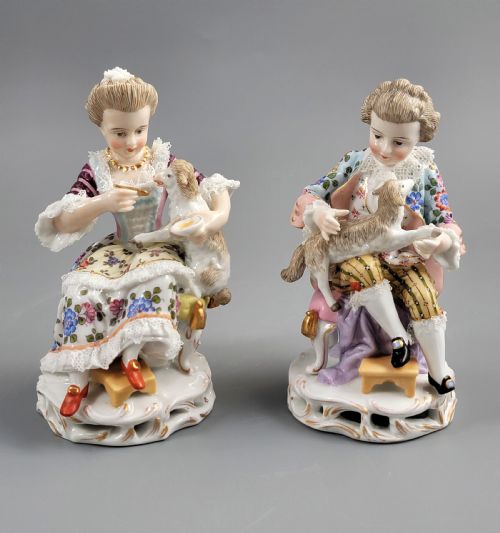


Antique Ceramic Pastoral Figures
These antique ceramic pastoral figures capture idyllic rural scenes in porcelain and earthenware, offering collectors delightful depictions of shepherds, gardeners and musicians.
Antique Ceramic Pastoral Figures
Antique ceramic pastoral figures depict rustic subjects such as shepherds, shepherdesses, gardeners and musicians in porcelain and earthenware. These charming sculptural objects take the form of individual figurines, pairs, figural candlesticks, watch holders and group scenes.
Most examples originate from the eighteenth and nineteenth centuries, spanning Georgian, Victorian and later periods. Factories and workshops across Germany, France and Britain produced these decorative pieces, frequently drawing inspiration from earlier Meissen, Chelsea and Derby styles.
How They Were Made
Makers utilised hard-paste porcelain, earthenware, pearlware and bisque porcelain to form these figures, often finishing surfaces with glaze or leaving them unglazed for a matte texture. Artisans applied delicate enamel painting by hand to clothe and adorn the characters, frequently adding gold leaf and gilt highlights.
Production involved skilled moulding and modelling, resulting in detailed statuettes that range from small single figures to large sculptural groups. Candlestick variations integrate functional holders into the rural narrative, while spill holders combine decorative pastoral scenes with practical hearth accessories.
Listings feature hard-paste porcelain, bisque porcelain and earthenware alongside enamel painting, glaze and gold leaf.
What Varies in Quality
The crispness of moulded details and the preservation of delicate elements such as foliage, lambs and baskets distinguish superior works. Complete pairs and intact sculptural groups retain greater visual coherence than scattered individual pieces.
Meissen·Derby·Samson·Sitzendorf·Bloor Derby·Vion et Baury·KPM·Carl Thieme·Ludwigsburg·Royal Dux
The Antique Ceramic Pastoral Figures Glossary
- Bisque Porcelain
- Unglazed fired porcelain possessing a smooth, matte white surface resembling marble. This finish highlights fine sculptural details without the reflective sheen of a traditional glaze.
- Pearlware
- A refined type of earthenware developed in the late eighteenth century featuring a pale greyish-blue glaze that pools slightly in crevices. Staffordshire potteries frequently utilised this ceramic body for early figures.
- Spill Holder
- A hollow ceramic vertical vessel incorporated into a figure group designed to hold slender wooden spills for lighting pipes or candles. These utilitarian additions merge practicality with decorative rustic subjects.
- Hard-Paste Porcelain
- A dense, durable ceramic composition fired at high temperatures using kaolin and petuntse. European factories adopted this formula to create crisp, detailed figurines.
- Gilt
- A thin layer of gold applied to ceramic surfaces as a decorative accent. Artisans brushed or painted this metallic finish onto borders, bases and clothing details.
Antique Ceramic Pastoral Figures: Frequently Asked Questions
What are pastoral figures?
These ceramic sculptures depict idealized rural characters, including shepherds, shepherdesses, farmers and gardeners, often accompanied by farm animals such as sheep, cows and lambs.
Originating largely from eighteenth and nineteenth-century European factories, they romanticise country life through elaborate and colourful porcelain or earthenware modelling.
How were they used?
Makers designed these pieces strictly for decorative display on mantelpieces, sideboards and cabinet shelves within wealthy homes. Some specialised variations integrated functional elements, such as figural candlesticks or watch holders, combining ornamentation with domestic utility.
Others incorporated hollow spill holders intended to store wooden tapers used for lighting household fires and candles.
How do you style them at home?
Display these figures in traditional or eclectic interiors where their fine enamel colours and detailed modelling can be appreciated up close. Placing matched pairs together on a mantelpiece or pairing them with complementary nineteenth-century ceramics maintains visual balance.
Their small scale allows them to sit comfortably inside glass cabinets or upon open wooden shelves alongside period books.
How do you tell periods apart?
Early eighteenth-century examples often exhibit soft-paste characteristics, lighter proportions and Rococo scrollwork bases inspired by Meissen and Chelsea models. Nineteenth-century reproductions and later Continental pieces frequently employ brighter enamel palettes, heavier porcelain bodies and distinct factory marks.
Staffordshire earthenwares from the Georgian and Victorian eras display distinct regional potting techniques, including pearlware glazes and flat-back constructions.