



Anglo Eastern Side Table
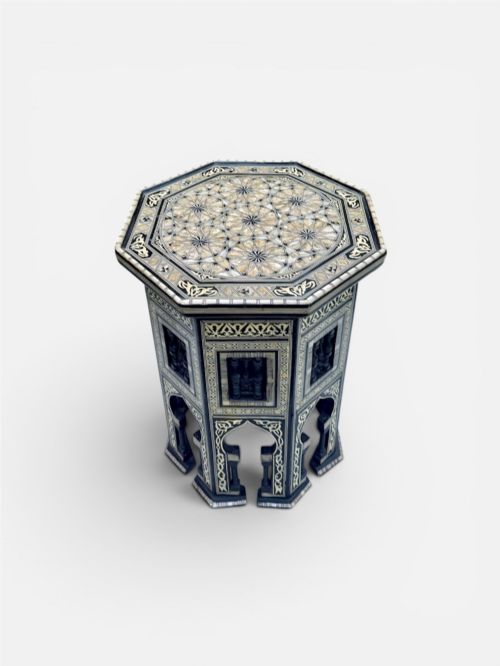
These pieces known as an anglo eastern side table bring intricate geometric woodwork and mother-of-pearl into a room.
Anglo Eastern Side Table
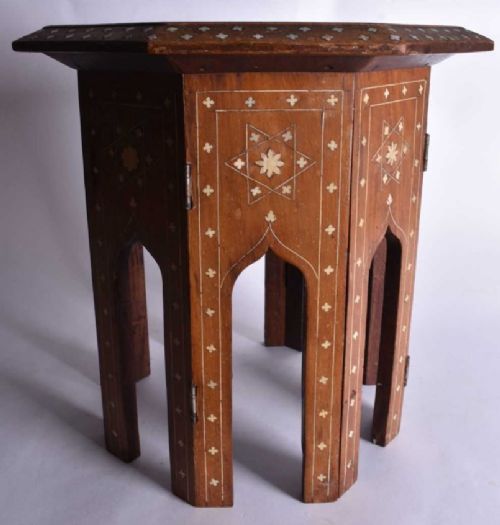
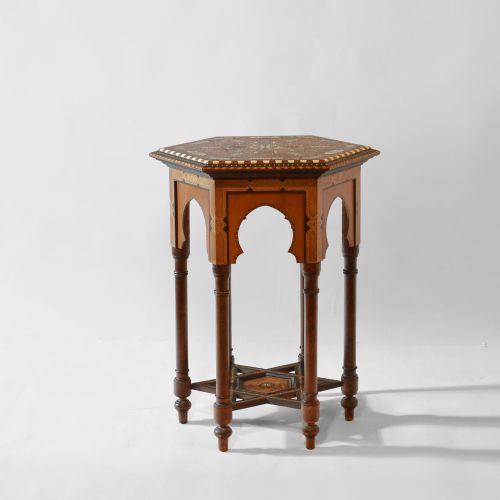
An anglo eastern side table draws on traditions from the Middle East, India, and Syria, often taking octagonal or hexagonal forms that function as occasional tables, coffee tables, or lamp stands. The selection here spans the Victorian era through to the 1920s, encompassing styles such as Moorish Revival, Anglo-Indian, and Ottoman.
Most examples you encounter on this page feature geometric folding bases or carved stands designed to support intricate tops. These tables serve practical uses while introducing distinct regional craftwork into domestic spaces.
How they were made
Makers constructed these tables from hardwoods, walnut, teak, and red lacquer, applying hand-carving techniques to shape the wooden frames. Surface decoration relies heavily on detailed bone and mother-of-pearl inlay arranged in complex geometric patterns.
Many of the tables incorporate folding structures, allowing the octagonal or hexagonal tops to detach or fold flat against the base. Brass elements occasionally appear alongside the woodwork and shell inlay to reinforce joints and provide subtle contrast.
Several tables fold completely flat, proving that Victorian practicality and intricate Damascus geometry could happily share the same floor space.
What varies in quality
The precision of the geometric woodwork and the density of the mother-of-pearl or bone inlay set finer examples apart. A higher grade of work is visible in the crispness of the hand-carved motifs and the tight alignment of inlaid pieces across the surface.
The integrity of the folding mechanism and the stability of the octagonal or hexagonal top also dictate the overall standard. Superior pieces maintain structural soundness alongside complex decorative programmes without loose components.
Liberty and Co
The Anglo Eastern Side Table Glossary
- Octagonal top
- A flat surface with eight sides, commonly found on tables designed in the Moorish and Damascus traditions.
- Mother-of-pearl
- The iridescent inner layer of certain mollusc shells, utilised for decorative inlay in geometric patterns.
- Moorish Revival
- An architectural and decorative style popular in the nineteenth century that reinterprets traditional Islamic design elements.
- Damascus table
- A piece of furniture originating from or styled after the craft traditions of Damascus, typically featuring extensive inlay.
Anglo Eastern Side Table: Frequently Asked Questions
What is an anglo eastern side table?
An anglo eastern side table is a low or occasional table influenced by Middle Eastern, Indian, or Syrian design traditions. These pieces typically feature octagonal tops and detailed inlay.
They emerged during the late nineteenth and early twentieth centuries, blending Eastern decorative motifs with Western domestic forms.
How were these tables used?
These tables served as versatile furniture pieces in Victorian and Edwardian homes, functioning as tea tables, lamp stands, or wine tables. Their portable nature made them easy to move around reception rooms.
Many incorporated folding bases, allowing the owners to store or reposition them with minimal effort.
How do I date an anglo eastern table?
Dating relies on examining the materials, construction methods, and stylistic cues such as Moorish Revival or Ottoman influences. Pieces span from the late nineteenth century through to the 1920s.
The specific combination of hardwood, hand-carving, and mother-of-pearl inlay helps narrow down the period of manufacture.
Are the tops usually removable?
Many examples feature octagonal or hexagonal tops that lift off or fold down from a collapsible wooden base. This clever construction was designed for portability and compact storage.
When setting up the table, the top simply rests upon or slots into the folding support frame.