


Agate Pebble Pin
The agate pebble pin is a Victorian Scottish revival jewel that fastens woollen plaid and holds historical charm.
Agate Pebble Pin
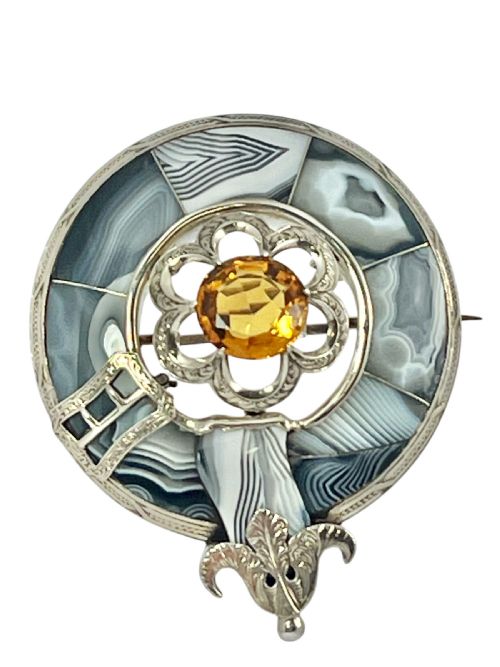
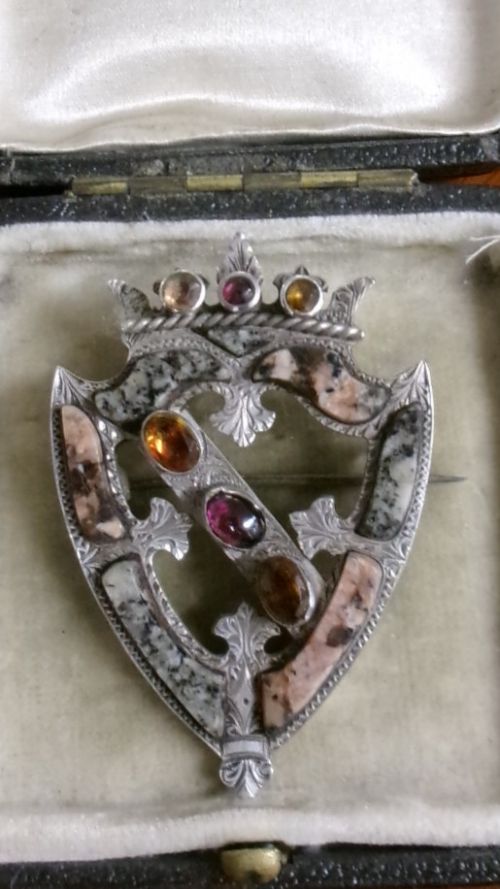
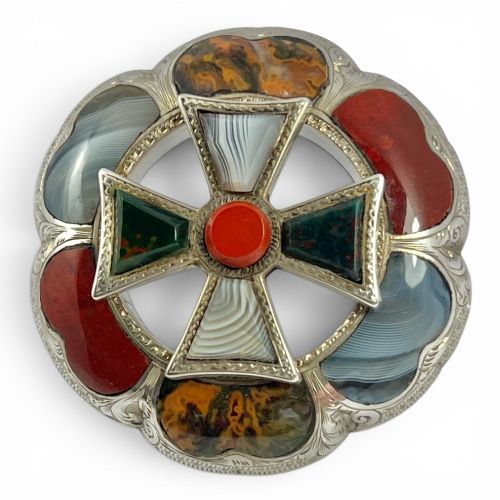
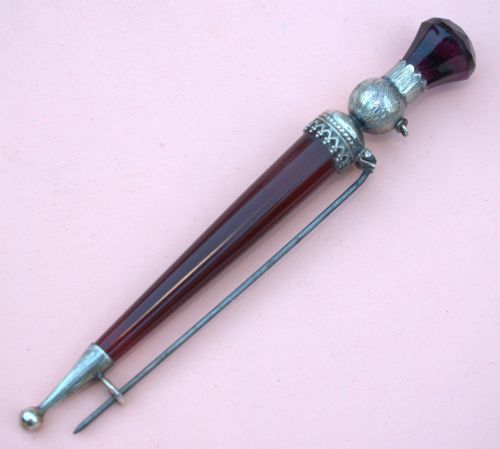
An agate pebble pin is a nineteenth-century Victorian Scottish revival jewel designed to secure heavy woollen garments like plaids and kilt shawls. These pieces combine substantial local stones with silver mounts, taking forms such as dirks, broadswords, shields, bows, and knots.
Most examples found here date from the Victorian era, specifically spanning from the eighteen-forties to nineteen-hundred. They showcase regional craftsmanship from centres like Inverness alongside broader Scottish Revival designs.
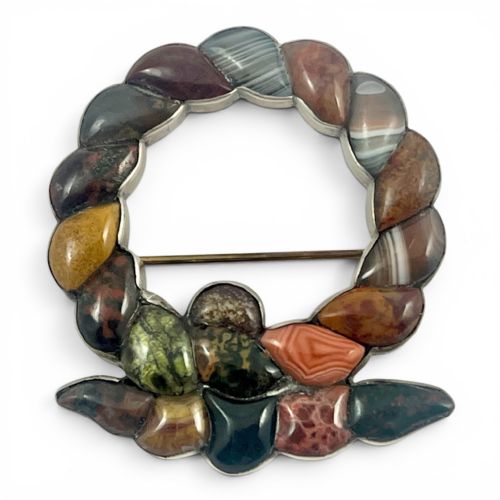
Buyers encounter a variety of substantial brooch and pin formats, often featuring multi-coloured hardstones arranged in geometric or traditional weapon motifs. Each item reflects the nineteenth-century romantic fascination with Highland traditions.
Gradations in quality
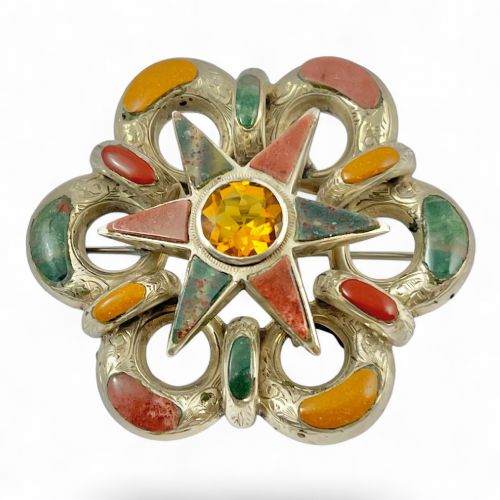
The sophistication of the stonemasonry and the complexity of the silver mount determine the calibre of each piece. Superior examples display intricately faceted citrines, finely polished specimen agates with distinct banding, and robust, detailed metalwork.
Scale and design ambition also separate standard production from finer output, with larger dirk and broadsword pins requiring advanced assembly. The variety of integrated hardstones, such as combining jasper and bloodstone within a single braided frame, indicates higher workshop effort.
Listings span the Victorian era, incorporating sterling silver, Montrose agate, jasper, bloodstone, and citrine within Scottish Revival brooch forms.
The Agate Pebble Pin Glossary
- Agate
- A cryptocrystalline variety of quartz characterised by fineness of grain and brightness of colour. These stones were gathered and polished in Scotland for Victorian jewellery.
- Plaid brooch
- A large circular or shaped fastener used traditionally in the Highlands to pin heavy woollen shawls and plaids. They often incorporate multiple hardstone panels.
- Dirk
- A long Scottish dagger, miniaturised by Victorian silversmiths into the metal framework of a kilt pin or brooch. These items feature sharp metallic blades paired with gemstone hilts.
- Citrine
- A yellow variety of quartz frequently mounted alongside agates in nineteenth-century Scottish jewellery. It provides bright colour contrast within silver settings.
- Pinchbeck
- An alloy of copper and zinc developed to imitate gold, occasionally utilised in the metal mounts of hardstone pebble pins. It offers a warm metallic tone without precious metal costs.
Agate Pebble Pin: Frequently Asked Questions
How do I wear an agate pebble pin?
These pieces function traditionally as heavy fastenings for woollen garments, capes, and scarves. Their substantial pin stems require thick fabrics to support their weight securely.
Today, they also serve as decorative brooches on modern jackets, coats, and heavy knitwear. Ensure the fabric has enough density to hold the pin without sagging.
What is Montrose agate?
Montrose agate refers to distinctive hardstones sourced and polished in the Scottish coastal area of Montrose. These stones are recognised for their specific natural patterns and local provenance.
Victorian jewellers prized these regional minerals for authentic Scottish Revival designs. They form the colourful centrepieces of many nineteenth-century brooches.
How do I date a Scottish pebble brooch?
Dating relies on stylistic clues, mounting techniques, and occasional hallmarks stamped onto the silver reverse. Pieces from the mid-nineteenth century often display early Victorian proportions and simpler frames.
Later examples towards nineteen-hundred incorporate more elaborate weapon motifs like broadswords and dirks. Examining the cut of the stones and the style of the pin hinge helps narrow the decade.
What is the difference between a kilt pin and a brooch?
Kilt pins typically take elongated forms such as swords or dirks and secure the apron of a kilt. Brooches are broader, often circular, shield, or bow shapes meant for fastening heavier shawls.
Both categories utilise similar silver mounts and agate pebble settings. Many listings describe these versatile items interchangeably due to their shared Scottish Revival heritage.