

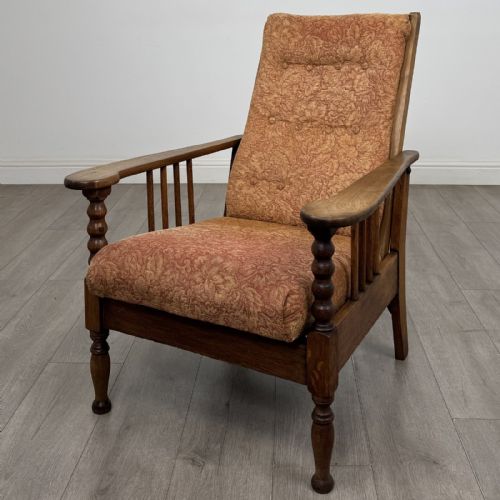

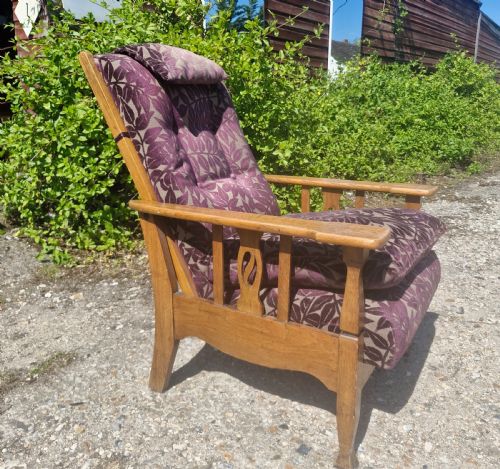


Adjustable Oak Armchair
These adjustable oak armchair pieces bring together solid timber frames and mechanical comfort, built for heavy daily use.
Adjustable Oak Armchair
An adjustable oak armchair combines sturdy wood construction with a pivoting or reclining mechanism designed for rest or work. When you search for an adjustable oak armchair, you meet pieces originating from the Georgian period through to the 1930s, encompassing styles like Arts and Crafts, Edwardian, Art Deco, and Jacobean Revival. The forms span domestic loungers, plantation style lean back chairs, and office seating.
The domestic versions often feature reclining actions, sometimes in the manner of Liberty's or Heals of London, while office and desk variants rely on swivel and height-adjusting mechanisms. Oak forms the primary timber skeleton, frequently paired with elm in earlier examples, alongside cast iron or metal working parts. You are most likely to encounter Edwardian and 1910 pieces equipped with fabric, leather, or cane inserts.
How they were made
Cabinetmakers constructed the primary frames using solid oak, occasionally combining elm for structural elements like seat panels or bowed backs. Iron and metal components were engineered into the frames to facilitate the reclining actions, swivel bases, and height adjustments found on desk and lounge chairs.
Upholstery techniques varied according to function, utilising fabric, tan leather, or woven cane fitted into the wooden framework. Metal castors often completed the base of swivel and desk chairs to allow smooth movement across office floors.
Adjustable Oak Armchair Retail Price Guide 2026
Typical asking prices for adjustable oak armchair among the pieces listed under this phrase on Sellingantiques today, from the lower quarter to the upper quarter. They describe what is for sale here now, not the wider market.
Foot & Sons specialised in adjustable loungers for invalids and travellers, accidentally inventing the ultimate nap chair for the Edwardian home.
What varies in quality
The distinction between standard commercial seating and superior workshop production rests in the execution of the mechanical parts and the choice of timber. Pieces associated with known retailers or specific makers demonstrate finer joinery and more robust swivel or reclining hardware.
The integrity of the original oak frame and the survival of secondary materials like tan leather or cast iron fittings dictate the standing of an individual chair. Earlier Georgian examples display distinct hand-tooling on the elm and oak compared to later mass-produced office variants.
Foot & Sons·Heals of London·Liberty's
The Adjustable Oak Armchair Glossary
- Arts and Crafts
- A design movement prioritising traditional craftsmanship, visible construction, and simple forms over mass-produced ornamentation. It heavily influences many reclining chairs from the early twentieth century.
- Reclining armchair
- A seat fitted with a mechanism allowing the backrest to tilt backward for resting. These often include adjustable footrests or notched ratchets.
- Swivel desk chair
- An office seat mounted on a central revolving spindle, allowing the user to turn without moving the base. They frequently feature height-adjustment screws and castors.
- Plantation style
- A seating form designed for warm climates featuring wide arms and a deep, sloping back for relaxed lounging. Examples appear in Edwardian and Art Deco contexts.
- Jacobean Revival
- A nineteenth and twentieth-century style copying seventeenth-century English furniture characteristics, including turned legs and heavy framework. It appears in several oak seating designs.
Adjustable Oak Armchair: Frequently Asked Questions
How do I operate the reclining mechanism?
Many early twentieth-century lounge chairs use a ratchet system concealed within the arm supports or back pivots. Users lift the arms or shift the backrest manually to drop the frame into a locked angle.
Later desk and office variants rely on threaded spindles for height alteration and tilt tensions underneath the seat pan. Checking the movement gently reveals how the original hardware was intended to function.
What is the difference between a desk chair and a lounge chair?
Desk chairs are engineered for upright seating at a table, featuring swivel bases, height adjustment, and castors for mobility. They prioritise lower back support and quick movement.
Lounge armchairs focus on relaxation, featuring fixed wooden bases with reclining backs and upholstered cushions in fabric or tan leather. Their proportions are wider and lower than office counterparts.
How do I date an oak swivel chair?
Dating relies on the combination of materials, ironwork complexity, and structural style. Pieces from the Edwardian era and the 1910s often feature cast iron underframes and simpler swivel fixings.
Chairs from the 1930s tend to show heavier commercial standardisation in their metal components and screw threads. Georgian examples display entirely hand-turned wooden spindles and elm elements without modern steel.
Are these chairs suitable for daily use?
Solid oak frames and sturdy mechanical parts make these pieces durable for everyday seating. Desk variants fit modern office setups when the swivel and height mechanisms operate smoothly.
Upholstery materials like leather and fabric can handle regular contact if the underlying webbing and padding remain secure. Checking the iron joints ensures safe movement during daily adjustments.