


Adjustable Drafting Desk
An adjustable drafting desk offers clever mechanical height and angle changes that let you work sitting or standing with absolute ease.
Adjustable Drafting Desk
An adjustable drafting desk provides a sturdy surface designed for draughtsmen, architects, and readers who need variable angles. These pieces date across several periods, stretching from the Georgian era through the nineteenth century and into the early twentieth century.
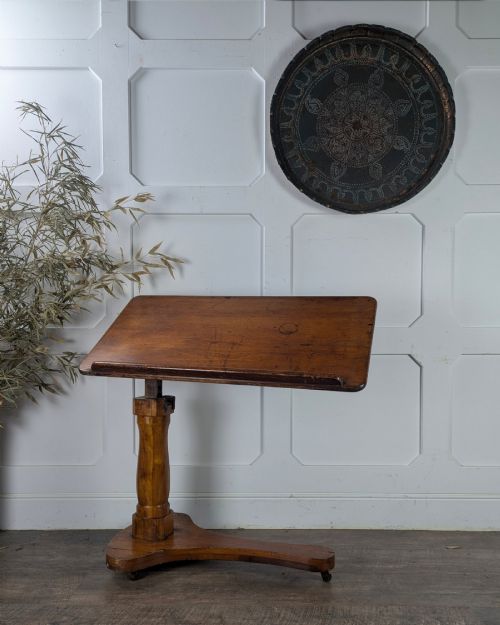
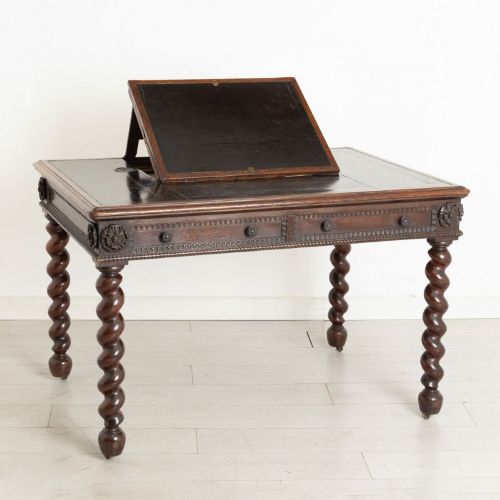
The forms on this page include architect's desks, reading tables, lecterns, and library tables, often equipped with metamorphic or rising mechanisms. Mahogany and oak dominate the selection, frequently paired with leather inserts and brass fittings.
You will encounter pieces styled in the Georgian, Regency, Edwardian, Neo-Jacobean, and nineteenth-century French traditions. Each design solves the practical problem of tilting a work surface to suit the user's eye and hand.
Materials and construction
Cabinetmakers built these tables using dense timbers like mahogany, oak, and rosewood, sometimes adding pine or boxwood details. Timber selection dictated how well the frame endured the constant movement of ratchets and hinges.
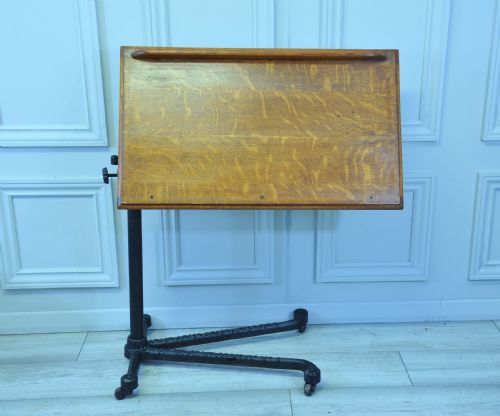
Cast iron and brass components provided the mechanical strength needed for rising desks and adjustable lecterns. Leather surfaces supplied a durable, smooth plane for writing and drawing.
Joinery techniques united sliding mechanisms and pivoting frames securely to the main carcase. Makers ensured that joints could withstand the shifting loads placed on tilting tops.
Listings feature mahogany, oak, pine, and rosewood, alongside iron and brass hardware.
Assessing quality and finish
Quality rests in the precision of the mechanical action and the smoothness of the rising or tilting movement. Superior pieces operate without catching, using well-fitted brass ratchets or iron screws.
The choice of timber and the figure of the mahogany or oak mark the distinction between standard items and finer commissions. Finely figured veneers and well-preserved leather inserts indicate a higher grade of manufacture.
Integration of secondary woods and the neatness of the interior joinery reveal the maker's hand. Solid brass fittings rather than plated base metals separate workshop standards.
Carters Of London·Gillows
The Adjustable Drafting Desk Glossary
- Metamorphic
- A descriptive term for furniture that transforms from one form or height into another through hidden hinges or ratchets. These designs allow a standard table to function as a standing desk or lectern.
- Lectern
- A stand with a slanted top designed to hold books or papers at a readable angle. They appear frequently among early reading tables.
- Ratchet
- A mechanical device with teeth and a engaging bar that allows linear or rotary motion in only one direction. In these desks, ratchets hold the sloping top securely at the chosen angle.
- Figured mahogany
- Timber cut to reveal distinctive grain patterns such as flame or curl. Cabinetmakers selected these boards for the most visible surfaces of fine desks.
- Neo-Jacobean
- A revival style drawing on seventeenth-century English motifs, characterised by robust proportions and carved details. This style appears on heavy oak architectural desks.
Adjustable Drafting Desk: Frequently Asked Questions
Can I use this as a standing desk?
Many tall architect's desks and riser tables were originally engineered for standing work or high stool seating. Their elevated frames and adjustable tops suit modern standing office configurations perfectly.
Check the specific height dimensions of each piece to ensure it matches your preferred working posture before setting up your workspace.
What maintenance do leather desk tops need?
Leather inserts benefit from occasional treatment with a neutral leather balm or wax to prevent the hide from drying and cracking over time. Avoid using modern chemical cleaners that might strip the historic dye or rot the surrounding timber.
Keep these desks away from direct sunlight and radiators to protect both the leather surface and the underlying mahogany or oak carcase.
How do I date an adjustable desk?
Dating relies on observing the secondary woods, the style of the brass hardware, and the construction methods used in the frame. Georgian and Regency examples typically feature hand-cut dovetails and lighter mahogany frames, while early twentieth-century pieces often incorporate cast iron.
Comparing the decorative vocabulary, such as Neo-Jacobean carving or plain Edwardian lines, helps narrow down the period of manufacture.