


19th Century Welsh Artwork
These pieces of 19th century welsh artwork capture rugged landscapes, castles, and rural scenes through period watercolours, oils, and carved slate.
19th Century Welsh Artwork
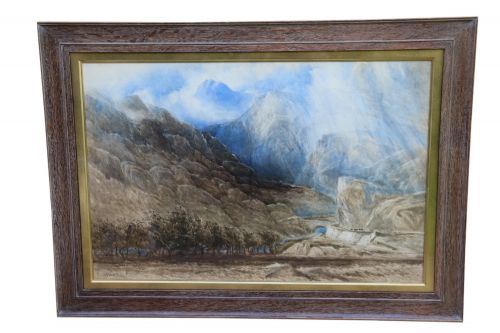
When you search for 19th century welsh artwork, you encounter regional topographical views, pastoral scenes, and historic castles created during the Victorian era and the broader nineteenth century. The selection leans heavily toward landscape oil paintings and watercolours depicting specific locations such as North Wales, Snowdonia, rivers, and Welsh cottages.
The objects take the form of framed wall art, fine art paintings, and occasional decorative pieces like folk art hearth pieces in Welsh slate. Painters documented rural life, cattle grazing by rivers, and mountainous terrain, often working on canvas, paper, or panel.
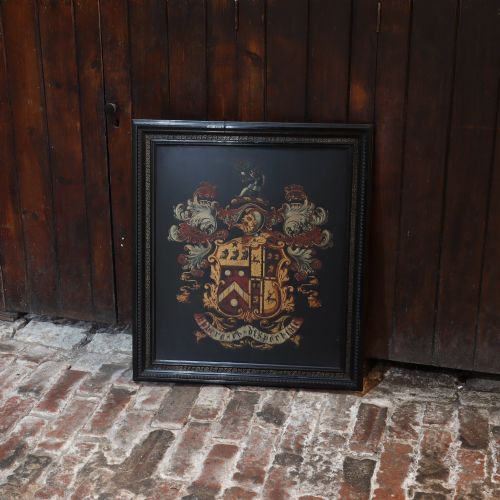
You will also find heraldic panels and specific topographical studies by named artists of the period. These items reflect both the Romantic and Victorian Realism movements, focusing on the dramatic scenery and traditional architecture of Wales.
Materials and methods
Artists utilised oil on canvas, wood, and paper alongside watercolour paints to render atmospheric Welsh landscapes and genre scenes. Canvases received layers of pigment to build depth in mountain ranges and river valleys, while watercolours relied on fluid washes on paper.
Frames often involved gesso and giltwood or plain wood moulding to house the paintings. Distinctly, regional items such as hearth pieces utilised carved Welsh slate to depict local landmarks like castles.
Paintings were created using brushwork characteristic of nineteenth-century British landscape traditions, capturing natural light and weather conditions across valleys and coastal straits.
Cattle and donkeys make frequent appearances in these valleys, faithfully posing for artists beside nineteenth-century Welsh rivers.
Judging quality in nineteenth-century Welsh pieces
Quality rests upon the skill of the artist's brushwork, the accuracy and depth of the topographical detail, and the preservation of the surface. Stronger compositions handle natural light and atmospheric conditions with greater control.
The condition of the canvas, paper, or slate matters significantly, alongside the originality of the mounting or frame. Pieces by documented artists with clear regional provenance command higher regard than anonymous works.
Henry Martin Pope·Sidney Richard Percy·Thomas Spinks·Clarence Henry Roe·Frederick Waters Watts·William Mellor·Harold Lawes·William Langley·Samuel Sidley·Willie Stephenson·Henry Brittan Willis·William Henry Mander·Cornelius Pearson·Walter J Watson·Benjamin Williams Leader·David Bates·Charles France·Carleton Grant·Alfred Provis·Alfred de Breanski·George Parson-Norman·James Poole·Henry Bright
The 19th Century Welsh Artwork Glossary
- Oil on Canvas
- A painting medium where pigments are suspended in drying oils and applied to a woven fabric support stretched over a wooden frame. This technique allowed artists to achieve rich colour saturation and subtle tonal gradations in large landscapes.
- Watercolour
- A painting method where water-soluble pigments are applied to paper to create translucent washes of colour. It was frequently employed by nineteenth-century artists recording views during travels through mountainous regions.
- Giltwood
- Wood that has been covered with a thin layer of gold leaf or gold paint, commonly used for traditional picture frames. It adds a reflective border that complements the tones of oil paintings.
- Folk Art
- Objects created by self-taught or traditional makers outside the formal academic art training system. In this context, it includes items like carved slate panels celebrating local Welsh architecture.
- Genre Painting
- Artwork depicting scenes from everyday life, such as figures in a cottage or rural workers. These pieces offer social history alongside artistic merit.
19th Century Welsh Artwork: Frequently Asked Questions
What subjects appear most in 19th century welsh artwork?
Paintings predominantly feature Welsh landscapes, including mountain ranges, rivers, lakes, and castles such as Conwy and Caernarfon. Artists also recorded rural genre scenes with figures, cattle, and traditional cottages.
Views frequently focus on North Wales locations like Snowdon, Betws-y-coed, and the Menai Strait, reflecting the era's fascination with picturesque topography.
How do I care for antique watercolours?
Watercolours on paper are sensitive to light and moisture, requiring careful placement away from direct sunlight to prevent fading. Framing should use acid-free mounts and UV-protective glass to safeguard the paper.
Keep them in stable room environments with moderate humidity to protect both the paper and the historic frame from deterioration.
Are these pieces signed by artists?
Many of the listed works feature signatures or inscriptions from nineteenth-century artists, while others remain anonymous. Signatures help attribute works to specific painters active in the Welsh landscape tradition.
Inscriptions on the reverse often identify exact locations, dates, and former collections, adding context to the piece.
What is a Welsh slate folk art piece?
These are decorative items carved from regional Welsh slate, often depicting local landmarks like castles. They reflect vernacular craftsmanship utilising native geological materials.
Such pieces combine local industry with commemorative art, serving as hearth pieces or wall plaques.