


Antique Welsh Mountain Artwork
Antique Welsh mountain artwork captures the rugged peaks and sweeping river valleys of Wales through nineteenth and early twentieth century oils and watercolours.
Antique Welsh Mountain Artwork
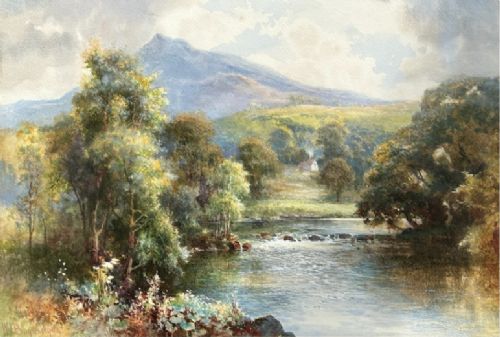
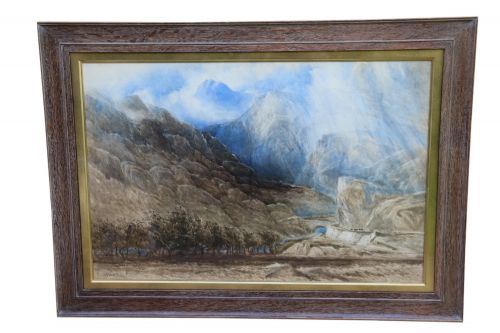
Antique Welsh mountain artwork comprises nineteenth and early twentieth century paintings depicting specific locations such as Snowdon, the Conwy valley, and Betws-y-coed. These pieces focus heavily on dramatic topography, rivers, and pastoral scenes set against towering Welsh peaks.
The works most commonly encountered on this page are framed oil paintings on canvas and delicate paper watercolours from the Victorian and Edwardian eras. Artists frequently recorded real topographical landmarks, capturing specific geological formations and rural Welsh life.
Subjects range from wide vistas featuring distant mountains to intimate river cottage studies with craggy backdrops. Painters active during this period utilised both oil and watercolour mediums to translate the atmospheric light of North Wales onto canvas.
Materials and Techniques
Painters utilised oil on canvas or applied watercolour pigments to paper, often framing the finished pieces in ornate giltwood, gesso, or simple oak moulding. The combination of oil paint and textured canvas allowed artists to build rich, layered depictions of rocky terrain and turbulent rivers.
Watercolour works relied on paper supports, sometimes finished with fine brushwork to delineate distant peaks and atmospheric skies over Snowdonia. Framing materials typically included period gilt or wooden surrounds that complemented the domestic scale of the paintings.
Materials recorded across the inventory include oil on canvas, watercolour on paper, giltwood, gesso, and oak.
Factors of Quality
Quality rests upon the artist's ability to render the distinct light and atmospheric conditions of the Welsh landscape with precision and depth. Finer examples display confident brushwork that defines geological strata and water movement rather than relying on generalised formulas.
The condition of the pigment and the integrity of the original support significantly influence the standing of a piece. Works retaining their period frames, whether giltwood or oak, also preserve a greater degree of their original historical context.
William Joseph Boyes·Henry Martin Pope·Sidney Richard Percy·Thomas Spinks·Walter J Watson·J Barclay·William Henry Mander·Cornelius Pearson·Samuel Towers·Benjamin Williams Leader·Alfred de Breanski·James Poole·Henry Bright
The Antique Welsh Mountain Artwork Glossary
- Oil on Canvas
- A painting medium where pigments are bound with drying oils and applied to stretched fabric. This technique permits extensive blending and rich texture, commonly seen in nineteenth century landscape works.
- Watercolour
- A paint consisting of colour pigments suspended in a water-soluble vehicle, typically applied to paper. It allows for translucent washes that suit the depiction of misty mountain air.
- Giltwood
- Wood carved and coated with a thin layer of gold leaf or metallic powder. This material forms the decorative frames frequently found on Victorian oil paintings.
- Gesso
- A paint mixture consisting of a neutral binder mixed with chalk, gypsum, or pigment. It provides a smooth preparation surface for wooden frames before gilding.
Antique Welsh Mountain Artwork: Frequently Asked Questions
How do I identify the location in a painting?
Artists frequently inscribed the specific Welsh valley, river, or mountain peak directly onto the canvas reverse, stretcher bars, or lower margins. Titles often reference recognisable landmarks such as Snowdon, Cader Idris, or specific river routes.
Matching these inscribed titles with nineteenth century geographical names reveals the exact vantage point the artist chose. Local topography helps confirm whether a scene depicts Conwy, Beddgelert, or the surrounding upland terrain.
What is the difference between oil and watercolour versions?
Oil paintings on canvas generally offer heavier texture and deeper colour saturation, allowing artists to build up thick layers of paint for craggy mountain surfaces. Watercolours on paper provide a lighter, more translucent quality well suited to capturing changing weather and mist.
Oils were typically framed in heavier giltwood or gesso surrounds for formal display, while watercolours often required protective glass and simpler framing to preserve the paper support.
How should I care for a nineteenth century painting?
Keep nineteenth century artworks away from direct sunlight and sources of excessive heat or dampness to protect both the paint layer and the paper or canvas support. Stable room temperatures prevent the canvas from slackening and protect the gesso on antique frames from cracking.
Dust watercolours under glass gently with a soft dry cloth, and consult a professional conservator if the oil surface requires cleaning or varnish attention.
Can I determine when the artwork was painted?
Many Victorian and Edwardian pieces carry signatures, dates, or inscription details applied by the artist at the time of creation. Examining the canvas weave, stretcher construction, and framing materials provides additional clues regarding the manufacturing date.
Comparative style analysis against known dated works by artists active in Wales during the nineteenth century further narrows the probable production window.