
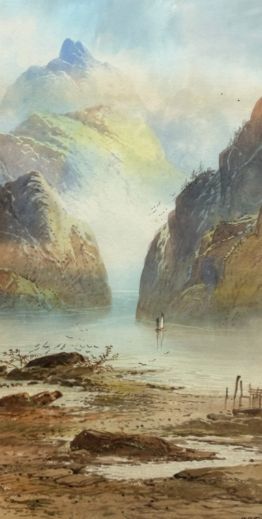
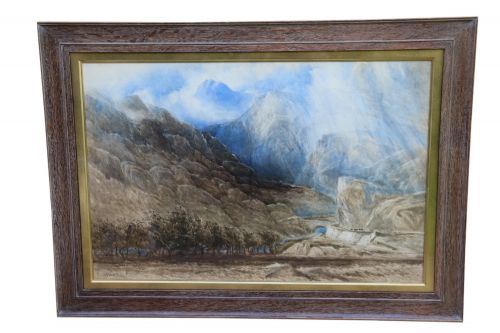


Victorian Mountain Watercolour Painting
These Victorian mountain watercolour painting works capture dramatic upland scenery on paper, offering buyers a evocative window into nineteenth-century landscape art.
Victorian Mountain Watercolour Painting
A Victorian mountain watercolour painting captures dramatic topography, sweeping valleys, and rugged peaks across the British Isles and continental Europe. These works form a distinct branch of nineteenth-century landscape painting, executed on paper using water-soluble pigments.
Buyers browsing this selection will most frequently encounter works dated across the nineteenth century, including specific decades such as eighteen-seventy and eighteen-fifty, alongside Victorian and Georgian periods. Many examples depict recognisable Welsh, Scottish, and Swiss locations.
Framing typically involves wood, gilt, or gilt wood surrounds, often protected under glass to preserve the delicate pigment on paper. The compositions range from expansive Scottish lochs and Welsh passes to alpine views in Switzerland and northern Italy.
Materials and Technique
Artists executed these landscapes using watercolour pigment applied directly to paper sheets, occasionally employing sepia tones for monochrome depth. The technique relied on transparent washes to build atmospheric light and mountain mist.
Completed paintings were mounted behind glass and housed in wooden frames, frequently finished with gilt or gilt wood mouldings to complement the domestic interiors of the period.
Current listings feature watercolours on paper housed in wood, gilt, and gilt wood frames across nineteenth-century styles.
Assessing Quality and Hand
Quality in a Victorian mountain watercolour painting rests upon the confidence of the brushwork and the artist's ability to render atmospheric depth and geological form. Finer works display assured handling of light across distant peaks and water.
The sophistication of the framing and the preservation of the paper support further distinguish superior examples. Retaining original gilt wood frames and clear signatures from recorded nineteenth-century painters enhances the standing of a piece.
William Henry Earp·Henry Martin Pope·John Syer·Thomas Lound·James H Hulse·Cornelius Pearson
The Victorian Mountain Watercolour Painting Glossary
- Watercolour pigment
- Finely ground colour particles mixed with a binder, applied with water onto paper to create transparent washes. This medium allows for luminous depictions of atmospheric mountain skies.
- Gilt wood
- Timber frames coated with a thin layer of gold leaf or metallic gilt, commonly used during the nineteenth century. These frames provide a decorative boundary that enhances the painted landscape.
- Norwich School
- A regional association of artists active during the nineteenth century, known for landscape painting inspired by local scenery. Members contributed significantly to the development of British watercolour art.
- Sepia
- A dark brown pigment derived from the ink sac of the cuttlefish, frequently used for monochromatic drawings and early Victorian landscape sketches. It produces warm, tonal variations across paper.
Victorian Mountain Watercolour Painting: Frequently Asked Questions
How should I hang a watercolour?
Watercolours are sensitive to bright sunlight and require placement away from direct rays to prevent the pigments from fading over time. Maintaining stable indoor humidity levels also protects both the paper support and the gilt frame.
Using professional framing with acid-free mounts ensures the paper remains in good condition for decades. Position the painting at eye level in a room with gentle, indirect illumination.
Are these paintings original?
The works listed are original nineteenth-century paintings executed by hand on paper rather than modern reproductions or prints. Many feature artist signatures or contemporary inscriptions detailing specific locations in Wales, Scotland, or the Alps.
Verification relies on examining the paper texture, pigment application under magnification, and the construction of the period frame. These physical characteristics confirm the age and authenticity of each piece.
What subjects are most common?
Mountain passes, river valleys, and highland lakes dominate the subject matter, reflecting the nineteenth-century passion for picturesque and romantic scenery. Views from Wales, Scotland, and Switzerland appear frequently among the listings.
Artists often included small figures such as fishermen or travellers to establish the immense scale of the surrounding peaks. This human element grounds the grand topography within a narrative context.
How do I date a watercolour?
Dating relies on stylistic evidence, artist working periods, and any dated inscriptions or signatures recorded on the front or reverse of the paper. Frame construction and backing materials also offer reliable clues to the decade of creation.
Comparative analysis with known works by artists from the British School helps narrow down the active period of production. Victorian landscapes often bear specific stylistic markers tied to mid or late nineteenth-century tastes.