

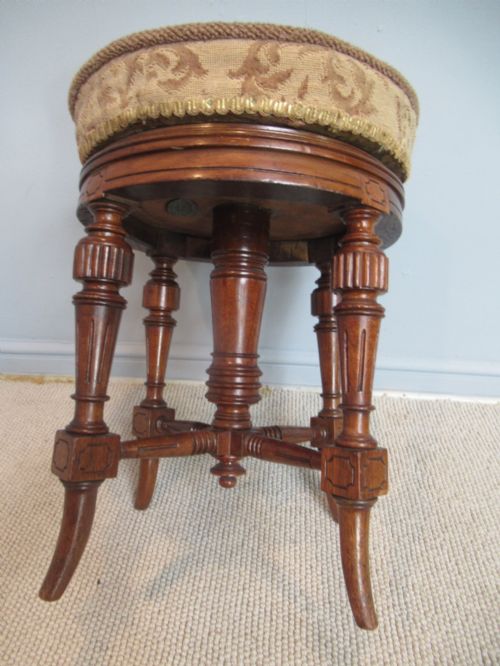
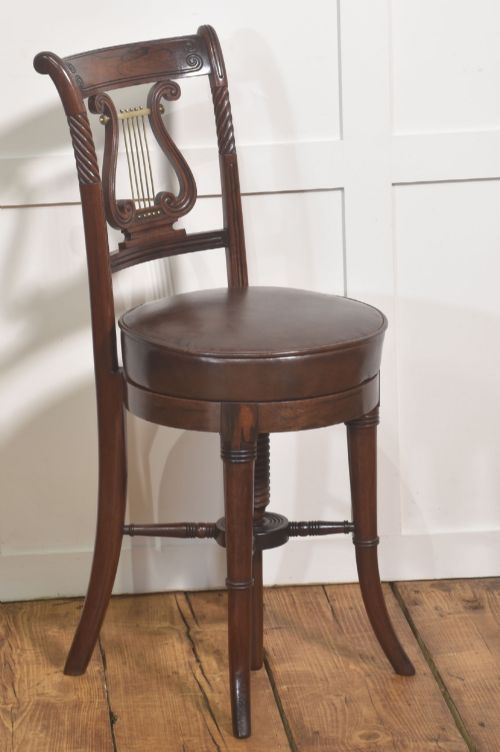
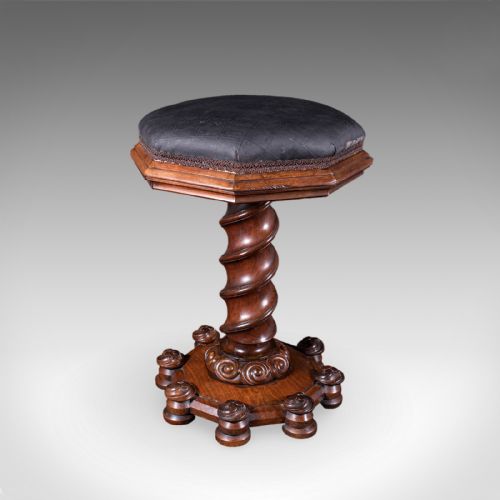


19th Century Swivel Stool
These 19th century swivel stool examples bring mechanical ingenuity and rich timbers together for the parlour or music room.
19th Century Swivel Stool
A 19th century swivel stool serves as a seating option designed for musicians, pianists, and dressing tables. These pieces allow the sitter to rotate or adjust height through a central screw mechanism.
The selection ranges from piano stools and music chairs to dressing table chairs and country swivel stools. Walnut, mahogany, and rosewood dominate the forms across Victorian, Regency, and William IV periods.
Makers adapted these adjustable seats for specific duties, creating harpist chairs, organist stools, and revolving piano seats. Buyers encounter square tops, tripod legs, and upholstered revolving seats in diverse regional styles.
How They Were Made
Cabinet makers utilised dense hardwoods such as mahogany, walnut, rosewood, and padouk for the frames and legs. Brass components frequently form the screw mechanisms and decorative inlays found on Regency and Victorian examples.
Upholstery materials include leather, velvet, fabric, and original textiles secured to revolving seats. Papier-mâché combines with mahogany on specialised Victorian pieces, while gilt paint decorates empire style frames.
19th Century Swivel Stool Retail Price Guide 2026
Typical asking prices for 19th century swivel stool among the pieces listed under this phrase on Sellingantiques today, from the lower quarter to the upper quarter. They describe what is for sale here now, not the wider market.
The inventory records pieces spanning the Georgian, Regency, William IV, and Victorian periods.
What Varies in Quality
The refinement of the turning mechanism dictates the mechanical success of an adjustable stool. Smooth screw action and stable revolving joints separate standard pieces from superior examples.
Timber selection and decorative detail define the upper tier of craftsmanship. Fine rosewood or mahogany framing combined with brass inlay or carved tripod bases indicates workshops of higher ambition.
Jennens & Bettridge·Holland & Son
The 19th Century Swivel Stool Glossary
- Swivel stool
- A seat designed to rotate on a central pivot or screw mechanism. This movement allows musicians and dressers to turn easily without shifting the base.
- Revolving piano stool
- An adjustable seat engineered for keyboard players. The top spins to alter the sitting height.
- Adjustable screw top
- A mechanism using a threaded metal rod inside the central column. Turning the seat raises or lowers the height.
- Tripod legs
- A three-legged base providing stability on uneven floors. These supports frequently feature carving on 19th century examples.
- Padouk
- A heavy, durable tropical timber used in colonial cabinet making. It appears in specific overseas pieces such as harpist chairs.
19th Century Swivel Stool: Frequently Asked Questions
How do I adjust the height?
The seat top rotates on a threaded wooden or metal screw. Turning the cushion clockwise or anticlockwise raises or lowers the sitting position.
Older mechanisms require steady rotation to engage the internal thread properly without straining the central pillar.
Where were these stools used?
These seats belonged primarily in music rooms, parlours, and bedrooms. Musicians sat at pianos, harps, and chapel organs while using the revolving action.
Dressing tables also utilised adjustable chairs to suit different mirror heights and users.
How do I identify a Regency piece?
Regency examples display classical restraint, often incorporating rosewood, brass inlay, and crisp carved details. The proportions reflect early nineteenth-century design influences.
Provisional dating relies on timber choice and leg configuration rather than stamped signatures.
Are the upholstery fabrics original?
Some pieces retain original leather, velvet, or woven fabric fixed with traditional tacks. Many surviving examples have been re-covered over time to suit later domestic interiors.
Inspect the underside webbing and tack lines to assess the history of the upholstery.