


19th Century Semainier Chest
A 19th century semainier chest offers seven stacked drawers of slender elegance, bringing French practicality and stately height to any bedroom.

19th Century Semainier Chest
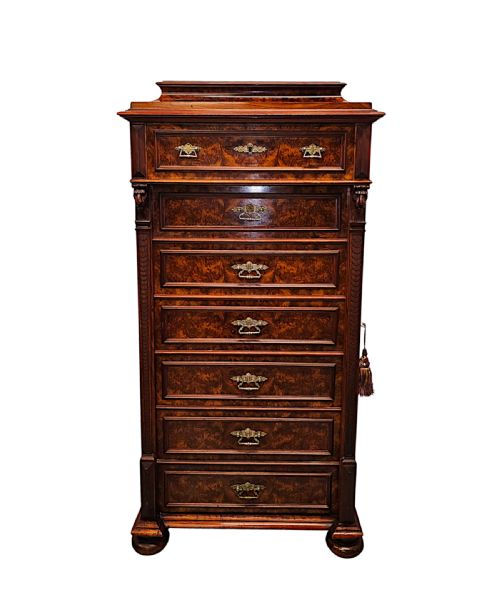
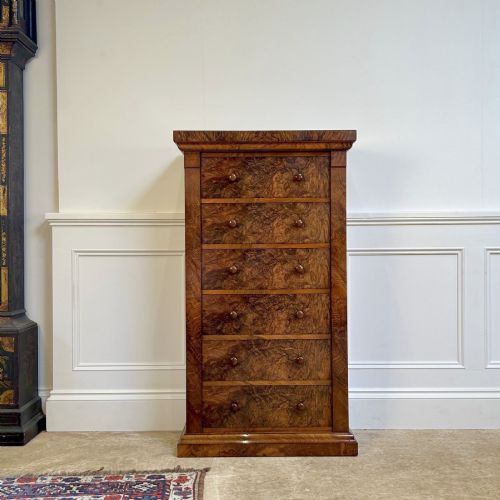
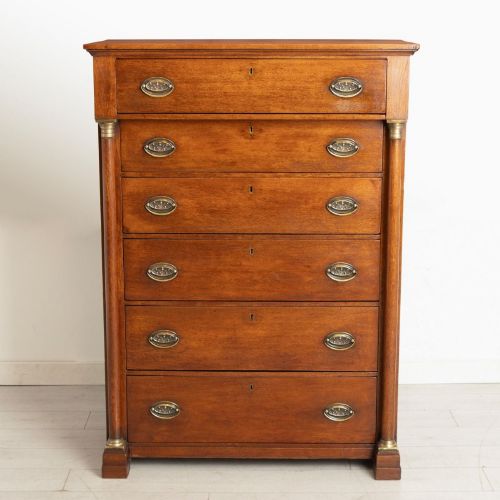
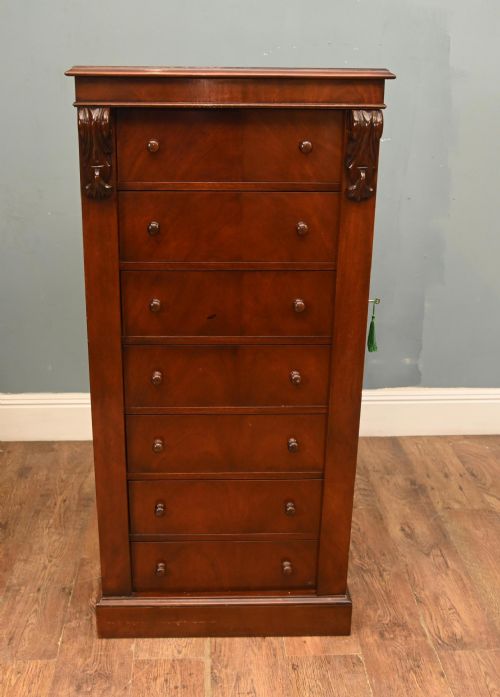
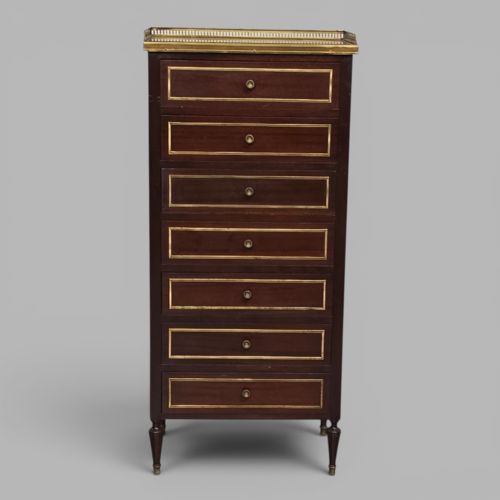
A 19th century semainier chest stands tall and narrow, traditionally designed with seven drawers to hold one for each day of the week. The pieces found here span the Victorian era, the Edwardian period, and French provincial workshops, manifesting chiefly as upright chests, Wellington chests, and secretaire cabinets. French examples often feature marble tops and gilt mounts, whilst British interpretations lean towards robust mahogany or burr walnut.
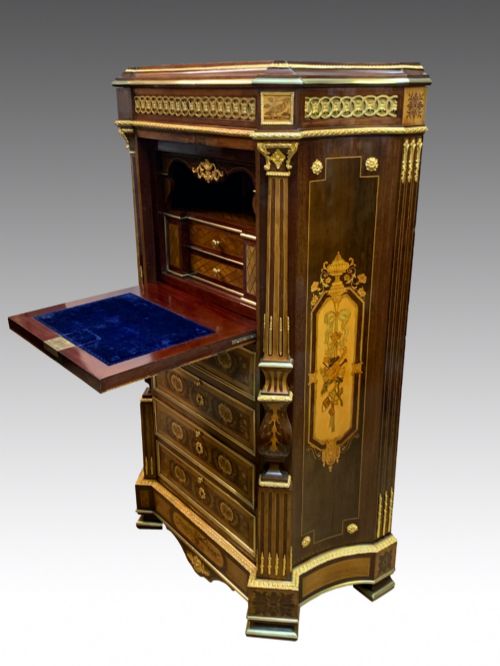
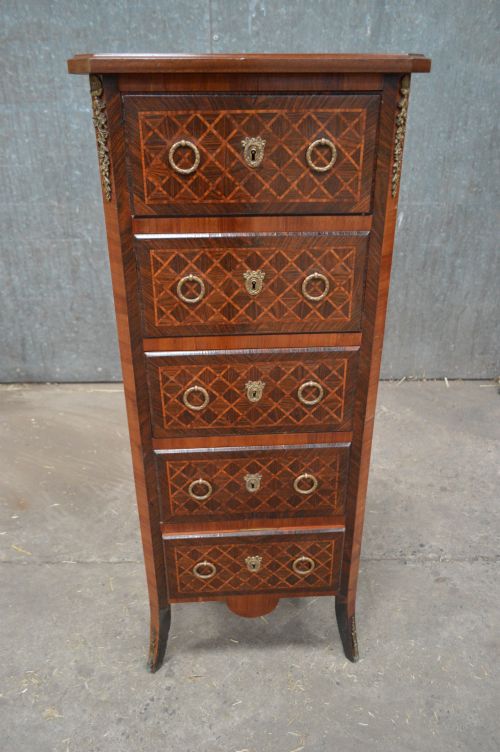
The proportions are dictated by utility and verticality, making these chests ideal for rooms where floor space is limited but storage capacity remains essential. Makers utilised the height to incorporate hidden locking bars, drop-down writing desks, or multiple graduated tiers without widening the footprint. Buyers encounter both austere domestic pieces and highly ornate continental variants with marquetry or parquetry surfaces.
Regional variations define the character of each piece, shifting from the disciplined geometry of William IV designs to the opulent veneers of French Empire and Louis XVI styles. Cherrywood, satin birch, and rosewood frequently appear alongside the standard walnut and mahogany, offering a diverse palette for interior placement. Each drawer operates independently, often secured by a hinged locking stile that guards the entire column.
Materials and Construction Methods
Cabinetmakers constructed the carcass from dense secondary timbers like oak or pine, then applied face veneers of burr walnut, mahogany, or exotic woods such as kingwood and satinwood. Bookmatching and marquetry patterns were meticulously sawn and laid by hand to create symmetrical geometric or floral designs across the drawer fronts. Ormolu and gilt bronze mounts were cast and chased to embellish the corners and key escutcheons of continental pieces.
Solid marble slabs, varying in colour from white to grey veined varieties, were fitted directly to the top surface of many French pieces to provide a durable, cooling counter. Drawer construction relied on tight hand-cut dovetails, ensuring the slender drawers withstood daily opening despite seasonal timber movement. Side-locking mechanisms, characteristic of Wellington styles, required precision joinery to allow a single locking bar to secure every drawer simultaneously.
Listings for this phrase demonstrate a strong presence of French regional cabinet-making, dominated by walnut, mahogany, and marble finishes from the mid-nineteenth century.
Distinctions in Execution and Materials
Quality rests upon the selection and continuity of the timber veneers, where superior pieces exhibit balanced grain matching across multiple stacked drawers rather than haphazard patches. The crispness of hand-cut marquetry and the weight of cast ormolu mounts signal the workshop's investment in finer decorative details. Furthermore, the thickness of the marble top and the integrity of the original locking mechanisms elevate certain examples above standard utility furniture.
Internal joinery reveals the maker's discipline, demonstrated by oak-lined drawer boxes with fine, even dovetailing rather than crude softwood replacements. The proportion and stance of the carved feet or plinth bases dictate the visual balance of the piece, preventing the considerable height from appearing clumsy. Master workshops ensured that even concealed structural elements received careful planing and finishing.
Gillows·Maison Krieger
The 19th Century Semainier Chest Glossary
- Semainier
- A traditional tall French chest of drawers, specifically designed with seven tiers to represent the days of the week. This form originated in France during the eighteenth century and remained popular throughout the nineteenth.
- Wellington chest
- A sturdy British tall chest featuring a hinged vertical locking bar on the right side that secures all drawers with a single key. The style is traditionally executed in mahogany or burr walnut.
- Ormolu
- Gilded bronze ornamentation applied to furniture mounts, feet, and handles. The technique involves treating metal with a mercury-gold amalgam before heating.
- Marquetry
- The art of applying decorative veneer pieces in wood, shell, or ivory to a structural background to form pictorial or geometric patterns. Artisans cut these thin layers together to ensure seamless interlocking fits.
- Parquetry
- A geometric mosaic of wood pieces used for decorative veneer on furniture surfaces. It differs from marquetry by strictly employing angular or repeating shapes like squares and triangles.
- Secretaire
- A cabinet or chest incorporating a pull-down drawer front that serves as a writing surface, often concealing small pigeonholes and inner compartments. This dual-purpose form was favoured in compact nineteenth-century interiors.
19th Century Semainier Chest: Frequently Asked Questions
What is a semainier chest used for?
A semainier chest provides tall, narrow storage with seven distinct drawers designed originally to hold weekly attire or linens. The generous vertical capacity suits modern bedrooms and dressing areas where floor space is limited.
Many examples also incorporate writing surfaces or secure compartments, allowing them to function as compact bureaus or bedside storage units.
Are these chests suitable for small bedrooms?
Their narrow footprint makes them exceptionally practical for tight spaces, offering substantial drawer volume without demanding wide wall clearances. The elevated height draws the eye upward, enhancing room proportions.
Placement should account for the swing of the side locking bar on Wellington models or the pull-down desk flap on secretaire variants.
How do I care for marble-topped chests?
Marble surfaces require gentle cleaning with warm water and mild, non-acidic soap to preserve the polished finish. Avoid harsh chemical cleaners or abrasive pads that can etch the stone.
Protect the surface from oils and liquids by using coasters or mats, ensuring the antique stone remains pristine over decades of daily use.
What distinguishes French nineteenth-century chests from British ones?
French nineteenth-century chests frequently showcase elaborate marquetry, parquetry, and gilt bronze mounts alongside fitted marble tops. British equivalents generally emphasise the natural grain of figured mahogany or burr walnut with minimal exterior metalwork.
Both traditions maintain meticulous internal joinery, but their aesthetic language reflects distinct regional tastes in nineteenth-century interior design.