




19th Century Leather Bindings
These 19th century leather bindings bring genuine historical weight and tactile depth to a room, offering classic literature wrapped in durable hide and gold leaf.
19th Century Leather Bindings
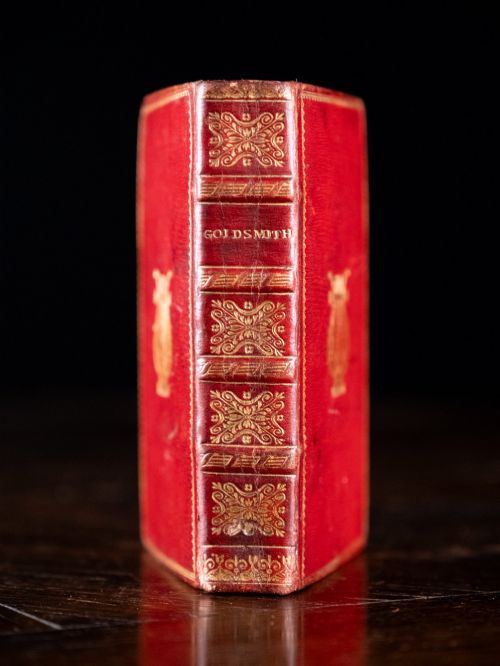
When you search for 19th century leather bindings, you find antiquarian books and book sets spanning the Regency and Victorian eras, encased in durable animal skins. These volumes range from miniature books of poetry to multi-volume sets of history, essays, and novels.
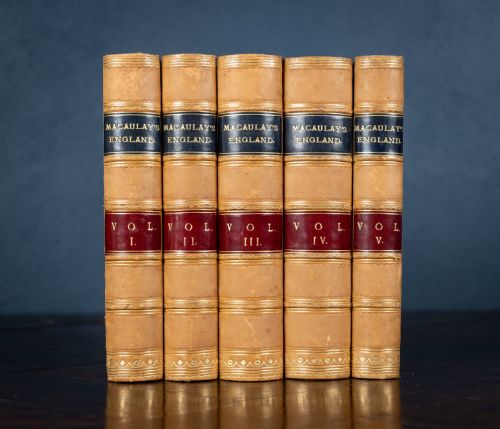
The pieces on this page include complete sets of Shakespeare plays, historical works by Thomas Babington Macaulay, and illustrated editions of Cervantes. Buyers encounter individual volumes alongside uniform sets dated between the early eighteen-hundreds and the early twentieth century.
Many of these texts showcase traditional craftsmanship applied to literature, featuring marbled paper endpapers and decorative tooling. They serve as both readable copies of classical works and decorative objects for library shelves.
How they were made
Binders constructed these volumes using leather, calfskin, and vellum stretched over sturdy board foundations to protect the printed paper pages within. Workers often utilised marbled paper for endpapers, adding patterned detail inside the covers.
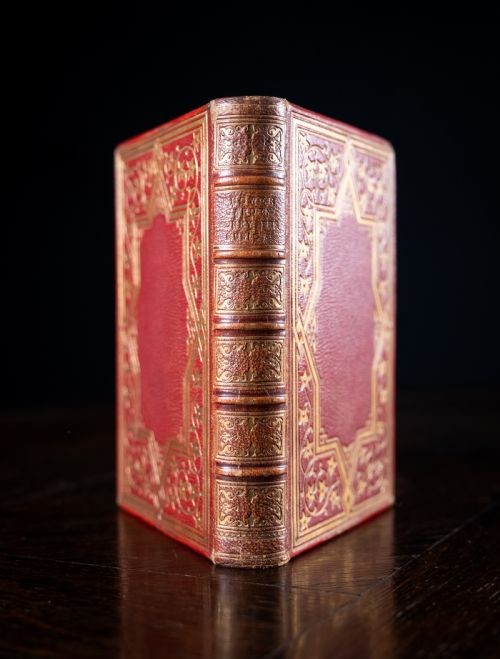
Spines and covers received decoration through the application of gold leaf, impressing metallic details into the leather bindings. Craftsmen bound individual volumes or assembled multi-volume sets uniformly, ensuring matching heights and spine designs across collections.
The periods represented on this page span the Regency and Victorian eras.
What varies in quality
The standard of a volume often depends on the uniformity of a set and the complexity of its tooling. Matched multi-volume collections demonstrate greater coherence on a shelf than assembled groupings.
The condition of the leather and the brightness of the gold leaf decoration dictate the visual impact of the book. Intricate gilding and well-preserved calfskin or vellum distinguish finer examples from plain utilitarian bindings.
The 19th Century Leather Bindings Glossary
- Calfskin
- A fine, smooth leather derived from the skin of a calf, frequently utilised for quality book bindings during the nineteenth century.
- Vellum
- A prepared animal skin, traditionally calf or sheep, used to cover books for a durable and smooth exterior.
- Tooling
- The decorative impression of designs, letters, or patterns onto leather covers, often enhanced with gold leaf.
- Marbled paper
- Coloured paper featuring swirling patterns resembling marble, commonly placed inside the front and back covers of antiquarian books.
- Miniature book
- An exceptionally small volume designed to be easily portable, often containing poetry or religious texts.
19th Century Leather Bindings: Frequently Asked Questions
How should I care for leather bound books?
Keep the volumes away from direct sunlight and damp conditions to prevent the leather and paper from degrading.
Maintain a stable room temperature and handle the spines carefully when removing books from a shelf.
Are these books suitable for reading?
Most volumes remain structurally sound enough for careful reading, provided you support the spine and open the book gently.
Older bindings require a gentle touch to preserve the integrity of the historical materials.
How can I tell the Regency period from the Victorian era?
Regency bindings date from the early decades of the nineteenth century and often reflect neoclassical design tendencies.
Victorian volumes typically display the heavier, more ornate decorative styles popular later in the eighteen-hundreds.
Why do some multi-volume sets look different?
Publishers sometimes issued works over extended periods, leading to slight variations in binding styles across the set.
Uniform sets were bound together intentionally to ensure identical spines and leather shades on the shelf.