



19th Century French Watercolour
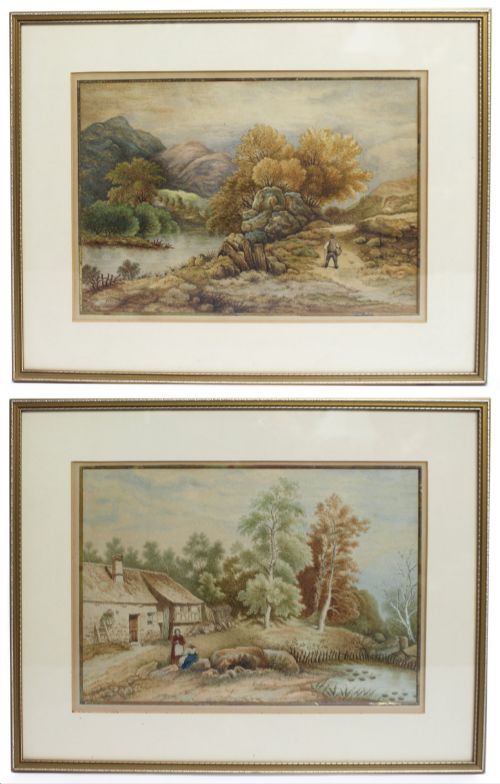
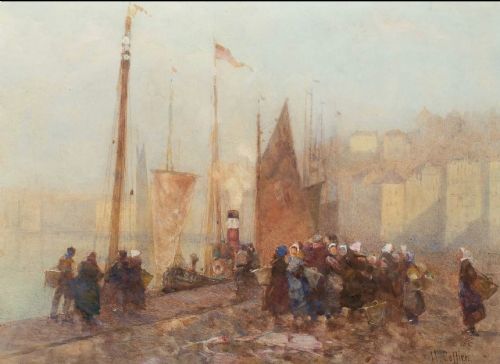
These 19th century french watercolour pieces capture coastal scenes, townscapes, and portraits created on paper.
19th Century French Watercolour
A 19th century french watercolour brings together landscape views, architectural studies, and portrait miniatures executed across the decades from eighteen-sixty to nineteen-hundred. Buyers encounter framed artworks, pairs of paintings, and portable artist boxes associated with the period.
The selection ranges from coastal views of Normandy and Boulogne to genre scenes and interior studies. Works span several movements including French Orientalist, Second Empire, and Barbizon School traditions.
Materials and Techniques
Artists painted primarily with watercolour paint and ink applied to paper supports. Framed works utilise glass protection alongside wooden and gilt wood frames.
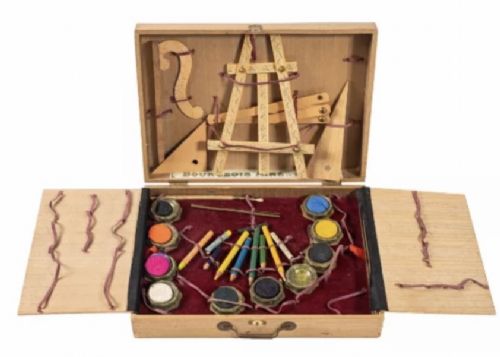
Some items comprise beechwood artist paintboxes outfitted for field work, while other objects take the form of architectural prints and drawings.
Materials documented across these works include watercolour paint, ink, paper, glass, wood, gilt wood, and beechwood.
Quality and Execution
The standard of a piece rests on the handling of light and pigment across the paper surface, distinguishing hurried sketches from fully realised compositions. Signed works by documented artists carry distinct archival weight compared to anonymous studio outputs.
Framing materials and overall preservation contribute to the physical integrity of the piece, with intact glass and period frames maintaining the original context of the artwork.
Th. Thibault·Hector Caffieri·Albert Ludovici Jnr·Bourgeoise Aine Paris·Charles Bellay·Henri Joseph Harpinies·Joseph W. Milliken·Eugene Boudin·Leon Girardet·Elisabeth Vigee Le Brun·Keeley Halswelle·Thomas Colman Dibdin·Mary Evelina Kindon·George Bryant Campion·Griset
The 19th Century French Watercolour Glossary
- Watercolour paint
- A water-based medium utilising finely ground pigments suspended in a binder, applied to paper to achieve transparent washes or opaque details.
- Genre watercolour
- A painting depicting scenes from everyday life, such as street markets, urban commutes, or domestic interiors.
- French Orientalist
- A style reflecting nineteenth-century European artistic engagement with Middle Eastern and North African subjects, rendered through detailed watercolour techniques.
- Portrait miniature
- A small-scale painting capturing a likeness, often executed with fine brushwork on paper or vellum.
- Gilt wood
- Timber frames finished with a thin layer of gold leaf, frequently utilised to house nineteenth-century works on paper.
19th Century French Watercolour: Frequently Asked Questions
How do I identify a 19th century french watercolour?
Examine the paper support, pigment application, and framing style for nineteenth-century characteristics. Signatures and dates often point to specific academic or regional traditions.
Compare the subject matter against known historical motifs such as Normandy coasts, Parisian street scenes, or architectural studies.
Were these watercolours intended for framing?
Many works were created as finished cabinet pictures meant to be framed and displayed in domestic interiors. Others originated as preparatory studies or leaves within artist sketchbooks.
Framed presentations often utilise glass to protect the delicate water-soluble pigments from atmospheric moisture.
How should I care for a paper watercolour?
Keep works out of direct sunlight to prevent fading of the watercolour pigments and yellowing of the paper support. Maintain stable humidity levels within the room.
Ensure framing is sealed properly to prevent dust and insects from damaging the surface of the paper.
What subjects are common in these paintings?
Common subjects include coastal harbours, rural landscapes, townscapes, architectural prints, and portrait miniatures. Artists frequently recorded French regional life from Normandy to Paris.
Genre scenes depicting daily activities and figures in combat or market settings also appear regularly.