
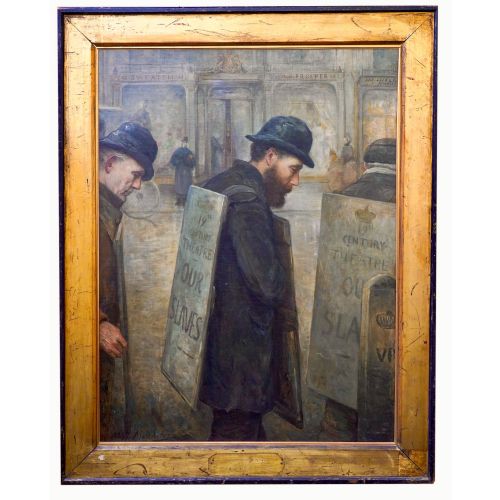


Edwardian Street Scene Artwork
Edwardian street scene artwork captures town life through watercolours and oils framed in wood and gold leaf.
Edwardian Street Scene Artwork
When you search for edwardian street scene artwork, you encounter paintings depicting townscapes, markets and urban moments from the turn of the twentieth century. These works capture city life through the eyes of artists working during the Victorian, Edwardian and Belle Epoque periods.
The most common examples on this page are watercolours on paper and oil paintings on board or canvas, housed in wood frames with or without gold leaf. Subjects range from London squares and continental markets to moonlit provincial streets and snowy thoroughfares.
The creators recorded in the listings include named artists such as Charles James Lauder, William Manners and Thomas Ellison, alongside works from the broader nineteenth and early twentieth centuries.
How they were made
These pieces rely on traditional painting techniques executed on paper, board and canvas using watercolour, ink and oil pigments. Artists built their urban compositions through layered washes of translucent watercolour or thicker applications of oil paint.
Framing forms an integral part of the physical object, utilising wood and gold leaf to protect and present the work. Glass is frequently employed to cover and preserve delicate watercolour paintings on paper.
One artist titled their snowy urban watercolour simply after weather.
What varies in quality
Quality in these urban depictions rests on the artist's ability to handle light, atmosphere and perspective within a busy townscape. Works that capture the specific mood of a moonlit street or a bustling market square demonstrate superior draftsmanship and composition.
The preservation of the medium also distinguishes the works, particularly where delicate watercolours on paper remain bright beneath glass and within their original wood frames.
Felix Stone Moscheles·Thomas Ellison·Albert Ludovici Jnr·William Manners·Charles James Lauder·John Smith Atherton·George Whyatt·Andrew Young·Robert Hollands Walker·Joseph W Milliken·Annie L Lee·Matthew Hale
The Edwardian Street Scene Artwork Glossary
- Watercolour
- A painting method where fine pigment is mixed with water-soluble binders and applied to paper. This medium allows for luminous washes that define many urban watercolours.
- Oil on board
- A painting technique using oil-based pigments applied to a rigid wooden or composite board. This surface provided artists with a sturdy support for textured street scenes.
- Gold leaf wood frame
- A wooden picture surround finished with very thin leaves of beaten gold. These ornate borders were designed to complement the tones of the artwork within.
- Genre painting
- A style of art depicting scenes from everyday life, such as people navigating city streets or visiting markets. It forms a key category among the listed townscapes.
- Belle Epoque
- A period of European history lasting from the late nineteenth century until the First World War. Art from this era often reflects urban optimism and changing social life.
Edwardian Street Scene Artwork: Frequently Asked Questions
What periods do these street scenes cover?
The selection spans from the late nineteenth century through the Edwardian era and into the early twentieth century, including Victorian examples.
Artists working across these decades documented urban life using traditional painting methods on paper and canvas.
Are these artworks framed?
Many examples are presented in wood frames, occasionally featuring gold leaf details to enhance the visual presentation.
Watercolour paintings on paper are typically set behind glass for protection against dust and moisture.
What subjects appear in these paintings?
The compositions focus on townscapes, including London squares, continental markets, inns and moonlit streets.
Genre scenes involving people going about daily urban routines frequently appear alongside architectural studies.
How do I care for a watercolour street scene?
Watercolours on paper require protection from direct sunlight to prevent the pigments from fading over time.
Keeping the protective glass clean and avoiding damp environments ensures the paper and frame remain stable.