


19th Century Canterbury Drawer
A 19th century canterbury drawer brings orderly elegance to any room for holding music sheets, newspapers, and magazines.
19th Century Canterbury Drawer
A 19th century canterbury drawer combines divided upright sections for storing folios, sheets, and periodicals with a low base storage compartment underneath. These pieces originated as mobile stands for sheet music and evolved to serve as general paper and magazine tidies in country houses and parlours.
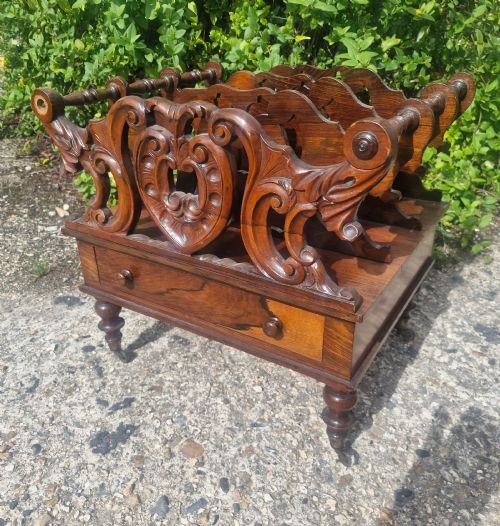
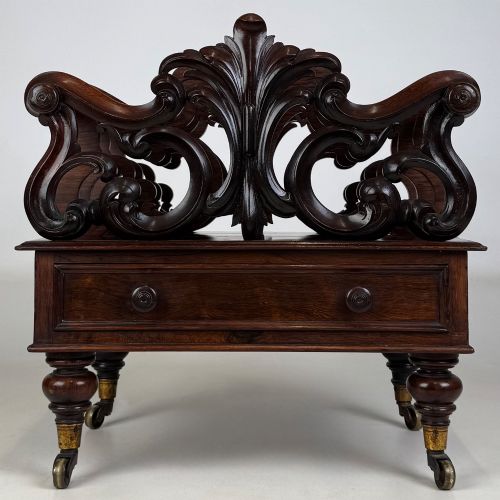
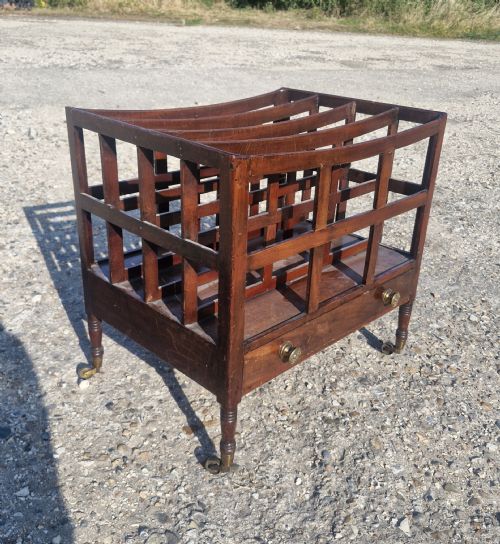
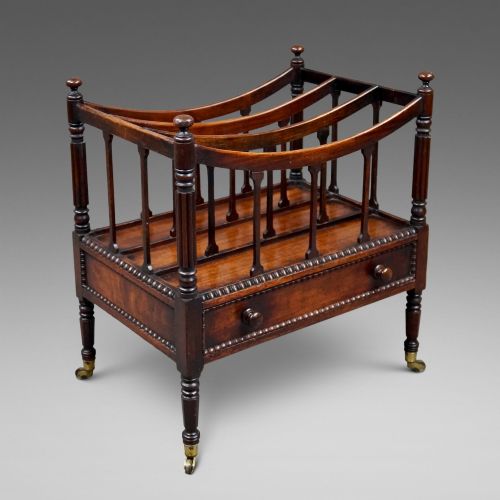
The version most commonly met on this page is constructed from rich timbers like mahogany or rosewood, frequently dated across the Regency, William IV, and Victorian periods. Most examples present open slatted or pierced divisions above a single frieze drawer, often mounted on castors for ease of movement across carpets.
Factors of Quality
The grade of a piece rests heavily on the choice of timber figure, such as figured walnut or richly grained rosewood, matched against the crispness of hand-carved ornament and pierced fretwork. Superior examples display thoughtful proportions and refined turning on the supporting legs rather than plain, heavy scantlings.
Interior execution reveals the maker's hand through clean secondary wood in the drawer box, hand-cut dovetails, and original brass hardware. Pieces retaining their delicate turning and sturdy divisions without structural alteration command greater respect than heavily repaired or clumsily altered specimens.
Early cabinet makers occasionally tested their finest fretwork skills on music stands so patrons could visibly applaud their scrolling divisions.
Gillows of Lancaster
The 19th Century Canterbury Drawer Glossary
- Canterbury
- A low stand fitted with upright divisions for holding sheet music, books, or papers, usually incorporating a drawer below. The name derives from the Archbishop of Canterbury, who supposedly commissioned the first such piece.
- Frieze drawer
- A drawer situated immediately beneath the main upper section of a piece of furniture, set within the framing rail. It provides hidden storage for small items like writing implements or reading accessories.
- Pierced fretwork
- Ornamental woodwork pierced through with a fretsaw to create delicate decorative patterns and openwork designs. It appears frequently on the vertical partitions of finer music stands.
- Boat shaped
- A distinct curved form given to the top rail or tray edges of certain Regency stands, resembling the hull of a vessel. This curved profile softens the linear geometry of the partitions.
- Castors
- Small swivel wheels attached to the base of furniture legs to permit effortless relocation across a room. They are frequently cast from brass and fitted to the feet of heavier timber stands.
19th Century Canterbury Drawer: Frequently Asked Questions
What is a 19th century canterbury drawer used for?
These pieces were originally designed to hold sheet music, folios, and scores near a piano or music room seating area. Over time, households utilised them for daily newspapers, periodicals, and writing materials.
Today, they serve equally well beside a modern sofa to corral magazines, books, and tablets while adding period character to the interior.
How do I distinguish Regency from Victorian examples?
Regency pieces often display cleaner architectural lines, boat-shaped trays, and sabre legs, reflecting classical influences from the early decades of the century. Woods tend toward rich rosewood with brass inlay or straight-grained mahogany.
Victorian pieces frequently introduce heavier turned supports, darker walnut timbers, and elaborate pierced fretwork or carved foliate motifs. The overall aesthetic shifts from restrained classical elegance to more ornate, decorative expressions.
Were these stands always made with a drawer?
Not all stands include a base compartment, as many early versions consist solely of open vertical partitions mounted on legs. The inclusion of a drawer below the divisions provided extra storage for small accessories.
Listings encompass both open-frame racks and designs featuring a single frieze drawer, reflecting various domestic requirements of the period.
How should I care for a rosewood or mahogany stand?
Keep the timber away from direct sunlight and heat sources to prevent the fine veneers from drying out or splitting. Dust regularly with a dry, soft cloth and apply a quality wax polish sparingly when the wood appears dry.
Ensure that heavy loads are distributed evenly within the divisions to protect the vertical partitions and joints from undue stress.