
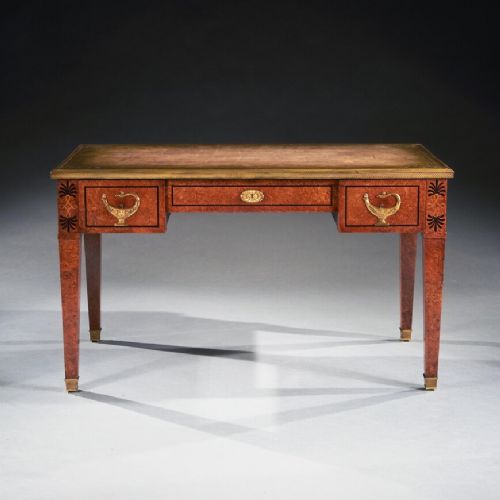
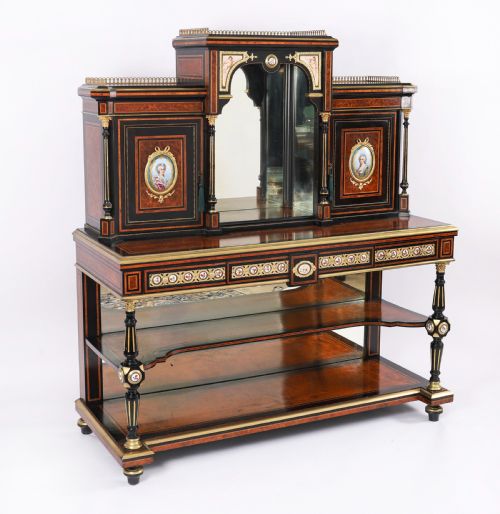


19th Century Amboyna Desk
A 19th century amboyna desk brings rich, mottled exotic grain and superb Victorian cabinet-making directly into a modern study.
19th Century Amboyna Desk
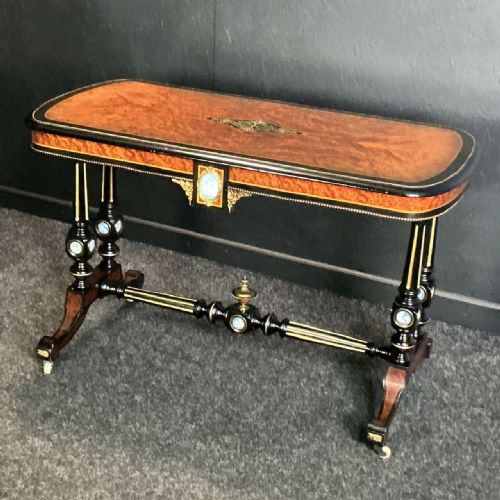
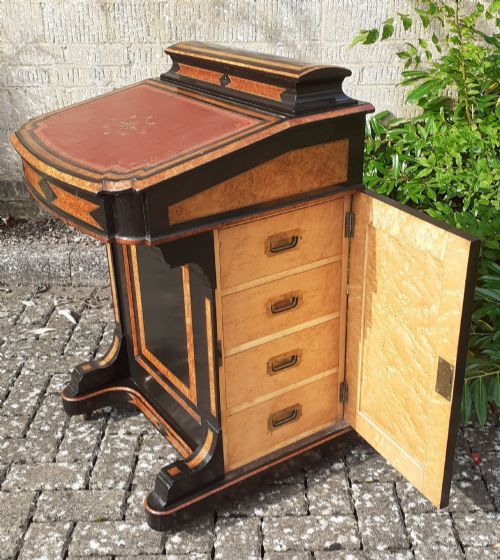
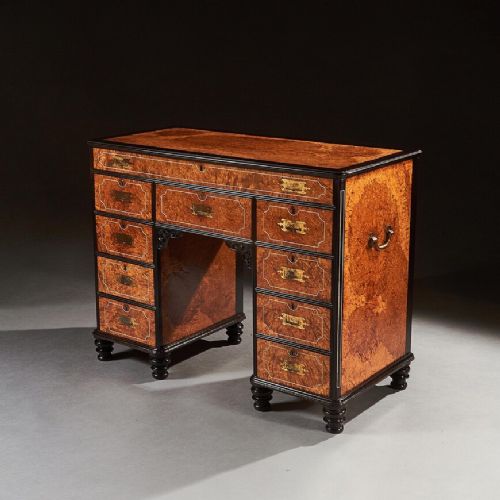
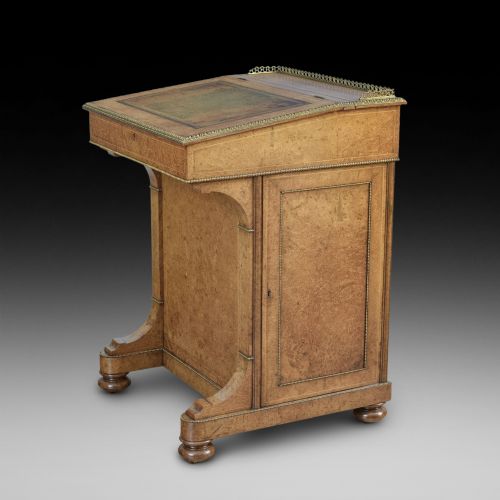
A 19th century amboyna desk encompasses compact Davenport forms, refined bonheur du jour writing cabinets, and grand library tables built during the Victorian era. These pieces showcase the dramatic, swirling pattern of amboyna wood, frequently contrasted with ebony or ebonised wood and highlighted by meticulous brass mounts or porcelain plaques.
The selection ranges from English Regency and Victorian productions to French Napoleon III and Louis XVI Revival pieces, including Chinese Export items. Buyers regularly encounter Davenport desks with side compartments and slope fronts, alongside elaborate lady's writing desks fitted with multiple small drawers and superstructures.
Originating primarily from English and French workshops, these desks served elite domestic spaces for correspondence and private accounts. Their survival in such varied regional styles demonstrates the high esteem in which cabinet-makers held this pale yellow-brown timber throughout the eighteen-hundreds.
Distinguishing quality in craftsmanship
The density and movement of the amboyna burl veneer establish the visual hierarchy of these desks, with tightly figured grain commanding greater visual depth. Master cabinet-makers selected symmetrical burl patterns that flowed seamlessly across opening doors and matching drawers.
Integration of secondary decorative elements separates standard production from exceptional pieces, particularly the inclusion of hand-painted Sevres porcelain plaques or finely chased ormolu mounts. The crispness of the brass stringing and the smoothness of interior mechanism drawers further define workshop status.
Structural integrity relies on the retention of original brass hardware, stable secondary timbers, and well-fitted writing slopes that close flush. Pieces retaining signed maker stamps or documented workshop provenance demonstrate higher execution standards throughout.
Listings feature pieces incorporating amboyna, brass, ormolu, porcelain, ebonised wood, and leather across the Victorian and Regency periods.
Paul Sormani·J and T Scott
The 19th Century Amboyna Desk Glossary
- Bonheur du jour
- A light pedestal desk featuring a small cabinet or superstructure with shelves and drawers above the writing surface. First developed in France, this form became popular in Victorian drawing rooms.
- Davenport desk
- A compact writing desk featuring a sloping, leather-lined lid above a pedestal of side drawers. The form typically incorporates a stationary compartment on top and often includes hinged side wells.
- Ormolu
- Finely chased or sculpted bronze that has been gilded with gold leaf or mercury amalgamation. French cabinet-makers used it extensively to mount and protect the corners of fine writing tables.
- Ebonised wood
- Timber treated with a dark stain or finish to imitate solid ebony. It served as a stark, dark border material to contrast against pale amboyna and satinwood veneers.
19th Century Amboyna Desk: Frequently Asked Questions
What is a Davenport desk?
A Davenport desk is a compact form featuring a sloping writing surface hinged above a pedestal of side drawers. It typically includes a stationery box on top.
Originally designed for yacht use or small drawing rooms, the writing slope lifts to reveal a fitted interior with small pigeonholes and accessory drawers.
How do I care for amboyna wood?
Amboyna requires protection from direct sunlight and dramatic humidity changes to prevent the underlying veneer from lifting or drying out. Dust the surface regularly with a dry, soft cloth.
Apply a microcrystalline wax periodically to nourish the polished finish without sealing moisture into the antique timber.
What is a bonheur du jour?
A bonheur du jour is a light, elegant lady's writing desk featuring a tiered superstructure with small drawers and open shelves above the writing surface.
Introduced in France, these pieces were intended for casual correspondence and display rather than heavy administrative duties.
How do I distinguish French and English desks?
French examples often incorporate heavier ormolu mounts, Sevres porcelain plaques, and lighter secondary woods like satinwood. English desks tend to favour structured mahogany carcases with precise brass stringing.
Regional differences also appear in the internal hardware, drawer construction, and overall silhouette relative to Regency or Victorian design canons.