
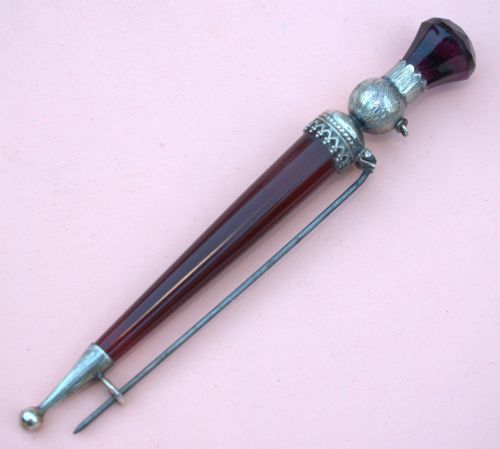


19th Century Agate Brooch
A 19th century agate brooch delivers the tactile weight of Victorian hardstone jewellery, prized for its banded patterns and regional Scottish character.
19th Century Agate Brooch
A 19th century agate brooch brings together banded hardstones, jaspers, and smoky quartz set in silver or gold. You find dirk, kilt pin, and pebble forms originating from the Victorian period, particularly within the Scottish Revival tradition.
Most pieces date from the middle to the late nineteenth century, spanning decades from eighteen fifty-five to eighteen ninety. Scottish designs dominate the selection, alongside continental French gold cameo pieces featuring hardstone and agate mounts.
How they were made
Lapidaries cut and polished natural agate, jasper, and hardstone specimens into precise geometric or figural shapes, displaying the stone's natural concentric banding. These polished hardstones were then mounted securely into silver settings or eighteen-carat gold frames.
Metalworkers utilised traditional techniques to fabricate substantial mountings, incorporating citrines, glass accents, and intricate metalwork to frame the central pebble specimens.
Current listings feature Victorian pieces spanning from eighteen fifty-five to eighteen ninety, incorporating silver, eighteen-carat gold, jasper, and smoky quartz.
What varies in quality
The sophistication of the lapidary work dictates the upper tier, where stones exhibit striking natural colour contrast, flawless high polish, and precise fitting within the metal bezel. Lower grades show duller stone surfaces and simpler, less complex arrangements of the hardstone sections.
Mounting construction also separates standard production from finer output, with heavier silver and eighteen-carat gold settings demonstrating greater durability and more elaborate chasing than lighter frames.
The 19th Century Agate Brooch Glossary
- Agate
- A cryptocrystalline variety of quartz, characterised by its fineness of grain and brightness of colour, displaying distinct natural bands. It formed the primary decorative element for nineteenth-century Scottish pebble jewellery.
- Hardstone
- A general term for semi-precious stones used in carving and jewellery, including jasper, quartz, and agate. These materials were shaped and polished to create durable ornamental brooches.
- Dirk brooch
- A form of fastened jewellery styled after the traditional Scottish dagger, featuring a blade or hilt design executed in silver and set with agate panels. These pieces often doubled as functional kilt pins.
- Victorian Scottish Revival
- A nineteenth-century cultural movement that popularized Celtic motifs, pebble jewellery, and highland weapons rendered in miniature as personal adornment. Queen Victoria's patronage of Balmoral heavily influenced this aesthetic.
19th Century Agate Brooch: Frequently Asked Questions
How do I date an agate brooch?
Dating relies on stylistic markers, metal types, and construction methods characteristic of the Victorian period between eighteen fifty-five and eighteen ninety.
Scottish Revival pieces often correlate with the height of Victorian interest in highland traditions and Balmoral estate culture.
Were these brooches worn daily?
Victorian wearers utilised these sturdy hardstone pieces to fasten heavy wool garments, plaids, and shawls.
The durability of quartz and agate made them suitable for regular fastening tasks while displaying colourful natural mineral patterns.
What metals support the stones?
Maker workshops set these hardstones primarily in silver, alongside occasional examples fashioned in eighteen-carat gold.
Some continental variations pair the agate elements with carved cameo portraits mounted in high-karat gold frames.