


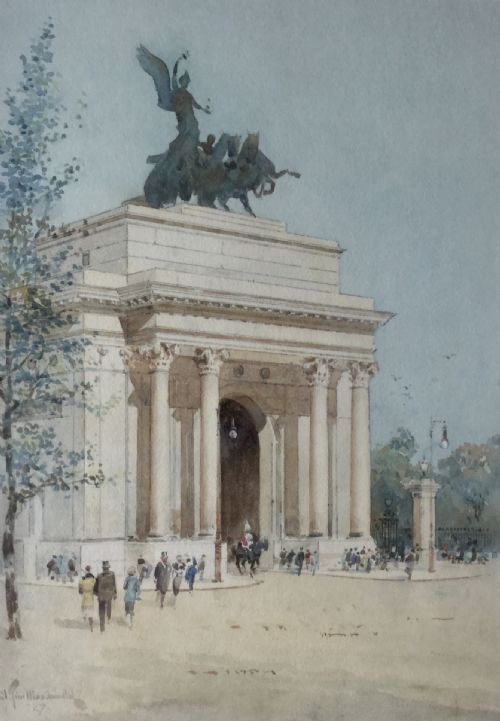


1920s Watercolour Landscape
A 1920s watercolour landscape captures the light and atmosphere of the interwar years through washes of pigment on paper.
1920s Watercolour Landscape
When you search for a 1920s watercolour landscape, you are looking at original paintings on paper executed during the early twentieth century. These works capture countryside vistas, townscapes, and harbour scenes created by British and European artists.
The pieces on this page lean heavily towards early twentieth-century British impressionism, interwar realism, and the 20th Century British School. You will frequently encounter framed watercolour drawings and paintings depicting specific locations such as Lincoln, Corfu, and London.
Subjects range from tranquil cottage gardens and haymaking fields to architectural studies like the Wellington Arch and French village scenes. Each piece offers a direct window into the artistic vision of the period.
Materials and construction
These works rely fundamentally on watercolour pigments applied to paper support, occasionally supplemented with ink or pencil for finer details. Artists utilised fluid washes to capture shifting light and atmospheric conditions in landscape settings.
Finished works are typically housed behind glass within wood or gilt wood frames to protect the delicate paper surface from environmental damage. The combination of traditional paper media and period framing preserves the integrity of the original artwork.
One French village scene was painted by a close confidant of Walter Sickert, bringing a distinct artistic circle straight to the paper.
Factors of quality
Quality in these watercolours rests upon the artist's handling of pigment and the precision of the composition. Stronger works demonstrate confident brushwork and a sophisticated grasp of light, whether depicting a bustling townscape or a quiet rural scene.
The condition of the paper and the integrity of the framing also influence the overall standard of the piece. Well-preserved works retain their original colour intensity and sit securely within period frames without excessive discolouration.
Owen Bowen·Edward Horace Thompson·Edith E Caswall·Fred Lawson·Jane Utley·Maurice Asselin·J Tim Macdonald·George Graham
The 1920s Watercolour Landscape Glossary
- Watercolour
- A painting method in which the paints are made of pigments suspended in a water-based solution. It is traditionally applied to paper to create translucent layers of colour.
- Gilt wood
- Wood that has been treated with a thin layer of gold leaf or gilt paint. This finish was commonly applied to frames to enhance the presentation of the artwork.
- Interwar realism
- An artistic approach prominent between the First and Second World Wars focusing on recognisable scenes depicted with clear observation. It avoids extreme abstraction in favour of tangible subject matter.
- Townscape
- A painting or drawing depicting urban scenery, streets, or architectural landmarks. In this selection, such works often record specific historic locations.
1920s Watercolour Landscape: Frequently Asked Questions
How do I care for a watercolour painting?
Keep the artwork away from direct sunlight to prevent the watercolour pigments from fading over time. Ensure the room humidity remains stable to protect the paper support and the surrounding wooden frame.
Display the piece securely on a wall using appropriate fixings. Professional framing with conservation-grade materials helps safeguard the painting for future years.
Are these watercolours original works?
The listings comprise original paintings and watercolour drawings created by individual artists during the early twentieth century. Each piece is a unique hand-painted item rather than a modern reproduction.
Signatures or inscriptions by the artist often accompany the works, helping to confirm their origin. The visible brushstrokes and paper texture further distinguish these original creations.
What subjects are common in these landscapes?
Common subjects include rural countryside views, agricultural scenes like haymaking, and domestic cottage gardens. Artists also focused heavily on urban environments, recording bridges, harbours, and architectural landmarks.
Geographical settings span British locations such as the Lake District and London, alongside European destinations including Corfu and French villages. This variety reflects the travel and sketching habits of artists of the era.
How are these artworks usually framed?
Most pieces are framed and glazed to protect the vulnerable paper surface from dust and physical contact. The glazing places a clear barrier between the environment and the pigment.
Frames often consist of wood or gilt wood, aligning with early twentieth-century presentation styles. Original framing, where present, complements the aesthetic of the period in which the watercolour was produced.