
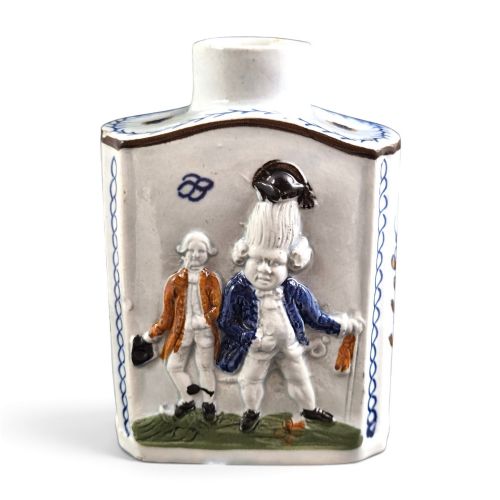


18th Century Pearlware
These 18th century pearlware items are refined earthenware pieces offering a brighter white body than older creamware, highly sought after by collectors of early ceramics.
18th Century Pearlware
When you search for 18th century pearlware, you encounter a refined ceramic body developed in the late Georgian period to rival true porcelain. The pieces you are most likely to meet on this page include jugs, tea caddies, platters, and decorative plates displaying distinct blue and white transfers or hand-painted enamels.
The objects span decorative groups and utilitarian tablewares, originating primarily from Staffordshire potteries and English factories. Forms range from cabbage leaf moulded jugs to blue printed spoon trays and figurative groups.
How they were made
Potters created these items using earthenware bodies covered with a thin lead glaze containing a small amount of cobalt. This addition masked the natural cream colour of the fired clay, producing the characteristic bluish tint pooled in crevices.
Decoration relied on cobalt pigment under the glaze, transfer printing in blue, and enamel glazes applied over the surface for polychrome designs.
The listings span the late 18th century and the year 1800, featuring earthenware, pearlware, and lead glaze.
What varies in quality
Quality rests in the crispness of the moulding and the clarity of the cobalt pigment or transfer print. Stronger pieces show precise details in modelled figures and clean application of the lead glaze without heavy pooling.
Early examples with well-defined painting or intricate cabbage leaf moulding distinguish themselves from simpler utilitarian output.
Ralph Wood·Enoch Wood And Sons·Lakin And Poole·Caughley
The 18th Century Pearlware Glossary
- Pearlware
- A refined earthenware developed in the late 18th century with a slightly bluish glaze. It bridged the gap between creamware and true porcelain.
- Lead Glaze
- A glossy coating containing lead oxide applied to pottery before firing. It provided a smooth waterproof surface for the earthenware body.
- Cobalt Pigment
- A metallic colourant used to produce deep blue designs under the glaze. It withstood high kiln temperatures without fading.
- Enamel Glaze
- Coloured glass powders painted over the fired glaze and fixed in a second, lower-temperature kiln. This technique allowed for vibrant polychrome decoration.
- Cabbage Leaf Moulding
- A raised plant leaf pattern pressed into the clay body of jugs and tableware. It added texture and dimension to functional vessels.
18th Century Pearlware: Frequently Asked Questions
How do I clean 18th century pearlware?
Wash these pieces gently by hand using lukewarm water and a mild detergent. Avoid dishwashers and harsh scrubbers to protect the delicate antique glaze.
Pat them dry immediately with a soft cloth rather than leaving them to air dry.
Are these pieces safe for daily use?
Historical ceramics with lead glazes are generally kept for display rather than food service. Modern acidic foods can react with the old glaze materials.
Enjoy them as decorative objects on tables, shelves, or in cabinets instead.
How can I tell pearlware from creamware?
Look closely at the colour of the glaze, particularly where it pools around handles or bases. Creamware has a warm, buttery yellow tone, whereas pearlware has a distinct bluish hue.
This blue tint comes from the cobalt added to the transparent glaze to mimic Chinese porcelain.
Where were these ceramics made?
Production centred heavily in the Staffordshire potteries of England, alongside regional factories like Caughley. Master potters and modellers shaped the domestic and export markets from these hubs.
Staffordshire remains the primary source for the figures and tableware found today.