



18th Century Corner Chair
An 18th century corner chair offers an ingenious domestic solution, fitting neatly into room angles while providing a sturdy, enveloping seat for writing or conversation.
18th Century Corner Chair
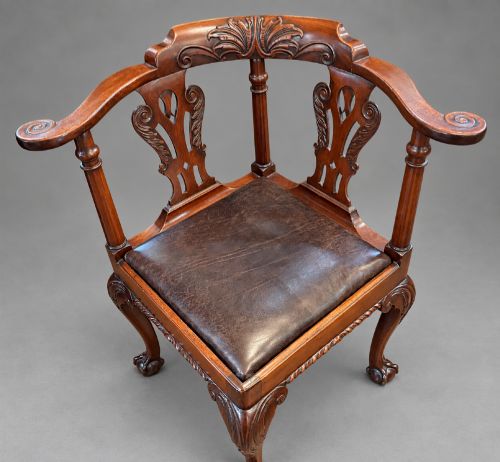
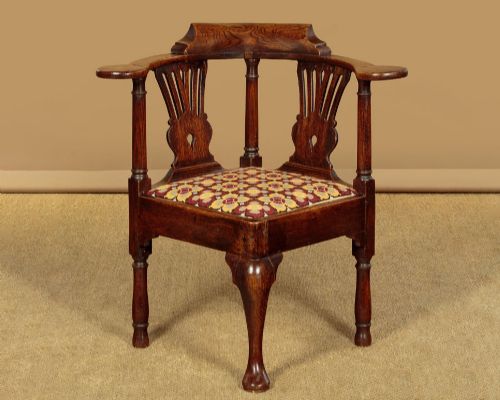
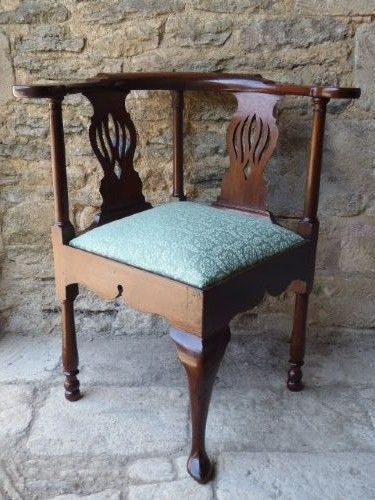
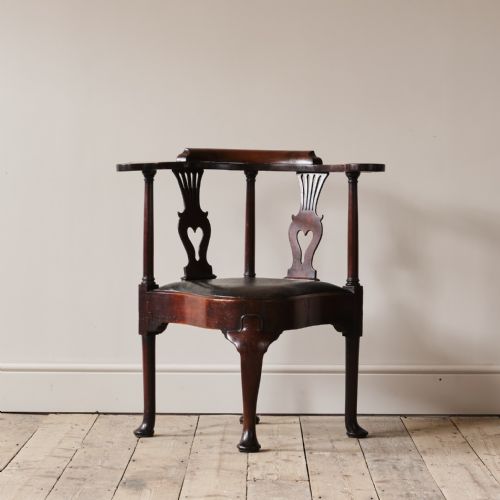
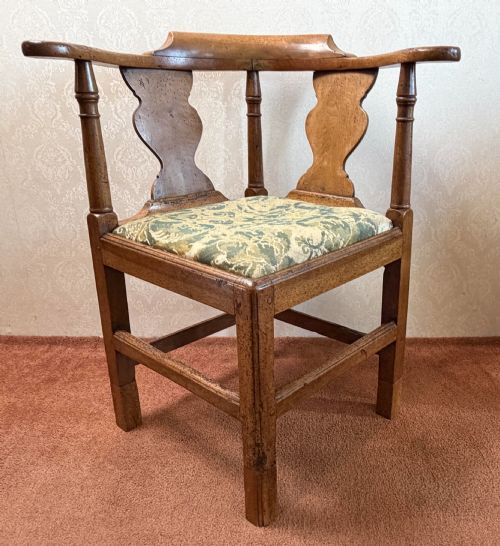
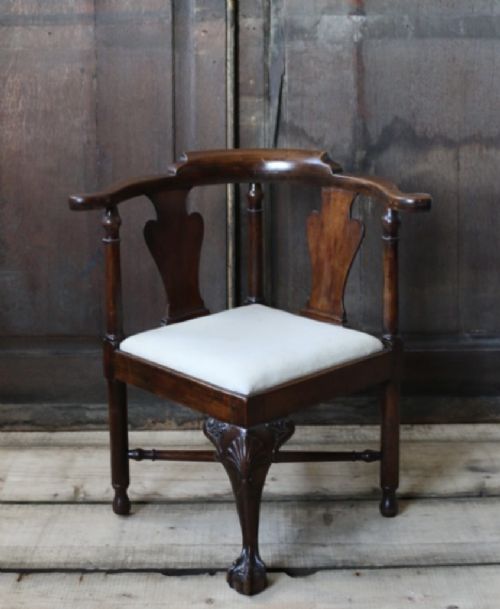
An 18th century corner chair takes the form of a horseshoe-shaped upper rail supported by turned pillars and a central splat, designed specifically to fit into the corner of a room or serve as a writing seat. These pieces emerge primarily from the Georgian era, spanning designs from Queen Anne origins through George II and George III periods.
The selection here ranges from formal mahogany and walnut examples with cabriole legs to robust country versions in oak, elm, and fruitwood. Alongside standard armchairs, buyers encounter specialised variants like desk chairs, children's models, and occasional export pieces.
Makers constructed these seats to maximise interior space without sacrificing comfort, resulting in a distinct diagonal orientation that defines their silhouette. Their survival through the centuries reflects both their practical utility and the enduring appeal of their architectural proportions.
Materials and construction methods
Cabinetmakers relied heavily on dense hardwoods such as mahogany and walnut for formal urban commissions, while rural joiners utilised local timber including oak, elm, and fruitwood. These woods were turned for the upright supports and shaped for the sweeping arm rails.
Seats commonly featured drop-in pads upholstered in fabric, leather, or tapestry, though some country examples retained woven rush surfaces. Joinery relied on mortise and tenon frames to withstand the lateral stresses placed upon the diagonal corner structure.
18th Century Corner Chair Retail Price Guide 2026
Typical asking prices for 18th century corner chair among the pieces listed under this phrase on Sellingantiques today, from the lower quarter to the upper quarter. They describe what is for sale here now, not the wider market.
The inventory records pieces built across the eighteenth century, incorporating walnut, mahogany, oak, elm, and fruitwood alongside rush and tapestry seats.
Distinguishing quality and execution
The distinction between ordinary and superior examples lies in the fluidity of the curves on the back rail and the crispness of the carving on the central splats and leg knees. Finer urban workshops employed more expensive timbers like figured walnut and rich mahogany, whereas provincial pieces show simpler turnings and utilitarian joints.
Proportion and structural integrity dictate long-term value, particularly how well the sweeping upper arms meet the central back pillar. Original drop-in seat frames and untouched surface patination command greater regard from collectors than heavily refinished or structurally altered frames.
The 18th Century Corner Chair Glossary
- Cabriole leg
- A furniture leg that bends outward in a convex curve and tapers inward in a concave curve, ending in a pad or foot. This stylistic element appears frequently on walnut and mahogany examples from the earlier Georgian decades.
- Splatted back
- A vertical wooden slat positioned in the centre of the chair back, often shaped or pierced for decoration. In these seats, multiple splats frequently radiate from the curved top rail toward the seat frame.
- Rush seat
- A seating surface woven from dried marsh grasses or reeds, commonly found on country-made vernacular examples. This traditional method provides a resilient and slightly flexible base.
- Drop-in seat
- A removable wooden frame upholstered separately and dropped into a ledge rebated inside the seat rail. This design allowed for easier reupholstering over generations of domestic use.
- Crest rail
- The uppermost horizontal or curved wooden member of a chair back. On corner seating, this piece forms a continuous semi-circular or horseshoe sweep ending in wooden handholds.
18th Century Corner Chair: Frequently Asked Questions
Where did people put corner chairs?
These pieces were built specifically to tuck into the right-angle intersection of two walls, saving floor space in panelled rooms and parlours.
They also functioned freely as portable writing seats near desks, allowing the sitter to swivel easily within a confined area.
How do I date an 18th century corner chair?
Dating relies on observing the transition of styles, from early Queen Anne and George I walnut pieces with pad feet to later George III mahogany or elm versions with straight pillar legs.
Secondary woods on the frame interior and the wear patterns on the footings also provide reliable clues to the exact decade of manufacture.
Were corner chairs used for writing?
Many examples served a dual purpose as reading and desk chairs, particularly during the middle decades of the eighteenth century when homeowners required compact seating for correspondence.
The wide horseshoe back provided comfortable elbow support while turning towards a writing table positioned in the room.
What is the difference between town and country chairs?
Urban pieces made in city workshops typically featured imported mahogany or walnut, fine cabriole legs, and carved splats intended for formal drawing rooms.
Provincial or country examples utilised local timbers like oak and elm, featuring simpler turned spindles and rush seats suited for everyday domestic utility.