52,387  PAGES BROWSED TODAY PAGES TODAY • 192 ANTIQUES UPLOADED TODAYNEW ARRIVALS
GIFTS
192 ITEMS ADDED TODAY
Sort Order
Items Per Page
Browse Categories
Sort order
Relevant Links
Items per page
ID #SA1244804
FOR SALE
£44,000
Email Phone Buy
Save
17th Century English School - Oil on Canvas Portrait of a Lady Dated 1624
For sale by Period Portraits
for sale €51,480     $55,880
£44,000
Period Portraits

Period Portraits

Sellingantiques Verified Since Jan 2017
Browse dealers 46 items
  • About Us
    Specialist dealer in portraits from the 17th century to the 20th century. Our stock includes quality oil paintings, drawings, and mezzotints
Id #SA1244804
PDF SHARE
SAVE

17th Century English School - Oil on Canvas Portrait of a Lady Dated 1624

17th century
For Sale by Period Portraits
Description

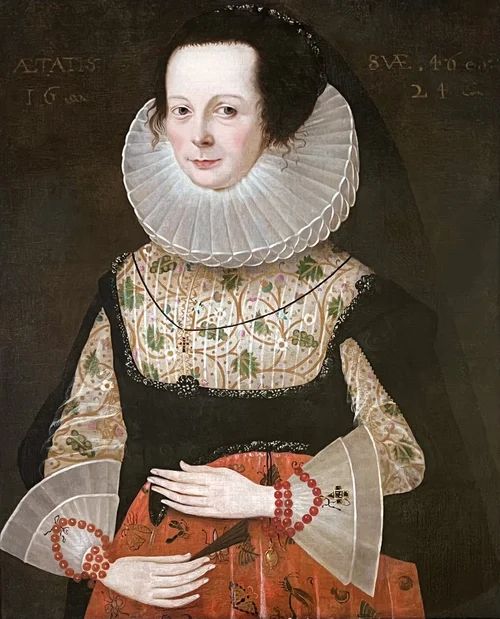
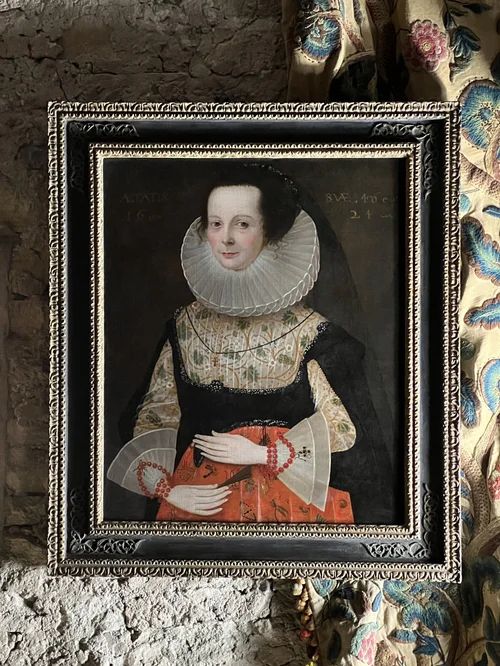
A sumptuous and highly detailed 17th century Jacobean oil on canvas portrait of a lady of significant wealth and status. She wears her finery, reveals her most virtuous characteristics and gazes at us with an air of confidence befitting her 46 years. A latin inscription gives us her age and the date (1624) and conveys with it the notion that the sitter is well read, and both her clothing and deportment tell us that she is well-bred.
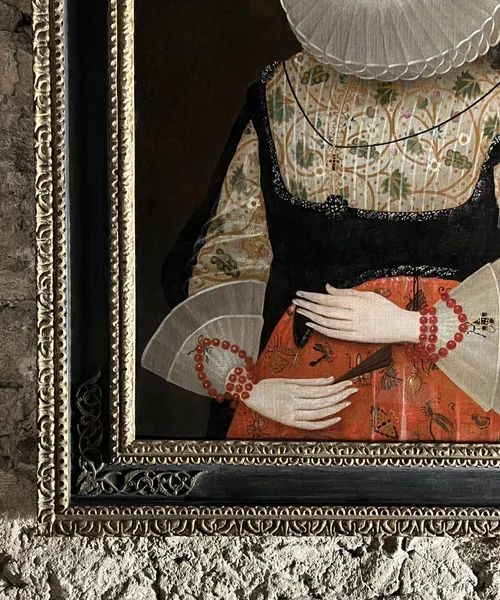
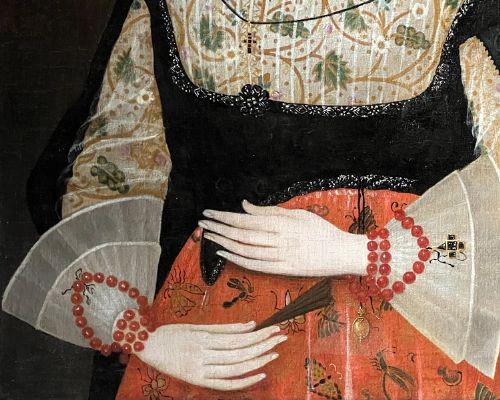
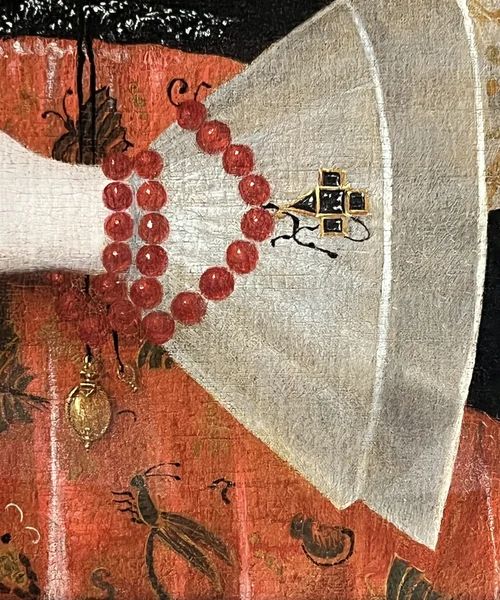
Display is evidently important to this sitter. Her wealth and power are revealed in her choice of colours – red and black were both extremely expensive dyes. Many women would have worn black silk twists of ribbon at the wrist (and perhaps one beaded bracelet) to set off the desired pale complexion. This lady’s show of red beaded bracelets is ostentatious and they would have been heavy and difficult to keep in the desired position. They are secured to stiffened starched linen cuffs with black silk ‘twists’ to decorate and disguise the pin.
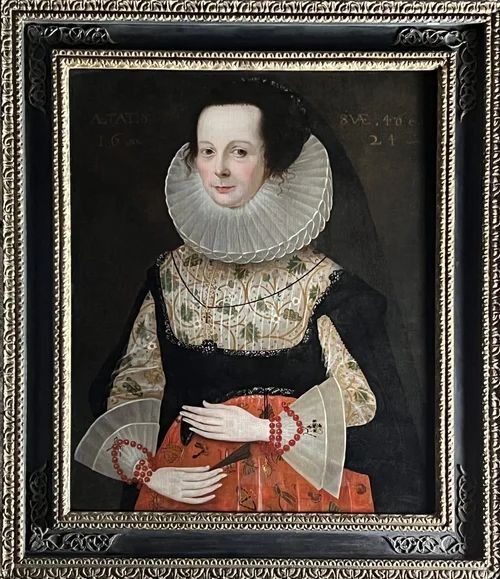
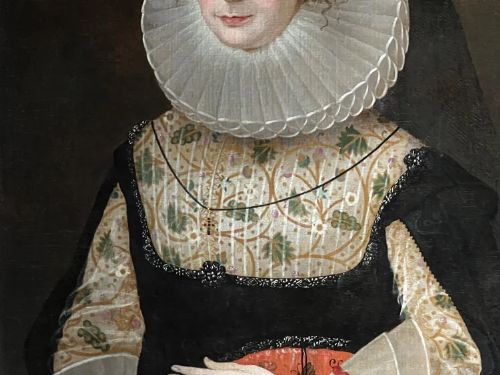
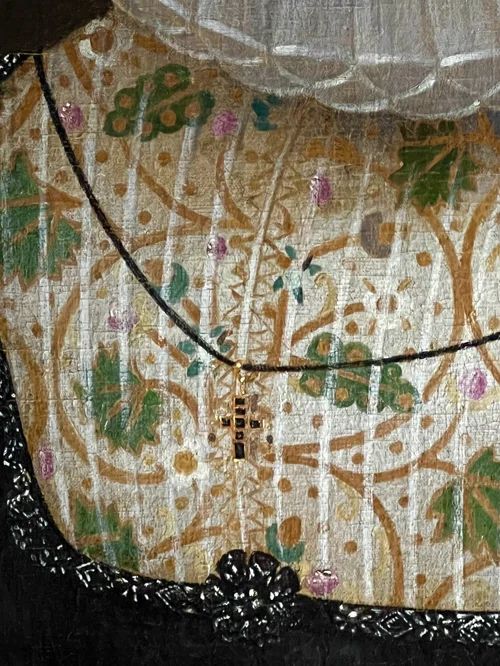
She invites us to admire her piety with a cross-shaped brooch, and perhaps the plainness of her linen (in place of very costly lace). Don’t be fooled however as the black stones that glisten from her wrist are in fact diamonds. With her golden locket, and another diamond cross round her neck, it is clear that she has worldly wealth in abundance.
The fashionable silhouette that she exhibits is consistent with the 1620’s – namely a hairstyle that is broad rather than high, with little straggles of hair – called ‘lovelocks’ spilling onto her ruff. The ruff is full and closed – i.e. not open at the front – and is raised up at the back. This would be supported by a stiffened pasteboard collar called a ‘pickadil’ or ‘underpropper’ or perhaps a wired contraption (a ‘supportasse’) that would keep the starched linen elevated.
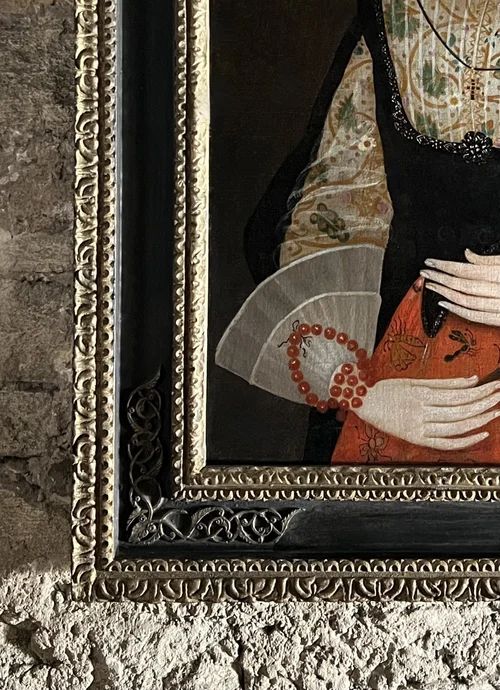
Her natural/high waistline is consistent with this period, as is the amount of wrist showing and the fullness of the sleeves. By the late 1620’s to 1630 sleeves would be full and would have shrunk to reveal the forearm, thus giving poets another area of the body to praise in poetry, and for moralists to condemn as sinfully and shamelessly displayed.
The use of polychrome embroidery - adorning her waistcoat and petticoat - is typical of the Jacobean era (the age of James I (1603-1625). The fashionable silhouette that she exhibits is consistent with the 1620’s – namely a hairstyle that is broad rather than high, with little straggles of hair – called ‘lovelocks’ spilling onto her ruff. The ruff is full and closed – i.e. not open at the front – and is raised up at the back. This would be supported by a stiffened pasteboard collar called a ‘pickadil’ or ‘underpropper’ or perhaps a wired contraption (a ‘supportasse’) that would keep the starched linen elevated.
The most striking feature of the sitters costume is undoubtedly the wealth of embroidery on display . This could have been the work of a professional embroiderer or created by the lady of the house herself as a demonstration of her skills.The polychrome patterns that adorn her high-necked waistcoat had been in fashion since the end of the Elizabethan era. There is a beautifully worked linen waistcoat from the Burrell Collection, Glasgow which exhibits a very similar scrolling pattern of gold, enclosing strawberry flowers and oak leaves. It can also be seen in the remarkable portrait by Marcus Gheerearts the Younger of Margaret Layton in the V&A - where the real jacket worn in the portrait also survives.
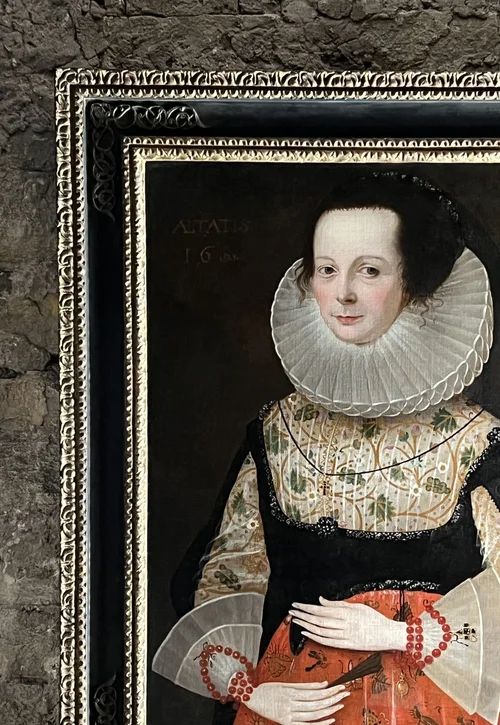
The embroidery in this portrait is more stylised than in the examples cited, but the motifs of oak leaves, acorns, strawberry leaves and flowers are clearly identifiable. Strawberries had been a popular motif since Virginia strawberries had been brought back from the ‘new world’ in the late C16th.The mini-beasts, butterflies and bugs that creep and crawl over her petticoat wo

Date of Manufacture

Period Portraits has dated this Jacobean Female Oil Portrait to the 17th Century.

Physical Dimensions
Height
98cm (38.58")
Width
89cm (35.04")
Depth
3cm (1.18")
Reference Numbers
Sellingantiques Reference
SA1244804
Description
A sumptuous and highly detailed 17th century Jacobean oil on canvas portrait of a lady of significant wealth and status.
“
She wears her finery, reveals her most virtuous characteristics and gazes at us with an air of confidence befitting her 46 years.
Period Portraits

A latin inscription gives us her age and the date (1624) and conveys with it the notion that the sitter is well read, and both her clothing and deportment tell us that she is well-bred.

fig 1. A seventeenth-century oil portrait of a woman wearing a white pleated ruff, patterned dress, and red bead bracelets, set within a carved black and gold frame.
fig 1. 17th Century English School - Oil on Canvas Portrait of a Lady Dated 1624

Display is evidently important to this sitter. Her wealth and power are revealed in her choice of colours – red and black were both extremely expensive dyes. Many women would have worn black silk twists of ribbon at the wrist (and perhaps one beaded bracelet) to set off the desired pale complexion. This lady’s show of red beaded bracelets is ostentatious and they would have been heavy and difficult to keep in the desired position. They are secured to stiffened starched linen cuffs with black silk ‘twists’ to decorate and disguise the pin.

fig 2. A seventeenth-century oil portrait of a woman wearing a white pleated ruff, patterned dress, and red bead bracelets, set within a carved black and gold frame.
fig 2. 17th Century English School - Oil on Canvas Portrait of a Lady Dated 1624

She invites us to admire her piety with a cross-shaped brooch, and perhaps the plainness of her linen (in place of very costly lace). Don’t be fooled however as the black stones that glisten from her wrist are in fact diamonds. With her golden locket, and another diamond cross round her neck, it is clear that she has worldly wealth in abundance.

fig 3. A seventeenth-century oil portrait of a woman wearing a white pleated ruff, patterned dress, and red bead bracelets, set within a carved black and gold frame.
fig 3. 17th Century English School - Oil on Canvas Portrait of a Lady Dated 1624

The fashionable silhouette that she exhibits is consistent with the 1620’s – namely a hairstyle that is broad rather than high, with little straggles of hair – called ‘lovelocks’ spilling onto her ruff. The ruff is full and closed – i.e. not open at the front – and is raised up at the back. This would be supported by a stiffened pasteboard collar called a ‘pickadil’ or ‘underpropper’ or perhaps a wired contraption (a ‘supportasse’) that would keep the starched linen elevated.

fig 4. A seventeenth-century oil portrait of a woman wearing a white pleated ruff, patterned dress, and red bead bracelets, set within a carved black and gold frame.
fig 4. 17th Century English School - Oil on Canvas Portrait of a Lady Dated 1624

Her natural/high waistline is consistent with this period, as is the amount of wrist showing and the fullness of the sleeves. By the late 1620’s to 1630 sleeves would be full and would have shrunk to reveal the forearm, thus giving poets another area of the body to praise in poetry, and for moralists to condemn as sinfully and shamelessly displayed.

fig 5. A seventeenth-century oil portrait of a woman wearing a white pleated ruff, patterned dress, and red bead bracelets, set within a carved black and gold frame.
fig 5. 17th Century English School - Oil on Canvas Portrait of a Lady Dated 1624

The use of polychrome embroidery - adorning her waistcoat and petticoat - is typical of the Jacobean era (the age of James I (1603-1625). The fashionable silhouette that she exhibits is consistent with the 1620’s – namely a hairstyle that is broad rather than high, with little straggles of hair – called ‘lovelocks’ spilling onto her ruff. The ruff is full and closed – i.e. not open at the front – and is raised up at the back. This would be supported by a stiffened pasteboard collar called a ‘pickadil’ or ‘underpropper’ or perhaps a wired contraption (a ‘supportasse’) that would keep the starched linen elevated.

fig 6. A seventeenth-century oil portrait of a woman wearing a white pleated ruff, patterned dress, and red bead bracelets, set within a carved black and gold frame.
fig 6. 17th Century English School - Oil on Canvas Portrait of a Lady Dated 1624

The most striking feature of the sitters costume is undoubtedly the wealth of embroidery on display . This could have been the work of a professional embroiderer or created by the lady of the house herself as a demonstration of her skills.The polychrome patterns that adorn her high-necked waistcoat had been in fashion since the end of the Elizabethan era. There is a beautifully worked linen waistcoat from the Burrell Collection, Glasgow which exhibits a very similar scrolling pattern of gold, enclosing strawberry flowers and oak leaves. It can also be seen in the remarkable portrait by Marcus Gheerearts the Younger of Margaret Layton in the V&A - where the real jacket worn in the portrait also survives.

fig 7. A seventeenth-century oil portrait of a woman wearing a white pleated ruff, patterned dress, and red bead bracelets, set within a carved black and gold frame.
fig 7. 17th Century English School - Oil on Canvas Portrait of a Lady Dated 1624

The embroidery in this portrait is more stylised than in the examples cited, but the motifs of oak leaves, acorns, strawberry leaves and flowers are clearly identifiable. Strawberries had been a popular motif since Virginia strawberries had been brought back from the ‘new world’ in the late C16th.The mini-beasts, butterflies and bugs that creep and crawl over her petticoat wo

Date of Manufacture

Period Portraits has dated this Jacobean Female Oil Portrait to the 17th Century.

Height
98cm (38.58")
Width
89cm (35.04")
Depth
3cm (1.18")
Reference Numbers
Sellingantiques Ref
SA1244804
Period Portraits
Period Portraits
Sellingantiques verified Since Jan 2017

Specialist dealer in portraits from the 17th century to the 20th century. Our stock includes quality oil paintings, drawings, and mezzotints

Dealer Profile

You can view the stock and full dealer information on the Period Portraits Profile Page
PDF SHARE
SAVE
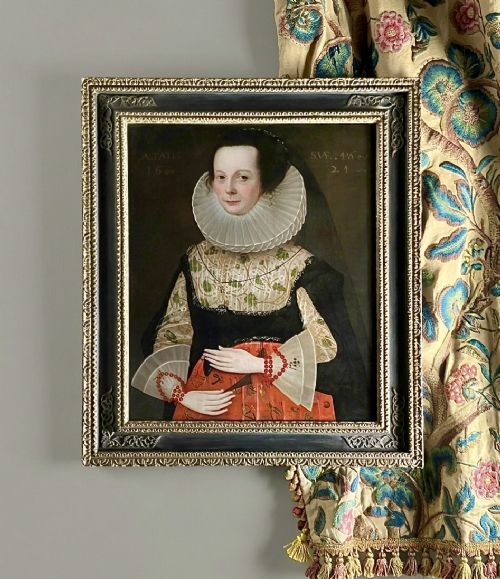
A seventeenth-century oil portrait of a woman wearing a white pleated ruff, patterned dress, and red bead bracelets, set within a carved black and gold frame.
1 / 12
Archive I A seventeenth-century oil portrait of a woman wearing a white pleated ruff, patterned dress, and red bead bracelets, set within a carved black and gold frame.

17th Century English School - Oil on Canvas Portrait of a Lady Dated 1624
Archive II A seventeenth-century oil portrait of a woman wearing a white pleated ruff, patterned dress, and red bead bracelets, set within a carved black and gold frame. View II
Archive III A seventeenth-century oil portrait of a woman wearing a white pleated ruff, patterned dress, and red bead bracelets, set within a carved black and gold frame. View III
Archive IV A seventeenth-century oil portrait of a woman wearing a white pleated ruff, patterned dress, and red bead bracelets, set within a carved black and gold frame. View IV
Archive V A seventeenth-century oil portrait of a woman wearing a white pleated ruff, patterned dress, and red bead bracelets, set within a carved black and gold frame. View V
Archive VI A seventeenth-century oil portrait of a woman wearing a white pleated ruff, patterned dress, and red bead bracelets, set within a carved black and gold frame. View VI
Archive VII A seventeenth-century oil portrait of a woman wearing a white pleated ruff, patterned dress, and red bead bracelets, set within a carved black and gold frame. View VII
Archive VIII A seventeenth-century oil portrait of a woman wearing a white pleated ruff, patterned dress, and red bead bracelets, set within a carved black and gold frame. View VIII
Archive IX A seventeenth-century oil portrait of a woman wearing a white pleated ruff, patterned dress, and red bead bracelets, set within a carved black and gold frame. View IX
Archive X A seventeenth-century oil portrait of a woman wearing a white pleated ruff, patterned dress, and red bead bracelets, set within a carved black and gold frame. View X
Archive XI A seventeenth-century oil portrait of a woman wearing a white pleated ruff, patterned dress, and red bead bracelets, set within a carved black and gold frame. View XI
Archive XII A seventeenth-century oil portrait of a woman wearing a white pleated ruff, patterned dress, and red bead bracelets, set within a carved black and gold frame. View XII
Enlarged Archival View
Telephone 07889 859729
Location
North Yorkshire
United Kingdom
Verified Since Jan 2017
Items For Sale 46
Items Sold 66
Period Portraits
Period Portraits
Verified Since Jan 2017
View Dealer Info
Location: North Yorkshire, United Kingdom
Verified
Jan 2017
For Sale
46
Sold
66
A seventeenth-century oil portrait of a woman wearing a white pleated ruff, patterned dress, and red bead bracelets, set within a carved black and gold frame.
17TH CENTURY ENGLISH SCHOOL - OIL ON CANVAS PORTRAIT OF A LADY DATED 1624
Ref: SA1244804
A seventeenth-century oil portrait of a woman wearing a white pleated ruff, patterned dress, and red bead bracelets, set within a carved black and gold frame.
Detail View 1
Detail View 2
Detail View 3
Detail View 4
Detail View 5
Detail View 6
Detail View 7
Detail View 8
Detail View 9
Detail View 10
Detail View 11
Archival Detail
Every single antique dealer on our platform is individually approved by our internal team. We verify their professional trade history, ethical standards, and photographic quality to ensure a secure, high-standard buying environment. Upon joining, every dealer agrees to a strict 9-point code of conduct. While issues can occasionally arise, our dealers typically resolve them swiftly and directly with the buyer. In fact, since our founding in 2002, Sellingantiques has only had to step in to help resolve an issue on roughly five occasions—a true testament to the quality of our dealers and their dedication to your happiness.
Our dealers are highly experienced in packing and shipping fragile, high-value antiques. Because you are in direct contact with the dealer, you will be able to easily go through all available shipping and insurance options together to ensure your item arrives safely.
Antiques are the ultimate green purchase. By choosing historical pieces over newly manufactured goods, you completely eliminate the carbon footprint of modern mass production while preserving exceptional, timeless craftsmanship.
Written by Sellingantiques from the dealer’s photographs and listing
  • ObjectOil Paintings
  • Period17th century
  • StyleJacobean
  • MaterialOil on Canvas, Gilt Wood
  • ColourBlack and Cream
  • MotifsPleated ruff collar, Latin inscription, Embroidered stomacher, Lace cuffs
  • SizeH 98 cm (39 in) x W 89 cm (35 in) x D 3 cm (1 in)

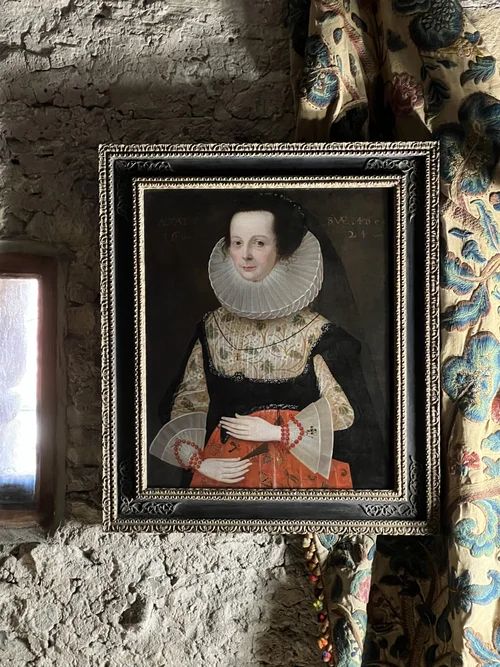
This seventeenth-century Jacobean oil on canvas portrait depicts a seated lady wearing an embroidered stomacher, pleated ruff collar, and lace cuffs. Dated 1624, the painting includes a Latin inscription and is set within a carved black and gold frame with beaded gilt mouldings. The palette comprises black, cream, red, and dark green tones, complemented by visible wear on the painted canvas surface and frame edges. The physical dimensions measure 98 cm high, 89 cm wide, and 3 cm deep. Positioned above the mantel in a traditional English country house interior, the piece hangs securely on a wall to serve as a focal point in a living room, hallway, or study. Lighting positioned above or beside the canvas illuminates the dark background and enhances the gilded details of the heavy wooden moulding.

Early 17th-century English portraiture, spanning the Jacobean and Caroline eras, is noted for its formal compositions, detailed costume depictions, and emphasis on social status through attire like ruffs and lace.

Artists during this period primarily used oil paints ground from natural pigments, applied to hand-stretched linen canvas or solid timber wood panels.

Authenticity is identified by characteristic craquelure patterns across the paint surface, period-appropriate stretcher construction, natural paint age, and historical inscriptions such as Latin age designations.

A historic portrait can serve as a focal point when hung against neutral wall tones or integrated alongside contemporary artwork within a curated gallery wall.

Keep the canvas positioned away from direct sunlight and heat sources, maintain stable relative humidity, and dust gently using a dry, soft brush without applying liquid cleaners.
items
Add keywords to the filter
Price
£100
£250000
Era
Period
Style
Material
Origin
Stock Location
Recently Added
Online Payments
Categories