
A 2026 Guide by Sellingantiques
Godparents often presented these small mugs during the baptism ceremony. It stems from the older custom of giving a silver spoon.
Wealthier families favoured solid silver for antique christening cups. Poorer households relied on pewter or ceramics.
Look at sixteenth-century records. You will find mention of small silver cups given to infants. The shape evolved from earlier adult tankards.
Victorian examples turn up frequently. The middle classes expanded rapidly during the nineteenth century, creating a larger market for baptismal gifts.
Engraving the child's initials and birth date became standard practice later on. Early pieces were sometimes left plain or bore the sponsor's crest.
Hester Bateman produced plain, elegant silver cups during the late eighteenth century. Her workshop stamped thousands of small domestic items.
Search the hallmarks for Charles Stuart Harris. He ran a large London workshop supplying heavy, ornate Victorian examples to retailers.
Provincial silversmiths also took orders for antique christening cups. Pieces from Exeter or Newcastle assay offices turn up occasionally.
The 2026 retail price guide for Antique Christening Cups is drawn from a proprietary archive of over 1.1 million retail prices indexed by Sellingantiques since 2003. This guide relies exclusively on their own internal data; no external sources or auction records are used.
Analysing nearly 25 years of UK antique market history alongside current retail values, the data indicates that typical UK retail prices for Antique Christening Cups range between £200 and £600. Entry-level prices generally fall under £200 and premium examples upwards of £600.
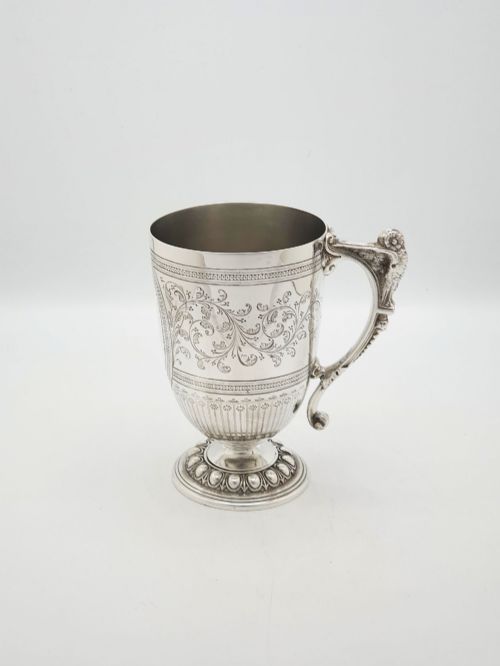
A single loop handle is standard. It needs to accommodate small fingers learning to grip.
The body often features repoussé work or flat chasing. Floral motifs and scrolls feature heavily on nineteenth-century pieces.
Rolled rims provide a smooth edge for drinking. The base is usually flared or stepped to stop the cup tipping over easily.
Early silversmiths raised the main body from a single flat sheet of metal. They hammered it over an anvil until the shape formed.
Casting was used for handles and heavier foot rings. The parts were joined using silver solder before final polishing.
Industrial advances changed production. Later Victorian factories spun silver sheets on a lathe to create antique christening cups faster.
"They were designed for daily use. Children actually drank their milk or watered wine from them during early meals."
"Some Georgian examples double as standard half-pint measures. The capacity was highly practical for the household once the child grew up."
"You can trace entire family trees through certain cups. Multiple names and dates were sometimes added as the piece passed down generations."
Based on almost 25 years of Sellingantiques UK antique market data, Antique Christening Cups appeared 263 times (out of 1,100,000 antiques) which gives it a rarity score of 95/100.
This score measures scarcity within the Sellingantiques archive only and is not a survey of the entire antiques market, so these statistics may not be indicative of the general availability of Antique Christening Cups elsewhere.
Yes, they can. Most antique christening cups were made for practical use rather than just display. The smooth rolled rims are quite safe for drinking.
It is best to wash them by hand. Modern dishwashers will damage the silver surface and strip away any remaining interior gilding.
Removing old initials involves polishing away a layer of the silver. Depending on how deep the original engraving sits, this can leave the metal dangerously thin.
Some old cups have already had names erased in the past. If the cartouche flexes easily under your thumb, the metal is too weak to withstand another erasure.
Many people choose to leave the historic initials intact. You can simply have the new name and date engraved on the other side or underneath the base.
The gold layer is called gilding. Silversmiths applied it to stop the silver from reacting with whatever liquid the cup held.
Fruit juices and some drinks contain acids that can tarnish silver quickly and leave a metallic taste. The gold wash prevents this reaction.
Standard commercial silver polish is usually fine for bringing back a black piece. You just need to work gently. Heavy rubbing can wear down the delicate chased patterns.
Once the thick black tarnish is gone, try to polish it as rarely as possible. Regular light dusting with a soft silver cloth will keep it bright without wearing away the surface.
Please note: This Antique Christening Cups guide and its associated pricing data are provided for general informational purposes only. It does not constitute formal financial, investment, or appraisal advice and should not be relied upon as the sole basis for any commercial activity, purchasing, or sales decisions. Sellingantiques.co.uk accepts no liability for any actions taken in reliance on this information. Always consult with a qualified professional or independent appraiser.
