

Antique Christening Cups
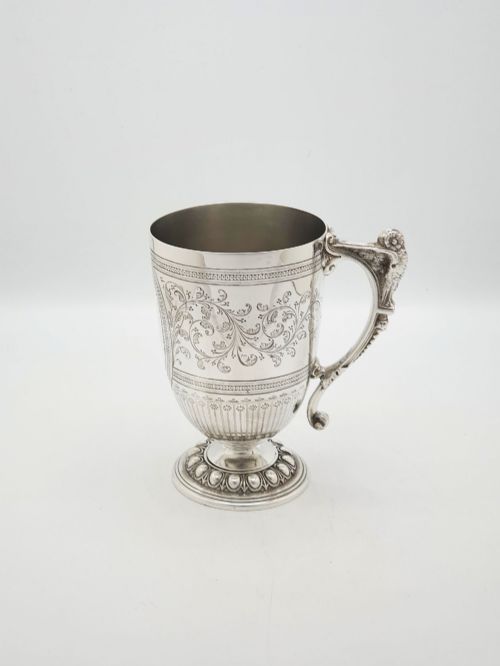
A small single-handled silver cup, given to a child at baptism and often engraved with a name or initials.
Antique Christening Cups
Small drinking vessels with one side handle, sized to hold in one hand. The custom of giving a handled cup at baptism was well established in Britain by the 18th century and at its most widespread in the 19th, when silver examples were made in quantity as a standard gift.
The form you are most likely to meet is a silver christening mug of the second half of the 19th century. Of the four listings behind this guide, three are Victorian or later, and three describe the piece in sterling or solid silver. The fourth is silver plated.
Naming is fluid. Three of the four titles use two words for the same object at once, mug and cup, or mug and tankard, so a taller form with a single handle may be searched under any of them. Alongside the Victorian mugs sit a George III solid silver mug and an Edwardian plated tankard of about 1905 with a handle modelled as an owl.
Dates in titles tend to be firmer than the period labels. London 1876 and 1893 come from an assay date letter; "Georgian" and "Victorian" on their own carry no year. Four dealers have listed one each on Sellingantiques, so the category arrives a piece at a time.
Where Value Sits
Metal does most of the work. Hallmarked silver sits above plate, and the one silver-plated piece in this evidence sits at the bottom of the range while the sterling and solid silver mugs sit above it. Plate has a base-metal body under a thin silver surface and carries no hallmark.
After that, age. The George III mug is the earliest piece here and sits above the Victorian and Edwardian ones. Information counts too: a title that carries an assay office, a year and a maker's name says more than one offering a reign or a period label alone, and only one title in this small group manages all three.
Novelty works sideways rather than upward. The owl handle on the Edwardian tankard is the only figural element anywhere in this evidence, and it marks the piece out as a different thing to look for rather than lifting it above hallmarked silver.
Antique Christening Cups Retail Price Guide 2026
Typical UK retail prices for christening cups, calculated from the Sellingantiques database of over a million retail prices indexed since 2003. This retail price guide relies exclusively on Sellingantiques data; no external sources or auction records are used, so the figures do not describe the wider market.
On this evidence roughly one christening cup a year comes to market on Sellingantiques, so they arrive one piece at a time rather than in runs.
The Antique Christening Cups Glossary
- Christening mug
- A small single-handled cup given as a baptism gift, and the usual name in these titles.
- Sterling silver
- The British standard of 925 parts per thousand, named in two of the four titles.
- Solid silver
- Dealer shorthand for hallmarked silver as against plate.
- Silver plated
- A base-metal body under a thin silver surface, with no hallmark.
- Assay year
- The date letter in a hallmark, which is where the 1876 and 1893 in these titles come from.
- Tankard
- Used loosely for a taller mug form with a single handle.
Antique Christening Cups: Frequently Asked Questions
What is a christening cup?
A small drinking vessel with a single side handle, given to a child at baptism. The custom was established in Britain by the 18th century and most widespread in the 19th.
Examples were often engraved with the child's name or initials.
Are they always silver?
Not always. Three of the four listings behind this guide are described as sterling or solid silver, and the fourth is silver plated.
Plate has a base-metal body under a thin silver surface and carries no hallmark, so it sits at the bottom of the range.
Why do titles call the same thing a mug and a cup?
Because dealers hedge their search terms. Three of the four titles use two names at once, mug and cup, or mug and tankard.
The object is the same: a small handled vessel. "Tankard" tends to signal a taller form.
How old are the ones that come up?
The span in this evidence runs from a George III solid silver mug at the earliest to an Edwardian plated tankard of about 1905 at the latest.
Between them sit Victorian silver mugs, including one assayed in London in 1876 and one of 1893.
Which assay offices appear on them?
London is the only office named anywhere in these titles, on the mug of 1876.
With four pieces in the evidence, that says more about the size of the sample than about where christening mugs were made.
Do figural handles turn up?
Once, in this evidence. The Edwardian silver-plated tankard of about 1905 has its handle modelled as an owl.
It is the only figural element in the group, and it marks the piece out rather than raising it above the hallmarked silver.