



Antique Stirrup Cups
A stirrup cup is a small handleless, footless drinking cup, made to be handed up to a rider, drained in the saddle and passed straight back.
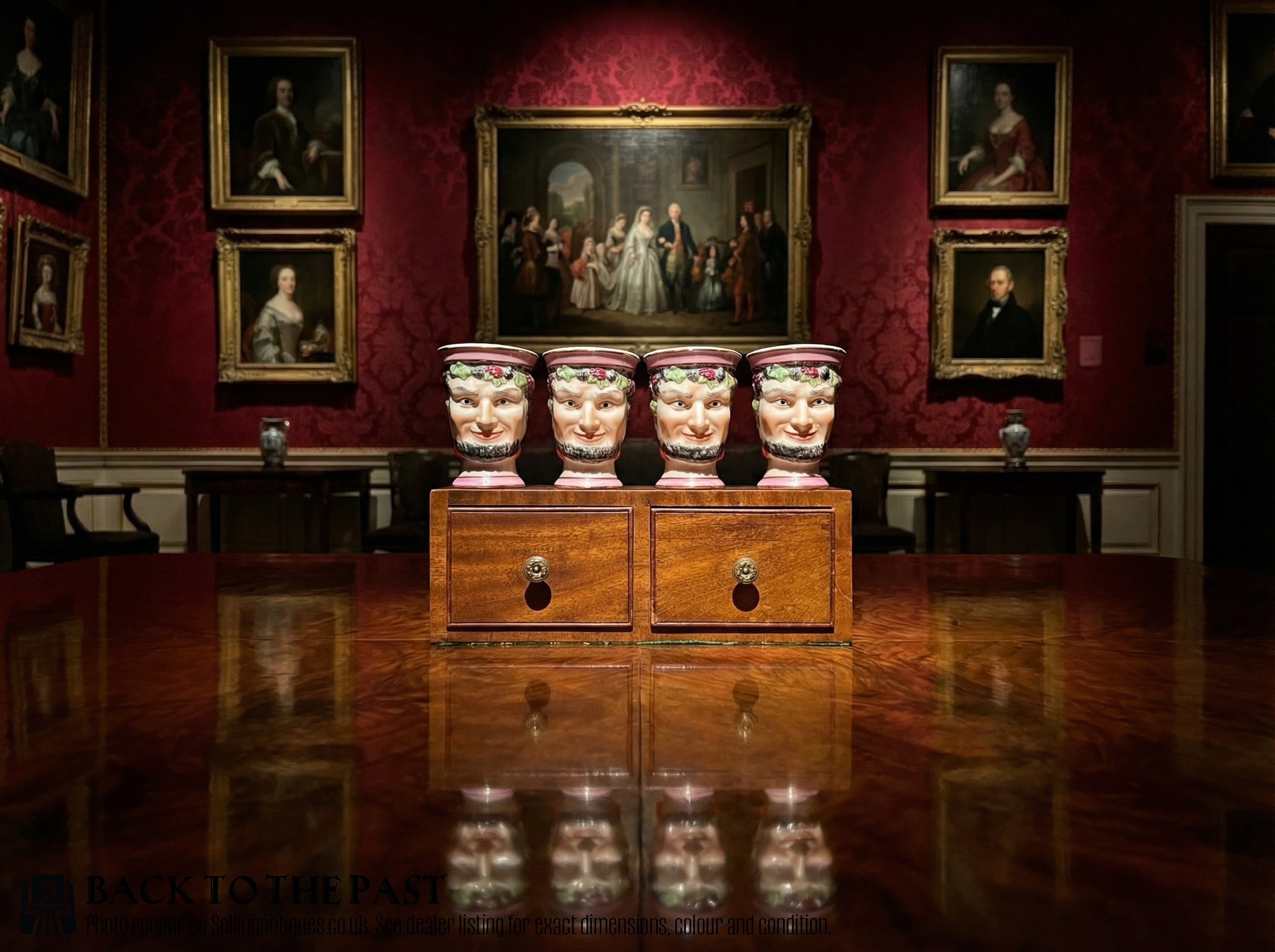
Antique Stirrup Cups
The form became recognisable in Britain during the eighteenth and nineteenth centuries, in ceramic and in metal. Because there is no handle and no foot, the cup can't be set down, which is the whole point of it: it goes up to the mounted rider and comes back empty.
On Sellingantiques the recorded examples are all English and all ceramic. Porcelain in two, Yorkshire Prattware in one, Staffordshire in two of the titles. No silver, glass, horn or Continental piece appears in the archive at all, so a buyer working this corner is looking at pottery and porcelain rather than plate.
Two of the four are modelled as heads rather than made as plain-walled cups: a fox mask, and a pair of Bacchus and satyr wine cups. The fox head is the best-known figural type, and it is also the earliest here at c.1815. The other two are plainer vessels, one of them carrying the named pottery subject 'Vicar & Moses'.
Dating is loose. Three of the four titles use circa, and two of the dealer period fields say no more than '19th Century', with the rest given as Regency and Victorian. Nothing eighteenth-century and nothing after about 1870 has been recorded. Roughly one a year is listed, spread across four different dealers.
Where Value Sits
Modelling does the most work. The top of the recorded range is a modelled animal head rather than a plain cup, and the shape of the vessel is the decoration. Plain-walled cups sit lower, though a modelled subject alone doesn't guarantee it: the c.1870 Bacchus and satyr pair sits at the bottom of the four.
Date pulls in the expected direction. The Regency piece at c.1815 tops the range and the Victorian pair at c.1870 closes it, so within a narrow nineteenth-century window the earlier end is the stronger one.
A recognised subject and a suggested factory both lift a listing. The Prattware cup with the named 'Vicar & Moses' subject sits second of the four, and the highest piece carries a hedged porcelain attribution rather than a mark, while a lower one leans on Royal Staffordshire in the title.
Antique Stirrup Cups Retail Price Guide 2026
Typical UK retail prices for stirrup cups, calculated from the Sellingantiques database of over a million retail prices indexed since 2003. This retail price guide relies exclusively on Sellingantiques data; no external sources or auction records are used, so the figures do not describe the wider market.
Stirrup cups have been listed on Sellingantiques since 2022.
The Antique Stirrup Cups Glossary
- Stirrup cup
- A small cup with no handle and no foot, meant to be drained in the saddle and handed back to the servant.
- Circa (c.)
- An approximate date. Three of the four titles in this archive use it, so read the year as a bracket rather than a fixed point.
- Staffordshire
- The English pottery district. In titles it works as a place of making, not the name of a firm.
- Prattware
- Late-Georgian English earthenware painted in a limited palette of high-temperature colours; the one example here is Yorkshire.
- Fox head
- A cup modelled as an animal mask. The best-known figural type and one of the four recorded pieces.
- Vicar & Moses
- A named Staffordshire and Yorkshire pottery subject, appearing once in this archive on a Prattware cup.
Antique Stirrup Cups: Frequently Asked Questions
Why do stirrup cups have no handle or foot?
The cup was handed up to someone already mounted, drained, and passed back down. With no foot it can't stand on a table, so it has to stay in a hand until it's empty.
That design is what ties the form to the hunt, traditionally a drink before riding out.
Are stirrup cups usually silver?
Silver and other metals were used for the form in Britain generally, but not in what has been recorded on Sellingantiques. Every example listed there is English ceramic.
That means porcelain and earthenware, including Prattware and pieces titled as Staffordshire. No glass or horn appears either.
What period do these cups date from?
All four recorded pieces are nineteenth-century English, running from about 1815 to about 1870. Nothing earlier and nothing later has come through.
The labels used are Regency for the earliest and Victorian for the latest, with two listings dated no more precisely than '19th Century'.
How common are they on the market?
Thin. About one a year is listed on Sellingantiques, which makes it one of the quietest corners of the cups category.
Four dealers account for the four recorded listings, so no single seller holds this ground.
Which figural models turn up?
Two of the four are modelled as heads. One is a fox mask in porcelain, dated c.1815, and the other is a pair of Bacchus and satyr wine cups from around 1870.
The fox head is the type most people picture when the form is mentioned. The remaining two are plainer cups.
Does an attribution appear on these pieces?
Attribution here tends to be suggested rather than marked. The highest-priced piece in the archive carries a hedged porcelain factory attribution in its description.
One of the lower listings leans on Royal Staffordshire in its title instead, and Staffordshire or Yorkshire is used elsewhere as a place of making.