



Antique Chocolate Cups
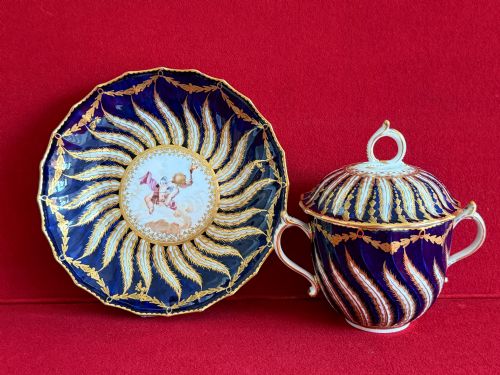
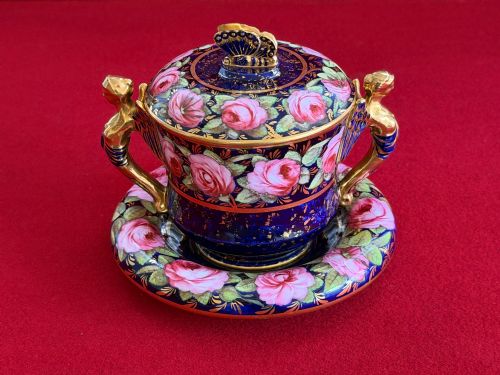
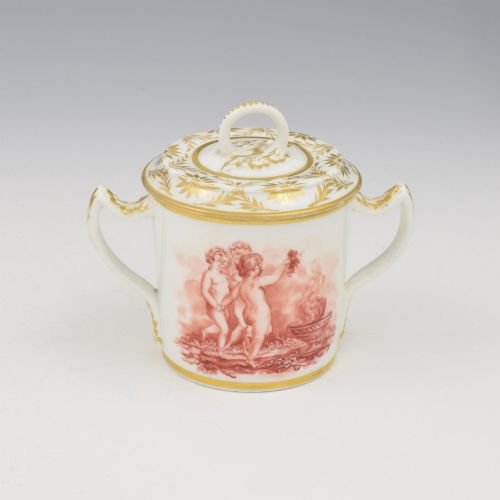
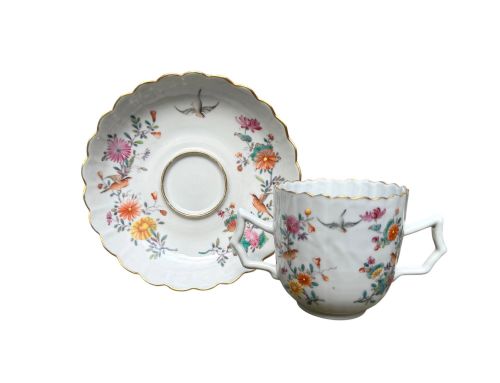
A chocolate cup is a deep, usually two-handled porcelain cup, commonly with a fitted cover and its own stand, made for the thick hot drink that reached European tables in the 17th century.
Antique Chocolate Cups
Drinking chocolate arrived in Europe in the 17th century, and by the 18th the vessel had settled into a recognisable shape: a deep, straight-sided cup, a handle at either side, a cover to hold the heat in, and a saucer or stand beneath. English and Continental porcelain factories made the form through the 18th and 19th centuries.
What you will meet on Sellingantiques is nearly always porcelain. Sixteen of twenty-three titles say the word outright and the rest are ceramic too. The set rather than the bare cup is the norm here: nine titles carry a cover and eight a stand, with saucer standing in for stand in several others.
Roughly half the archive is English factory work, with Worcester, Derby, Spode, Coalport and Minton all appearing. German and Austrian porcelain makes up about a third, from Vienna, Dresden, Meissen and Berlin. Two listings sit outside that: a Chinese famille rose cup and stand of about 1750, and a Russian cup, cover and stand of about 1890.
Dating is broad rather than exact. Twenty-one listings carry a period, the 18th century leading with eight and the 19th following with four, while Georgian, Regency and Victorian overlap the same span. Only one listing in the whole archive gives a clean year, 1880; everything else is a circa date or a band such as c.1780-1820.
The Range
Completeness does most of the work. A cup with both its cover and its stand sits at the top of the range, and titles naming all three cluster there. Bare cups, with neither lid nor dish, sit at the bottom. Since the set is the norm in this category, a single cup is the exception.
A named factory pushes a listing upward, and almost everything here carries one. Even the two cheapest name Coalport and Minton, while the upper end runs through Berlin, Royal Vienna, Worcester, Grainger's and KPM. Age works the same way: the 18th-century group, roughly c.1750 to c.1780, occupies much of the upper half, and the 1880s and 1890s examples sit mid-range.
Then decoration. Allegorical woodland scenes, harbour views with puce chinoiserie, sepia putti and flower-encrusted bodies turn up on the dearer pieces, while a plain pattern number marks the cheapest. The trembleuse stand, with its gallery gripping the cup's foot, appears three times and all three sit in the upper half.
Antique Chocolate Cups Retail Price Guide 2026
Typical UK retail prices for chocolate cups, calculated from the Sellingantiques database of over a million retail prices indexed since 2003. This retail price guide relies exclusively on Sellingantiques data; no external sources or auction records are used, so the figures do not describe the wider market.
18th Century is the period label used most on Sellingantiques for chocolate cups, with 19th Century next and Regency third.
The Antique Chocolate Cups Glossary
- Cover
- The fitted lid that kept the thick drink hot. Nine of twenty-three titles carry one, and its presence is part of what makes a set complete.
- Stand
- The dish the cup sits in, named in eight titles. Some dealers call it a saucer instead, and the two words do the same job here.
- Trembleuse
- A stand with a raised well or gallery that grips the cup's foot and steadies it. Three listings use the word, one each from Dresden, Paris and Berlin.
- Twin handled
- Two handles, one either side, which is the usual arrangement for a chocolate cup rather than a variation on it.
- Japan pattern
- The English factories' name for Imari-derived designs in underglaze blue, iron-red and gilding. Three titles use it, alongside two that say Imari outright.
- First Period
- Shorthand for the earliest Worcester production, cited in three titles as a way of dating the cup without giving a year.
Antique Chocolate Cups: Frequently Asked Questions
How often do chocolate cups come up for sale?
Around two a year are listed on Sellingantiques, and across the whole archive seven dealers have handled one. It's a small category.
Every listing is a single cup. No pairs and no larger services appear in the archive.
What is a trembleuse stand?
A saucer with a raised well or gallery that holds the cup's foot in place, so the cup doesn't slide as it's carried or set down.
Three listings use the term, from Dresden, Paris and Berlin. All three sit in the upper half of the range.
Are chocolate cups always porcelain?
In this archive, near enough. Sixteen of twenty-three titles say porcelain outright, and the remainder are ceramic too.
No silver, metal or glass examples appear among the dated listings.
Which factories turn up most?
English work makes up roughly half, with Worcester appearing in five titles and Derby, Spode, Coalport and Minton also present. German and Austrian porcelain accounts for about a third, from Vienna, Dresden, Meissen and Berlin.
Russia and China each appear exactly once, which makes them the rarest origins in the category.
Why do Imari and Japan patterns appear so often?
They account for a notable share of a small category, with Imari in two titles and Japan in three, including Scarlet Japan and Old Japan Fan.
The pattern crosses factories rather than belonging to one: Worcester, Spode and Coalport cups all carry it.
Do listings give exact dates?
Rarely. Only one listing in the archive carries a clean single year, 1880. Everything else is a circa date or a period band.
Circa dates in the samples run from c.1750 to c.1890, and several are given as ranges such as c.1780-1800. A cup described as Georgian may sit anywhere from about 1770 to about 1815.