



Antique Meissen Cups
Small hard-paste porcelain drinking vessels from the Meissen factory in Saxony, made for coffee, tea and chocolate, and usually offered with the saucer that goes with them.
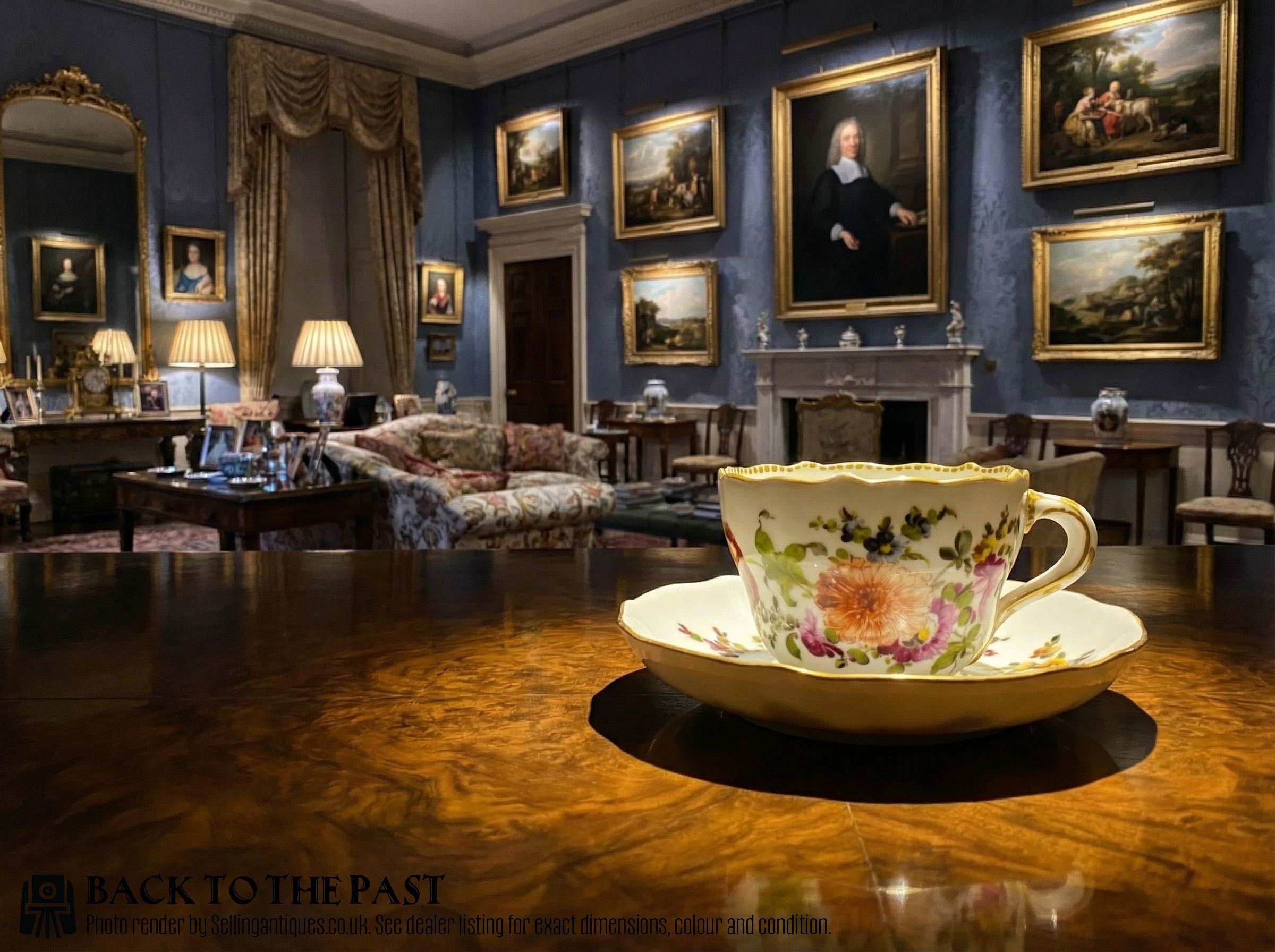
Antique Meissen Cups
Meissen, near Dresden, was the first European factory to make true hard-paste porcelain, from the early eighteenth century. Cups with matching saucers for coffee, tea and chocolate were staple products from the outset, and small display cups, made to be looked at as much as drunk from, became a standard form through the eighteenth and nineteenth centuries.
What you are most likely to meet on Sellingantiques is one cup with its own saucer: 14 of the 16 titles in the archive name the saucer, and only two offer cups alone. Small formats dominate. Cabinet cups appear in four titles, demitasse in three, miniature in two, with a breakfast cup and a covered chocolate cup as the larger outliers.
Decoration splits along familiar lines. Flowers run through the group, painted as Dresden Flowers or applied as forget-me-not encrusting. Topographical views turn up twice, dated c.1835 and c.1860. Beyond those, a puce chinoiserie chocolate cup with harbour views, moulded leaf work, gilding and a quatrefoil body that is the only shaped outline in the samples.
Dating needs a little care. The dealers' dated field runs 1750 to 1890, with 19th Century the largest bucket at 8 of 16 and 18th Century at 3, but only two listings carry a clean year. Titles are often more precise than the field, and the two disagree now and then. It is a small category, roughly two listings a year across seven dealers, so a particular form is something you wait for.
Where Value Sits
Painted subject does most of the work. The topographical cups and the Dresden view cup sit at the top of the sampled range, where the painting carries an identifiable place. Simple floral decoration sits lower, and applied flower encrusting lands in the middle, above the miniatures and below the view painting.
Size pulls in the same direction as ambition. The breakfast cup and the large cabinet cup sit near the top; the two miniatures are the two cheapest sampled, including the one listing to mention an Augustus Rex mark. Small does not mean slight here, but the market treats it as the modest end.
Dating tightens the picture. Titles reading c.1815, c.1835, c.1840 and c.1860 sit at the top of the range, while those offering only a century or a reign label sit at the bottom. Completeness matters too: cup with matching saucer is the norm, and a cup without one is the exception rather than the standard.
Antique Meissen Cups Retail Price Guide 2026
Typical UK retail prices for meissen cups, calculated from the Sellingantiques database of over a million retail prices indexed since 2003. This retail price guide relies exclusively on Sellingantiques data; no external sources or auction records are used, so the figures do not describe the wider market.
19th Century is the period label used most for Meissen cups on Sellingantiques, with 18th Century next.
The Antique Meissen Cups Glossary
- Cup and saucer
- The standard unit in this category, the two pieces offered together; 14 of the 16 archive titles name the saucer.
- Demitasse
- A small cup for strong coffee, roughly half the size of a teacup. Three titles use the word, one of them dated c.1815.
- Cabinet cup
- A cup made for display rather than daily use, usually elaborately decorated. Four titles, two of them flower-encrusted or moulded with leaves.
- Flower encrusted
- Three-dimensional porcelain flowers applied to the surface. Two titles use it, including a forget-me-not example.
- Topographical
- Painted with an identifiable place or view. Two examples in the archive, dated c.1835 and c.1860.
- Quatrefoil
- A four-lobed outline rather than a plain round one. One title, and the only shaped body among the samples.
Antique Meissen Cups: Frequently Asked Questions
Do these come with a saucer?
Almost always. Fourteen of the sixteen titles in the archive include the saucer, so the cup-and-saucer set is the unit that dominates the category.
The two exceptions are a pair of cups sold together and one other cup on its own.
What sizes turn up?
Small formats lead. Demitasse cups appear in three titles, cabinet cups in four, and miniatures in two.
The larger end is thin: a breakfast cup and saucer of c.1860 and a large cabinet cup and saucer of c.1880 are the biggest recorded, along with one covered chocolate cup.
How old are the ones that come up?
The dealers' dated field spans 1750 to 1890. 19th Century is the largest single label at 8 of 16 listings, with 18th Century at 3, and single entries for Victorian, Edwardian, the 1890s and the 1750s.
Only two listings carry a clean year. Titles often give closer dates, c.1740, c.1815, c.1835 and c.1860 among them, and sometimes the title and the dated field don't quite agree.
Which decoration is scarcest in the archive?
Topographical view painting. Two examples, dated c.1835 and c.1860, and both sit at the very top of the sampled range.
Flowers are the commoner theme, appearing as painted Dresden Flowers and as applied encrusting across four titles.
Are unusual shapes ever offered?
Rarely, but they exist. One cup is described as quatrefoil, a four-lobed outline, and it is the only shaped body among the samples.
A covered chocolate cup painted with harbour views in puce chinoiserie is the only piece in the archive with a cover.
How often do Meissen cups appear for sale?
Roughly two listings a year on Sellingantiques, spread across seven dealers.
That makes it a small category. Someone after one particular form, a breakfast cup or a view-painted saucer, waits for one rather than picking between several.