48,881  PAGES BROWSED TODAY PAGES TODAY 83  ANTIQUES UPLOADED TODAY NEW ARRIVALS
ID #SA995994
FOR SALE
£3,950
Email
Save
19th Century Gavioli Organ Figure
The House of Antiques
for sale €4,622     $5,017
£3,950
The House of Antiques

The House of Antiques

Sellingantiques Verified Since Nov 2022
View Dealers Stock Page
Relevant Links
Id #SA995994
PDF SHARE
SAVE

19th Century Gavioli Organ Figure

19th century
Description

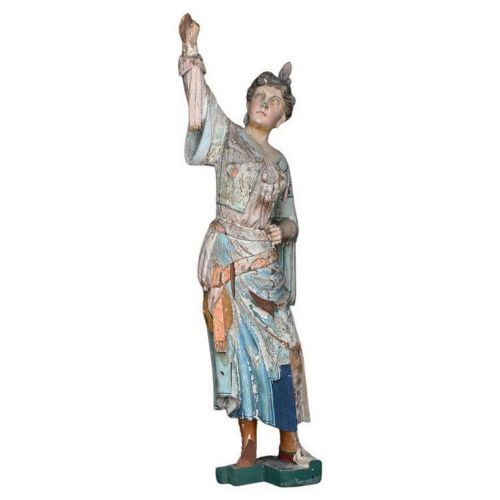
19th Century Hand Carved Ludovic Gavioli Organ Figure

Quite simply, she is beautiful and graceful. This amazing example of a late 19th century hand carved sectioned pine organ figure was produced by the world-renowned Ludovic Gavioli. The detail and expression on her face is what makes this example so delightful, an air of beauty and lifelike appeal in her expression. Personally, we have seen a few figures by Gavioli in the past but this one is special. The detail is of the finest quality and the late 19th century was most certainly when Gavioli produced some of his finest work.

Giacomo Gavioli (1786-1875) was considered the greatest of all band organ makers. Founded in 1806 in Modena, Italy, the firm spanned four generations of family involvement with branches in France, Germany, London and New York. The Gavioli family revolutionized organ manufacture when Anselme Gavioli patented the use of book music to play organs in 1892, using a punch-card system. This gave organs an effectively unlimited repertoire, allowing showmen to play the latest tunes. This coincided with the increasing mechanization of fairgrounds beginning in the late 19th century.

Fairground organs, or band organs as they are known in the United States, were designed to attract audiences, both with their large volume of sound and their ornate decorative case façade. The greatest period of active manufacture of fairground organs was the late 1880s through the 1920s, when electrical sound amplification was introduced. Band organ facades frequently included ornate human figures which moved in time with the music, providing a visual experience to accompany the music.

Material: Pine

Age: Late 19th Century

Size Approx.: Height 38” x Width 13” x Depth 7”

Origin: Europe

Condition Report

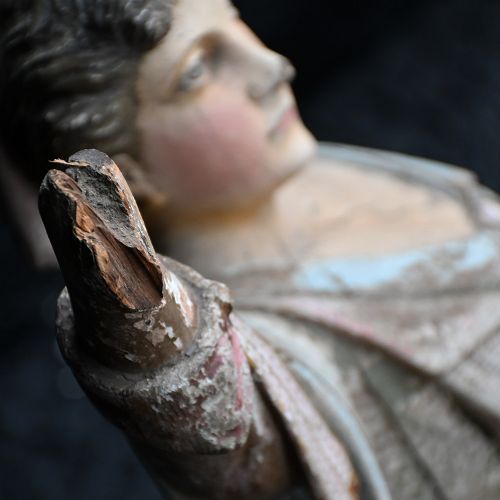
Naturally aged item, that has stood the test of time. The base is firm but would need a proper support fitted for display. The sections of wood are missing detail, at the base (feet) pointed hand has worn away, some wooden detail across the wavey dress, Paint has aged naturally.

Its exceedingly difficult to photograph all the areas of these pieces, therefore we strongly suggest reviewing all the photos provided as part of this advert and propose questions where sections are unclear to avoid disappointment upon purchase.

For multiple years we have sold antique and vintage items globally, please expect our items to show relevant age and natural wear, Items are only restored due to breaks and loss, and we always stipulate this in our condition report.

Physical Dimensions
Height
96.5cm (37.99")
Width
33cm (12.99")
Depth
17.8cm (7.01")
Declaration

The House of Antiques has dated this Carved Wooden Organ Figure to the 19th Century.

Reference Numbers
Sellingantiques Reference
SA995994
Dealers Internal Reference
Organ figure
Description
19th Century Hand Carved Ludovic Gavioli Organ Figure

Quite simply, she is beautiful and graceful.

This amazing example of a late 19th century hand carved sectioned pine organ figure was produced by the world-renowned Ludovic Gavioli.
The House of Antiques

The detail and expression on her face is what makes this example so delightful, an air of beauty and lifelike appeal in her expression. Personally, we have seen a few figures by Gavioli in the past but this one is special. The detail is of the finest quality and the late 19th century was most certainly when Gavioli produced some of his finest work.

fig 1. A 19th-century hand-carved wooden figure of a draped woman with raised arm, featuring distressed blue and cream polychrome paint finish.
fig 1. 19th Century Gavioli Organ Figure

Giacomo Gavioli (1786-1875) was considered the greatest of all band organ makers. Founded in 1806 in Modena, Italy, the firm spanned four generations of family involvement with branches in France, Germany, London and New York. The Gavioli family revolutionized organ manufacture when Anselme Gavioli patented the use of book music to play organs in 1892, using a punch-card system. This gave organs an effectively unlimited repertoire, allowing showmen to play the latest tunes. This coincided with the increasing mechanization of fairgrounds beginning in the late 19th century.

fig 2. A 19th-century hand-carved wooden figure of a draped woman with raised arm, featuring distressed blue and cream polychrome paint finish.
fig 2. 19th Century Gavioli Organ Figure

Fairground organs, or band organs as they are known in the United States, were designed to attract audiences, both with their large volume of sound and their ornate decorative case façade. The greatest period of active manufacture of fairground organs was the late 1880s through the 1920s, when electrical sound amplification was introduced. Band organ facades frequently included ornate human figures which moved in time with the music, providing a visual experience to accompany the music.

fig 3. A 19th-century hand-carved wooden figure of a draped woman with raised arm, featuring distressed blue and cream polychrome paint finish.
fig 3. 19th Century Gavioli Organ Figure

Material: Pine

Age: Late 19th Century

Size Approx.: Height 38” x Width 13” x Depth 7”

Origin: Europe

Condition Report

Naturally aged item, that has stood the test of time. The base is firm but would need a proper support fitted for display. The sections of wood are missing detail, at the base (feet) pointed hand has worn away, some wooden detail across the wavey dress, Paint has aged naturally.

fig 4. A 19th-century hand-carved wooden figure of a draped woman with raised arm, featuring distressed blue and cream polychrome paint finish.
fig 4. 19th Century Gavioli Organ Figure

Its exceedingly difficult to photograph all the areas of these pieces, therefore we strongly suggest reviewing all the photos provided as part of this advert and propose questions where sections are unclear to avoid disappointment upon purchase.

fig 5. A 19th-century hand-carved wooden figure of a draped woman with raised arm, featuring distressed blue and cream polychrome paint finish.
fig 5. 19th Century Gavioli Organ Figure

For multiple years we have sold antique and vintage items globally, please expect our items to show relevant age and natural wear, Items are only restored due to breaks and loss, and we always stipulate this in our condition report.

Height
96.5cm (37.99")
Width
33cm (12.99")
Depth
17.8cm (7.01")
Date of Manufacture

The House of Antiques has dated this Carved Wooden Organ Figure to the 19th Century.

Reference Numbers
Sellingantiques Ref
SA995994
Dealers Internal Ref
Organ figure
The House of Antiques
Sellingantiques verified Since Nov 2022
Dealer Profile

You can view the stock and full dealer information on the The House of Antiques Profile Page
Relevant Links
PDF SHARE
SAVE
A 19th-century hand-carved wooden figure of a draped woman with raised arm, featuring distressed blue and cream polychrome paint finish.
1 / 14
Archive I A 19th-century hand-carved wooden figure of a draped woman with raised arm, featuring distressed blue and cream polychrome paint finish.

19th Century Gavioli Organ Figure

Archive II A 19th-century hand-carved wooden figure of a draped woman with raised arm, featuring distressed blue and cream polychrome paint finish. View II
Archive III A 19th-century hand-carved wooden figure of a draped woman with raised arm, featuring distressed blue and cream polychrome paint finish. View III
Archive IV A 19th-century hand-carved wooden figure of a draped woman with raised arm, featuring distressed blue and cream polychrome paint finish. View IV
Archive V A 19th-century hand-carved wooden figure of a draped woman with raised arm, featuring distressed blue and cream polychrome paint finish. View V
Archive VI A 19th-century hand-carved wooden figure of a draped woman with raised arm, featuring distressed blue and cream polychrome paint finish. View VI
Archive VII A 19th-century hand-carved wooden figure of a draped woman with raised arm, featuring distressed blue and cream polychrome paint finish. View VII
Archive VIII A 19th-century hand-carved wooden figure of a draped woman with raised arm, featuring distressed blue and cream polychrome paint finish. View VIII
Archive IX A 19th-century hand-carved wooden figure of a draped woman with raised arm, featuring distressed blue and cream polychrome paint finish. View IX
Archive X A 19th-century hand-carved wooden figure of a draped woman with raised arm, featuring distressed blue and cream polychrome paint finish. View X
Archive XI A 19th-century hand-carved wooden figure of a draped woman with raised arm, featuring distressed blue and cream polychrome paint finish. View XI
Archive XII A 19th-century hand-carved wooden figure of a draped woman with raised arm, featuring distressed blue and cream polychrome paint finish. View XII
Archive XIII A 19th-century hand-carved wooden figure of a draped woman with raised arm, featuring distressed blue and cream polychrome paint finish. View XIII
Archive XIV A 19th-century hand-carved wooden figure of a draped woman with raised arm, featuring distressed blue and cream polychrome paint finish. View XIV
Enlarged Archival View
Telephone 07568 151 752
Location
22 Goodmayes Lane
Ilford
Essex
IG3 9NZ
United Kingdom
Verified Since Nov 2022
Items For Sale 141
Items Sold 11
The House of Antiques
Verified Since Nov 2022
View Dealer Info
Location: 22 Goodmayes Lane, Ilford, Essex, IG3 9NZ, United Kingdom
Verified
Nov 2022
For Sale
141
Sold
11
A 19th-century hand-carved wooden figure of a draped woman with raised arm, featuring distressed blue and cream polychrome paint finish.
19th Century Gavioli Organ Figure
Ref: SA995994
A 19th-century hand-carved wooden figure of a draped woman with raised arm, featuring distressed blue and cream polychrome paint finish.
Detail View 1
Detail View 2
Detail View 3
Detail View 4
Detail View 5
Detail View 6
Detail View 7
Detail View 8
Detail View 9
Detail View 10
Detail View 11
Detail View 12
Detail View 13
Archival Detail
Every single antique dealer on our platform is individually approved by our internal team. We verify their professional trade history, ethical standards, and photographic quality to ensure a secure, high-standard buying environment. Upon joining, every dealer agrees to a strict 9-point code of conduct. While issues can occasionally arise, our dealers typically resolve them swiftly and directly with the buyer. In fact, since our founding in 2002, Sellingantiques has only had to step in to help resolve an issue on roughly five occasions—a true testament to the quality of our dealers and their dedication to your happiness.
Our dealers are highly experienced in packing and shipping fragile, high-value antiques. Because you are in direct contact with the dealer, you will be able to easily go through all available shipping and insurance options together to ensure your item arrives safely.
Antiques are the ultimate green purchase. By choosing historical pieces over newly manufactured goods, you completely eliminate the carbon footprint of modern mass production while preserving exceptional, timeless craftsmanship.

A Gavioli organ figure is a hand-carved wooden sculpture designed to adorn large fairground or street organs manufactured by the Gavioli firm in the 19th and early 20th centuries. These figures often moved in tandem with the musical mechanisms, serving as animated conductors or dancers on the facade.

Organ figures were typically carved from lightweight hardwoods such as lime wood, pine, or walnut, then coated with gesso and polychrome paint. Certain figures incorporated internal metal rods or joints to enable automated movement powered by the organ mechanism.

Authentic period figures feature hand-carving marks, layered historical paint finishes over gesso, and age-consistent surface distressing or craquelure. Evidence of mounting points or mechanical link attachments on the reverse or base also indicates genuine usage on an instrument.

A carved organ figure functions as a standalone sculptural feature when positioned in an alcove, on a plinth, or in an entryway space. The graphic silhouette and aged paint finish provide textural depth when juxtaposed with minimalist or contemporary furniture.

Remove surface dust lightly using a dry, soft-bristled brush to prevent disturbing fragile paint layers. Keep the figure in a stable environment with controlled humidity, away from direct sunlight and heat sources that could cause wood movement or paint flaking.
items
Add keywords to the filter
Price
£100
£250000
Era
Movements
Material
Origin
Stock Location
Freshness
Online Payments
Categories