39,953  PAGES BROWSED TODAY PAGES TODAY 221 ANTIQUES UPLOADED TODAYNEW ARRIVALS
221 ITEMS ADDED TODAY
Sort Order
Items Per Page
Browse Categories
Sort order
Relevant Links
Items per page
ID #SA1233964
FOR SALE
£14,000
Email Buy
Save
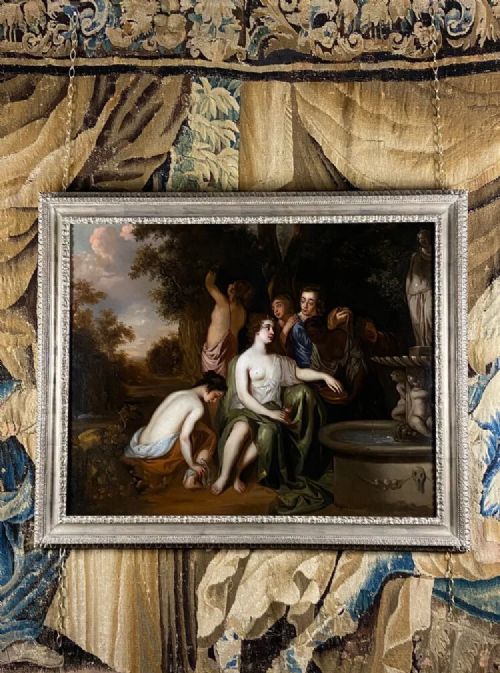
'The Bath of Diana' Classical Oil - Circle of Sir Peter Lely (1618-1680)
Period Portraits
for sale €16,380     $17,780
£14,000
Period Portraits

Period Portraits

Sellingantiques Verified Since Jan 2017
Browse dealers 46 items
  • About Us
    Specialist dealer in portraits from the 17th century to the 20th century. Our stock includes quality oil paintings, drawings, and mezzotints
Id #SA1233964
PDF SHARE
SAVE

'The Bath of Diana' Classical Oil - Circle of Sir Peter Lely (1618-1680)

17th century
For Sale by Period Portraits
Description

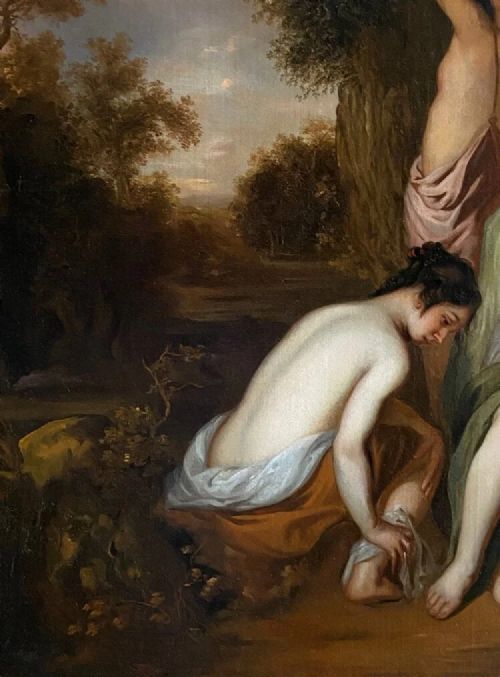
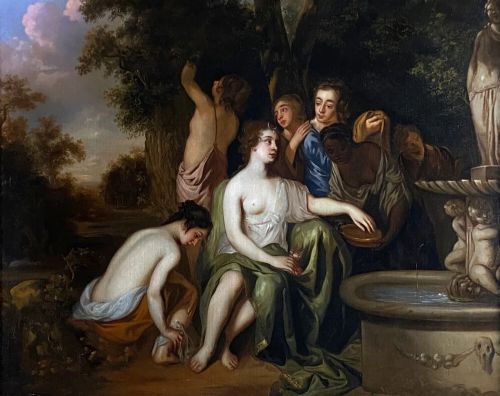
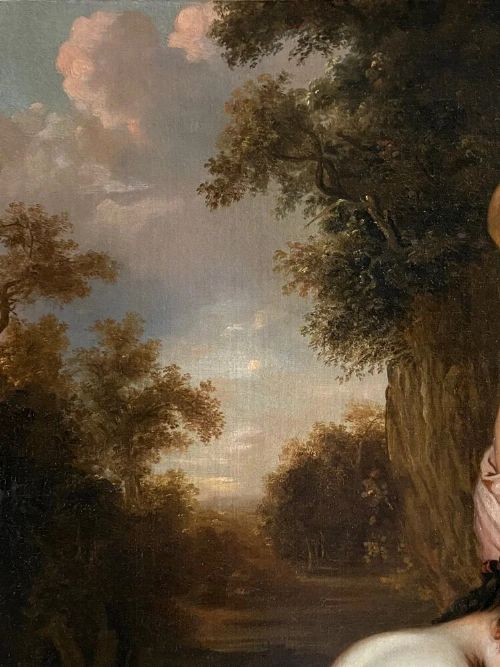
Large scale, richly coloured late 17th century English school oil on canvas of the goddess Diana and her attendants. They bathe in a forest clearing adjacent to a stone fountain, in a scene that anticipates the arrival of Acteon.

The fountain itself includes classical figures and a putti who relieves himself into the basin below. The goddess Diana holds a rose in her left hand and she dabs the fingers of her right hand in hand in a golden bowl. This bowl is held by a woman of African heritage, a significant inclusion in an English work of this period.

The evident quality of this work demonstrates a confident and experienced hand. This is particularly notable in the restrained and refined colour palette, the flesh tones and shimmering drapery.

This work is in an excellent state of conservation and is ready to hang an enjoy in a later quality silvered antique style frame by Tanous.

The prime version of this work can be seen in the collection of The Yale Centre for British Art.

Sir Peter Lely (1618-1660) (Born Soest, Westphalia, 14 September 1618; died London, 30 November 1680). Painter of Dutch origin who spent almost all his career in England and was naturalized in 1662. His family name was originally van der Faes, and the name Lely is said to have come from a lily carved on the house in The Hague where his father was born. Lely was born in Germany (where his father, a captain of infantry, was stationed) and trained in Haarlem.

He moved to England in the early 1640s (early biographers say 1641 or 1643), and although he first painted figure compositions in landscapes (Sleeping Nymphs, c.1650, Dulwich Picture Gal., London), he soon turned to the more profitable field of portraiture.

Fortune shone on him, for within a few years of his arrival the best portraitists in England disappeared from the scene: van Dyck and William Dobson died in 1641 and 1646 respectively, and Cornelius Johnson returned to Holland in 1643. In 1654 he was described as ‘the best artist in England’. Lely portrayed Charles I and his children, Oliver Cromwell and his son Richard, and other leading figures of the Interregnum, but he is associated chiefly with the Restoration court of Charles II. He was made principal painter to the king in 1661 and enjoyed a lavish lifestyle, described in the Diary of Samuel Pepys, who called him ‘a mighty proud man, and full of state’. With the aid of a team of assistants he maintained an enormous output, and his fleshy, sleepy beauties clad in exquisite silks and his bewigged courtiers have created the popular image of Restoration England.

Van Dyck was the strongest influence on his style, but Lely was more earthy and less refined. Much of his work is repetitive (it is sometimes hard to tell sitters apart), but he was a fluent and lively colourist and had a gift for impressive composition. He completely dominated English painting in his time, and his tradition of society portraiture, developed by Kneller and Richardson, endured well into the 18th century until it was challenged by Hogarth. Lely was a notable connoisseur and amassed one of the finest collections of Old Master drawings ever assembled; it was sold after his death.

Text source: The Oxford Dictionary of Art and Artists (Oxford University Press)

Higher resolution images on request.

Worldwide shipping available.

Canvas: 36” x 46" / 92cm x 117cm.

Frame: 45" x 54” / 114cm x 137cm.

Physical Dimensions
Height
114cm (44.88")
Width
137cm (53.94")
Depth
4cm (1.57")
Declaration

Period Portraits has dated this 17th Century Mythological Painting to the 17th Century.
Reference Numbers
Sellingantiques Reference
SA1233964
Description
Large scale, richly coloured late 17th century English school oil on canvas of the goddess Diana and her attendants.
They bathe in a forest clearing adjacent to a stone fountain, in a scene that anticipates the arrival of Acteon.
Period Portraits
fig 1. A classical oil painting framed in carved silvered wood depicting mythological figures gathered around a stone fountain in a shaded woodland landscape.
fig 1. 'The Bath of Diana' Classical Oil - Circle of Sir Peter Lely (1618-1680)

The fountain itself includes classical figures and a putti who relieves himself into the basin below. The goddess Diana holds a rose in her left hand and she dabs the fingers of her right hand in hand in a golden bowl. This bowl is held by a woman of African heritage, a significant inclusion in an English work of this period.

fig 2. A classical oil painting framed in carved silvered wood depicting mythological figures gathered around a stone fountain in a shaded woodland landscape.
fig 2. 'The Bath of Diana' Classical Oil - Circle of Sir Peter Lely (1618-1680)

The evident quality of this work demonstrates a confident and experienced hand. This is particularly notable in the restrained and refined colour palette, the flesh tones and shimmering drapery.

This work is in an excellent state of conservation and is ready to hang an enjoy in a later quality silvered antique style frame by Tanous.

fig 3. A classical oil painting framed in carved silvered wood depicting mythological figures gathered around a stone fountain in a shaded woodland landscape.
fig 3. 'The Bath of Diana' Classical Oil - Circle of Sir Peter Lely (1618-1680)

The prime version of this work can be seen in the collection of The Yale Centre for British Art.

Sir Peter Lely (1618-1660) (Born Soest, Westphalia, 14 September 1618; died London, 30 November 1680). Painter of Dutch origin who spent almost all his career in England and was naturalized in 1662. His family name was originally van der Faes, and the name Lely is said to have come from a lily carved on the house in The Hague where his father was born. Lely was born in Germany (where his father, a captain of infantry, was stationed) and trained in Haarlem.

fig 4. A classical oil painting framed in carved silvered wood depicting mythological figures gathered around a stone fountain in a shaded woodland landscape.
fig 4. 'The Bath of Diana' Classical Oil - Circle of Sir Peter Lely (1618-1680)

He moved to England in the early 1640s (early biographers say 1641 or 1643), and although he first painted figure compositions in landscapes (Sleeping Nymphs, c.1650, Dulwich Picture Gal., London), he soon turned to the more profitable field of portraiture.

fig 5. A classical oil painting framed in carved silvered wood depicting mythological figures gathered around a stone fountain in a shaded woodland landscape.
fig 5. 'The Bath of Diana' Classical Oil - Circle of Sir Peter Lely (1618-1680)

Fortune shone on him, for within a few years of his arrival the best portraitists in England disappeared from the scene: van Dyck and William Dobson died in 1641 and 1646 respectively, and Cornelius Johnson returned to Holland in 1643. In 1654 he was described as ‘the best artist in England’. Lely portrayed Charles I and his children, Oliver Cromwell and his son Richard, and other leading figures of the Interregnum, but he is associated chiefly with the Restoration court of Charles II. He was made principal painter to the king in 1661 and enjoyed a lavish lifestyle, described in the Diary of Samuel Pepys, who called him ‘a mighty proud man, and full of state’. With the aid of a team of assistants he maintained an enormous output, and his fleshy, sleepy beauties clad in exquisite silks and his bewigged courtiers have created the popular image of Restoration England.

fig 6. A classical oil painting framed in carved silvered wood depicting mythological figures gathered around a stone fountain in a shaded woodland landscape.
fig 6. 'The Bath of Diana' Classical Oil - Circle of Sir Peter Lely (1618-1680)

Van Dyck was the strongest influence on his style, but Lely was more earthy and less refined. Much of his work is repetitive (it is sometimes hard to tell sitters apart), but he was a fluent and lively colourist and had a gift for impressive composition. He completely dominated English painting in his time, and his tradition of society portraiture, developed by Kneller and Richardson, endured well into the 18th century until it was challenged by Hogarth. Lely was a notable connoisseur and amassed one of the finest collections of Old Master drawings ever assembled; it was sold after his death.

fig 7. A classical oil painting framed in carved silvered wood depicting mythological figures gathered around a stone fountain in a shaded woodland landscape.
fig 7. 'The Bath of Diana' Classical Oil - Circle of Sir Peter Lely (1618-1680)

Text source: The Oxford Dictionary of Art and Artists (Oxford University Press)

Higher resolution images on request.

Worldwide shipping available.

Canvas: 36” x 46" / 92cm x 117cm.

Frame: 45" x 54” / 114cm x 137cm.

Height
114cm (44.88")
Width
137cm (53.94")
Depth
4cm (1.57")
Date of Manufacture

Period Portraits has dated this 17th Century Mythological Painting to the 17th Century.

Reference Numbers
Sellingantiques Ref
SA1233964
Period Portraits
Period Portraits
Sellingantiques verified Since Jan 2017

Specialist dealer in portraits from the 17th century to the 20th century. Our stock includes quality oil paintings, drawings, and mezzotints

Dealer Profile

You can view the stock and full dealer information on the Period Portraits Profile Page
PDF SHARE
SAVE
A classical oil painting framed in carved silvered wood depicting mythological figures gathered around a stone fountain in a shaded woodland landscape.
1 / 8
Archive I A classical oil painting framed in carved silvered wood depicting mythological figures gathered around a stone fountain in a shaded woodland landscape.

'The Bath of Diana' Classical Oil - Circle of Sir Peter Lely (1618-1680)
Archive II A classical oil painting framed in carved silvered wood depicting mythological figures gathered around a stone fountain in a shaded woodland landscape. View II
Archive III A classical oil painting framed in carved silvered wood depicting mythological figures gathered around a stone fountain in a shaded woodland landscape. View III
Archive IV A classical oil painting framed in carved silvered wood depicting mythological figures gathered around a stone fountain in a shaded woodland landscape. View IV
Archive V A classical oil painting framed in carved silvered wood depicting mythological figures gathered around a stone fountain in a shaded woodland landscape. View V
Archive VI A classical oil painting framed in carved silvered wood depicting mythological figures gathered around a stone fountain in a shaded woodland landscape. View VI
Archive VII A classical oil painting framed in carved silvered wood depicting mythological figures gathered around a stone fountain in a shaded woodland landscape. View VII
Archive VIII A classical oil painting framed in carved silvered wood depicting mythological figures gathered around a stone fountain in a shaded woodland landscape. View VIII
Enlarged Archival View
Telephone 07889 859729
Location
North Yorkshire
United Kingdom
Verified Since Jan 2017
Items For Sale 46
Items Sold 62
Period Portraits
Period Portraits
Verified Since Jan 2017
View Dealer Info
Location: North Yorkshire, United Kingdom
Verified
Jan 2017
For Sale
46
Sold
62
A classical oil painting framed in carved silvered wood depicting mythological figures gathered around a stone fountain in a shaded woodland landscape.
'THE BATH OF DIANA' CLASSICAL OIL - CIRCLE OF SIR PETER LELY (1618-1680)
Ref: SA1233964
A classical oil painting framed in carved silvered wood depicting mythological figures gathered around a stone fountain in a shaded woodland landscape.
Detail View 1
Detail View 2
Detail View 3
Detail View 4
Detail View 5
Detail View 6
Detail View 7
Archival Detail
Every single antique dealer on our platform is individually approved by our internal team. We verify their professional trade history, ethical standards, and photographic quality to ensure a secure, high-standard buying environment. Upon joining, every dealer agrees to a strict 9-point code of conduct. While issues can occasionally arise, our dealers typically resolve them swiftly and directly with the buyer. In fact, since our founding in 2002, Sellingantiques has only had to step in to help resolve an issue on roughly five occasions—a true testament to the quality of our dealers and their dedication to your happiness.
Our dealers are highly experienced in packing and shipping fragile, high-value antiques. Because you are in direct contact with the dealer, you will be able to easily go through all available shipping and insurance options together to ensure your item arrives safely.
Antiques are the ultimate green purchase. By choosing historical pieces over newly manufactured goods, you completely eliminate the carbon footprint of modern mass production while preserving exceptional, timeless craftsmanship.

Baroque mythological painting from the XVII century is defined by dramatic lighting, rich colour palettes, theatrical compositions, and classical subject matter derived from Roman and Greek allegories.

Painters during this period applied hand-ground natural pigments suspended in linseed or walnut oil onto hand-stretched linen canvas, finished with natural resin varnishes and housed in carved wooden frames.

Authentic period paintings display natural craquelure patterns, evidence of historical lining or stretcher bar shadows, hand-carved joinery on original framing, and natural varnish oxidisation under ultraviolet light.

Position large classical artworks on neutral painted walls or above panelling to create a focal point, pairing them with contemporary minimalist furniture to establish visual contrast.

Keep paintings away from direct sunlight and fluctuating humidity, clean frame gilding gently with a dry soft brush, and avoid water or chemical solvents on the paint surface.
items
Add keywords to the filter
Price
£100
£250000
Era
Movements
Material
Origin
Stock Location
Freshness
Online Payments
Categories