19,473  PAGES BROWSED TODAY PAGES TODAY • 0 ANTIQUES UPLOADED TODAYNEW ARRIVALS
GIFTSNEW
LATEST STOCK
Sort Order
Items Per Page
Browse Categories
Sort order
Relevant Links
Items per page
ID #SA1226320
FOR SALE
£6,000
Email Phone
Save
Lena Gurr Night Work
For sale by Darnley Fine Art
Id #SA1226320
PDF SHARE
SAVE

Lena Gurr Night Work

1920 - 1940
For Sale by Darnley Fine Art
Description

Oil on Canvas, signed lower right, signed and titled verso

Image size: 25 x 21 inches (63.5 x 53.5cm)

Contemporary frame

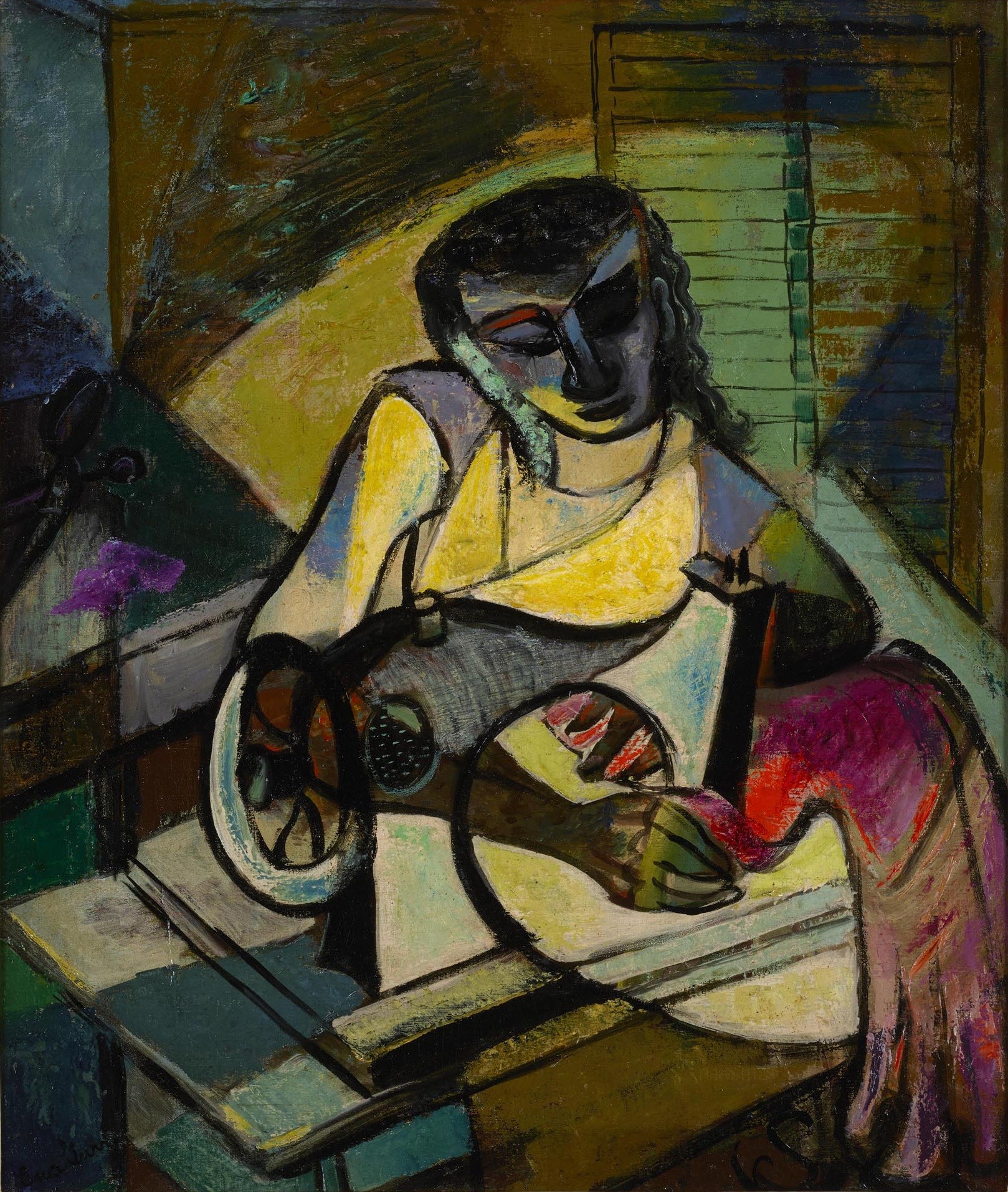
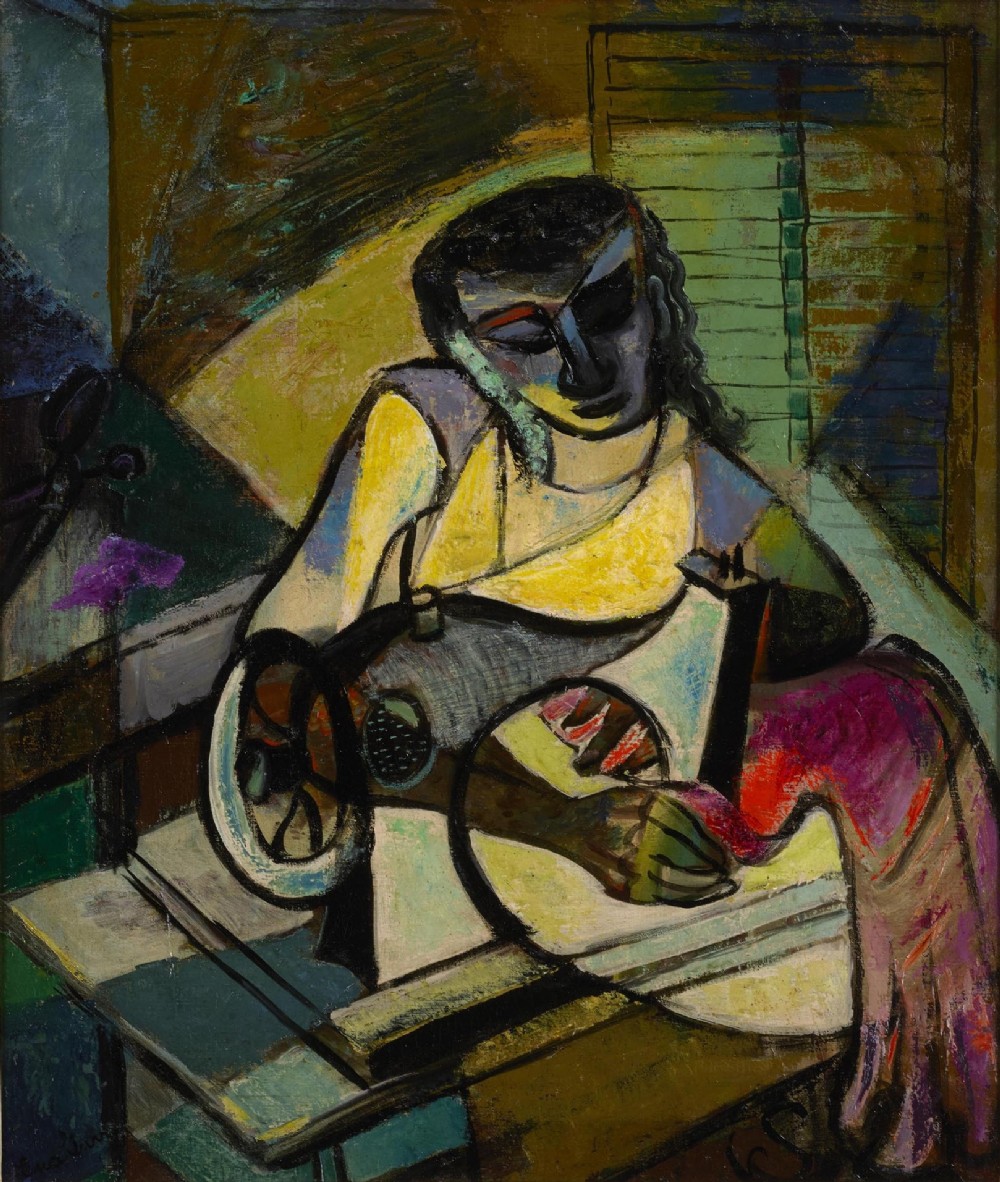
Night Work depicts a lonely seamstress at her sewing machine, her work illuminated by a single spotlight. On the right side of the canvas the shutters are closed and a pair of scissors with an off-cut of fabric sit on the workbench behind her. The woman’s head bends to the left as she concentrates on sewing the seam of the purple dress in her hands. 

The painting reflects Gurr’s move away from representative, semi-abstract art towards a more Cubist technique. The composition is made up of blocks of colour used to emphasise the contrast between the illuminated workspace and the surrounding darkness. Thicker brushstrokes of striking yellow and red light up the smock worn by the woman and the dress in her hands. The subject matter, a presumably working-class woman working late into the night, either to earn enough to make ends meet or repairing a much-loved garment she cannot afford to replace, is in keeping with Gurr’s interest in depicting modern urban life and poverty. Her feminism and social activism combine in this painting to capture the isolation and loneliness of being a working-class woman in the years following the Great Depression. 

Lena Gurr (1897 - 1992)

Lena Gurr was born into a Russian-Jewish immigrant family in Brooklyn in 1897. She began studying art at a young age, joining her high school’s art club. She studied at the Brooklyn Training School for Teachers, ensuring art was a component of the teacher training she received here. In 1919 she studied painting and print-making at the Educational Alliance Art School and, between 1920 and 1922, she was awarded a scholarship to the Arts Students League with John Sloan, and with Maurice Sterne in Paris as well as in Mentone and Nice, France. It was whilst studying at the Arts Students League that Gurr met her future husband, fellow artist Joseph Biel.

Gurr was one of a number of women artists from an immigrant background who studied at the Arts Students League in the early 20th century. An increasing number of women artists had come to study and work at the League from the late 1890s onwards with many of them taking on key roles within the institution. Opportunities were growing for women artists and it was becoming more socially acceptable for women to have a successful career as an independent artist. Many of her colleagues were WPA artists, though Gurr was not involved in the project herself, including Dorothy Block and Minna Harkavy. They, like Gurr, also tended to be from an immigrant background and had a strong social consciousness. This clearly influenced Gur’s choice of subject matter, frequently depicting subjects within this theme, depicting city scenes and the realities of poverty in urban life.  

Gurr’s feminism and social activism was reflected in the societies to which she belonged. She was a member of the Artists League of America, the National Association of Women Artists, the New York Society of Women Artists, the Brooklyn Society of Artists, Audubon Artists and the American Artists Congress. She exhibited in numerous exhibitions held by these organisations as well as the Whitney Studio Club, National Academy of Design, Virginia Museum of Fine Arts, Brooklyn Museum, and the 1939 World’s Fair.

Her work is included in the collections of the Biro-Bidjan Museum, Russia and the Library of Congress, where she has been selected as a “Curator’s Choice” in the Smithsonian Archives of American Art. In addition to her career as a painter, lithographer and serigrapher, she also taught art in the New York City public school system. She had three solo exhibitions at the ACA Gallery in 1935, 1939 and 1945, and a retrospective in 1963.

Physical Dimensions
Height
63.5cm (25.00")
Width
53.5cm (21.06")
Declaration

Darnley Fine Art has dated this Modernist Oil Portrait Painting to the 1940s.

Reference Numbers
Sellingantiques Reference
SA1226320
Description
Oil on Canvas, signed lower right, signed and titled verso

Image size: 25 x 21 inches (63.5 x 53.5cm)

Contemporary frame

“
Night Work depicts a lonely seamstress at her sewing machine, her work illuminated by a single spotlight.
Darnley Fine Art

On the right side of the canvas the shutters are closed and a pair of scissors with an off-cut of fabric sit on the workbench behind her. The woman’s head bends to the left as she concentrates on sewing the seam of the purple dress in her hands. 

The painting reflects Gurr’s move away from representative, semi-abstract art towards a more Cubist technique. The composition is made up of blocks of colour used to emphasise the contrast between the illuminated workspace and the surrounding darkness. Thicker brushstrokes of striking yellow and red light up the smock worn by the woman and the dress in her hands. The subject matter, a presumably working-class woman working late into the night, either to earn enough to make ends meet or repairing a much-loved garment she cannot afford to replace, is in keeping with Gurr’s interest in depicting modern urban life and poverty. Her feminism and social activism combine in this painting to capture the isolation and loneliness of being a working-class woman in the years following the Great Depression. 

Lena Gurr (1897 - 1992)

Lena Gurr was born into a Russian-Jewish immigrant family in Brooklyn in 1897. She began studying art at a young age, joining her high school’s art club. She studied at the Brooklyn Training School for Teachers, ensuring art was a component of the teacher training she received here. In 1919 she studied painting and print-making at the Educational Alliance Art School and, between 1920 and 1922, she was awarded a scholarship to the Arts Students League with John Sloan, and with Maurice Sterne in Paris as well as in Mentone and Nice, France. It was whilst studying at the Arts Students League that Gurr met her future husband, fellow artist Joseph Biel.

Gurr was one of a number of women artists from an immigrant background who studied at the Arts Students League in the early 20th century. An increasing number of women artists had come to study and work at the League from the late 1890s onwards with many of them taking on key roles within the institution. Opportunities were growing for women artists and it was becoming more socially acceptable for women to have a successful career as an independent artist. Many of her colleagues were WPA artists, though Gurr was not involved in the project herself, including Dorothy Block and Minna Harkavy. They, like Gurr, also tended to be from an immigrant background and had a strong social consciousness. This clearly influenced Gur’s choice of subject matter, frequently depicting subjects within this theme, depicting city scenes and the realities of poverty in urban life.  

Gurr’s feminism and social activism was reflected in the societies to which she belonged. She was a member of the Artists League of America, the National Association of Women Artists, the New York Society of Women Artists, the Brooklyn Society of Artists, Audubon Artists and the American Artists Congress. She exhibited in numerous exhibitions held by these organisations as well as the Whitney Studio Club, National Academy of Design, Virginia Museum of Fine Arts, Brooklyn Museum, and the 1939 World’s Fair.

Her work is included in the collections of the Biro-Bidjan Museum, Russia and the Library of Congress, where she has been selected as a “Curator’s Choice” in the Smithsonian Archives of American Art. In addition to her career as a painter, lithographer and serigrapher, she also taught art in the New York City public school system. She had three solo exhibitions at the ACA Gallery in 1935, 1939 and 1945, and a retrospective in 1963.

Height
63.5cm (25.00")
Width
53.5cm (21.06")
Date of Manufacture

Darnley Fine Art has dated this Modernist Oil Portrait Painting to the 1940s.

Reference Numbers
Sellingantiques Ref
SA1226320
Darnley Fine Art
Sellingantiques verified Since Jul 2026
Dealer Profile

You can view the stock and full dealer information on the Darnley Fine Art Profile Page
PDF SHARE
SAVE
A modernist oil painting depicting a woman seated at a sewing machine rendered with bold outlines and fractured geometric planes in shades of ochre yellow, green, and dark blue.
1 / 1
Archive I A modernist oil painting depicting a woman seated at a sewing machine rendered with bold outlines and fractured geometric planes in shades of ochre yellow, green, and dark blue.

Lena Gurr Night Work

Enlarged Archival View
Telephone 0207 379 0499
Location
2-4 Cecil Court
London
WC2N 4HE
United Kingdom

Opening Times
Monday to Saturday: 10:30 - 5:30
(excluding Bank Holidays)
Dealer Profile Page sellingantiques.co.uk/dfa
Verified Since Jul 2026
Items For Sale 76
Darnley Fine Art
Verified Since Jul 2026
View Dealer Info
Location: 2-4 Cecil Court, London, WC2N 4HE, United Kingdom, , Opening Times, Monday to Saturday: 10:30 - 5:30, (excluding Bank Holidays)
Verified
Jul 2026
For Sale
76
A modernist oil painting depicting a woman seated at a sewing machine rendered with bold outlines and fractured geometric planes in shades of ochre yellow, green, and dark blue.
Lena Gurr Night Work
Ref: SA1226320
A modernist oil painting depicting a woman seated at a sewing machine rendered with bold outlines and fractured geometric planes in shades of ochre yellow, green, and dark blue.
Archival Detail
Every single antique dealer on our platform is individually approved by our internal team. We verify their professional trade history, ethical standards, and photographic quality to ensure a secure, high-standard buying environment. Upon joining, every dealer agrees to a strict 9-point code of conduct. While issues can occasionally arise, our dealers typically resolve them swiftly and directly with the buyer. In fact, since our founding in 2002, Sellingantiques has only had to step in to help resolve an issue on roughly five occasions—a true testament to the quality of our dealers and their dedication to your happiness.
Our dealers are highly experienced in packing and shipping fragile, high-value antiques. Because you are in direct contact with the dealer, you will be able to easily go through all available shipping and insurance options together to ensure your item arrives safely.
Antiques are the ultimate green purchase. By choosing historical pieces over newly manufactured goods, you completely eliminate the carbon footprint of modern mass production while preserving exceptional, timeless craftsmanship.
Written by Sellingantiques from the dealer’s photographs and listing
  • ObjectOil Paintings
  • Period1920 - 1940
  • StyleMid-Century Modernism
  • MaterialOil Paint, Canvas
  • ColourOchre Yellow, Slate Blue, Muted Green
  • MotifsFractured planes, Bold black outlines, Stylised female figure, Geometric composition
  • SizeH 63.5 cm (25 in) x W 53.5 cm (21 in)

Lena Gurr Night Work is an oil painting on canvas created in 1940 in the mid-century modernism style. The composition uses oil paint in ochre yellow, slate blue, and muted green with bold black outlines, fractured planes, a stylised female figure, and a contemporary frame. The artwork includes a signature lower right, and a signature and title verso. The visible scene depicts a woman seated at a sewing machine in a workshop setting with closed shutters, a pair of scissors, and a purple dress. The piece measures 63.5 cm high and 53.5 cm wide. This oil painting suits display above a sideboard in a living room, dining room, or hallway. The geometric composition and narrative style of urban modern life complement contemporary and mid-century interiors, bringing character and colour to a wall space.

Mid-century modernist expressionist artworks are defined by fractured planes, bold outlines, simplified geometric forms, and emotive colour palettes. They often reflect themes of daily labor, human emotion, and industrial subject matter typical of the mid-20th century movement.

Artists during this era typically painted with oil pigments bound with linseed oil on stretched linen or cotton canvas, as well as Masonite or wooden panels. Heavy impasto and layered paint application were common techniques to create texture and depth.

Authentic works from this period usually feature period-appropriate frame wear, age-related craquelure, natural paint oxidisation, and artist signatures or gallery exhibition labels on the canvas reverse or stretcher bars.

Position the artwork as a focal point above a console table or mantelpiece, using directional warm picture lighting. Pair it with clean-lined contemporary furniture or mid-century timber pieces to complement its structural composition.

Keep the canvas away from direct sunlight, high humidity, and fluctuating heat sources to prevent cracking or warping. Dust the surface very gently with a dry, soft-bristled brush, avoiding water or chemical cleaning solutions.
items
Add keywords to the filter
Price
£100
£250000
Era
Period
Style
Material
Origin
Stock Location
Recently Added
Online Payments
Categories