59,560  PAGES BROWSED TODAY PAGES TODAY 59 ANTIQUES UPLOADED TODAYNEW ARRIVALS
59 ITEMS ADDED TODAY
Sort Order
Items Per Page
Browse Categories
Sort order
Relevant Links
Items per page
ID #SA1204890
FOR SALE
£1,250
Email
Save
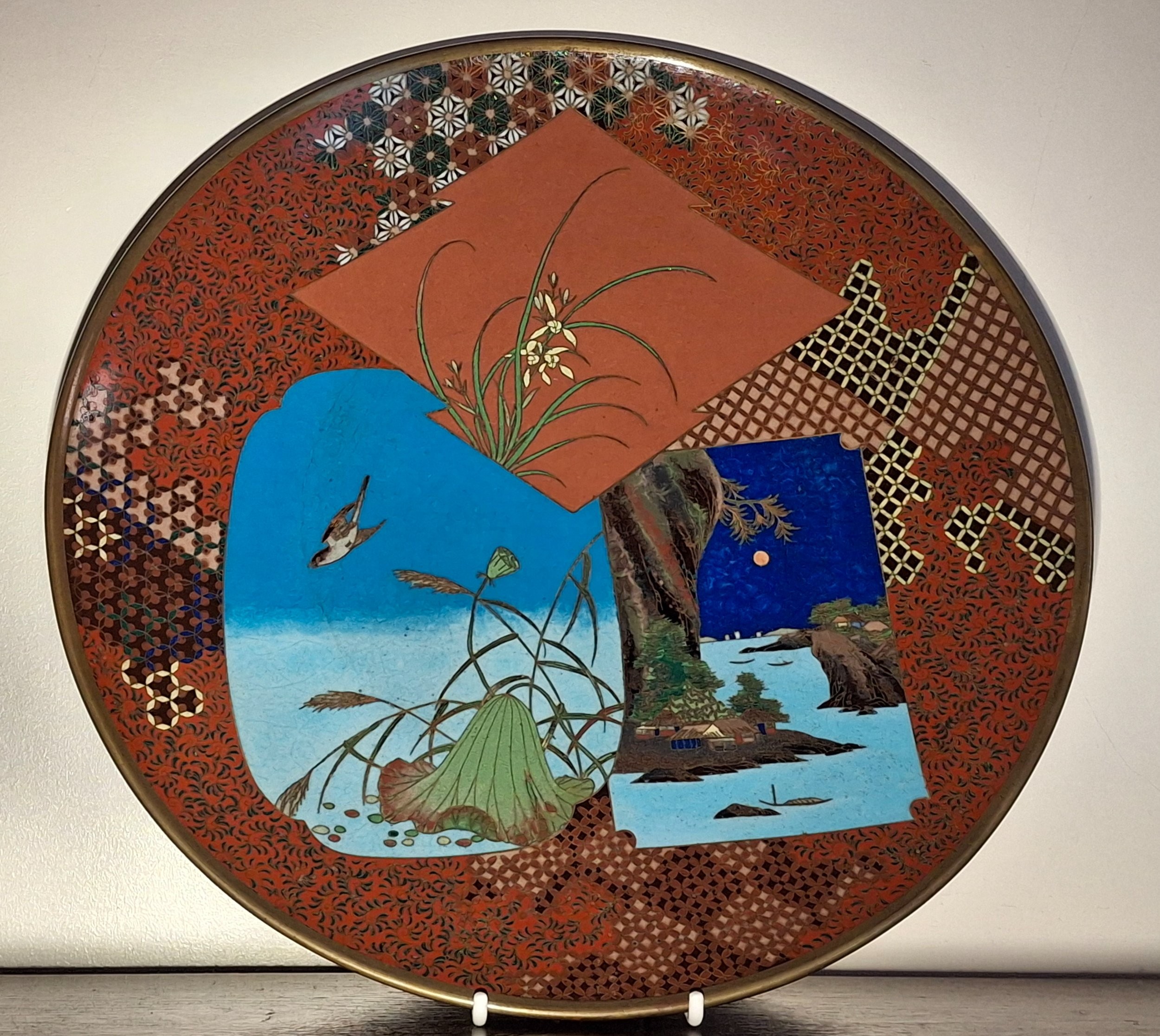
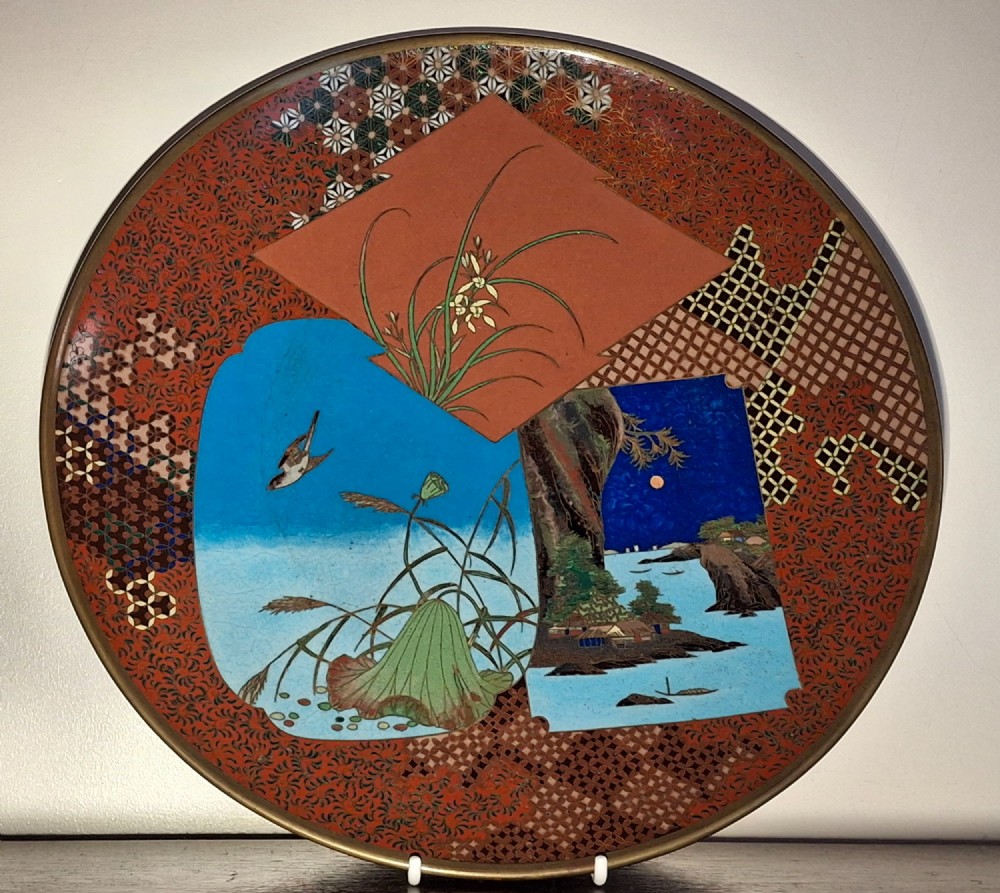
Rare Japanese Cloisonne Medium Plate - Landscape. Nagoya. Circa 1900.
Dragoncharger Antiques
for sale €1,463     $1,588
£1,250

Dragoncharger Antiques

Sellingantiques Verified Since Aug 2024
View Dealers Stock Page
  • About Us
    Specialising in early japanese cloisonne, edo enamel artisan period.
Id #SA1204890
PDF SHARE
SAVE

Rare Japanese Cloisonne Medium Plate - Landscape. Nagoya. Circa 1900.

1900 - 1920
Description

Rare Japanese Cloisonne Medium Plate - Landscape. Nagoya. Circa 1900.

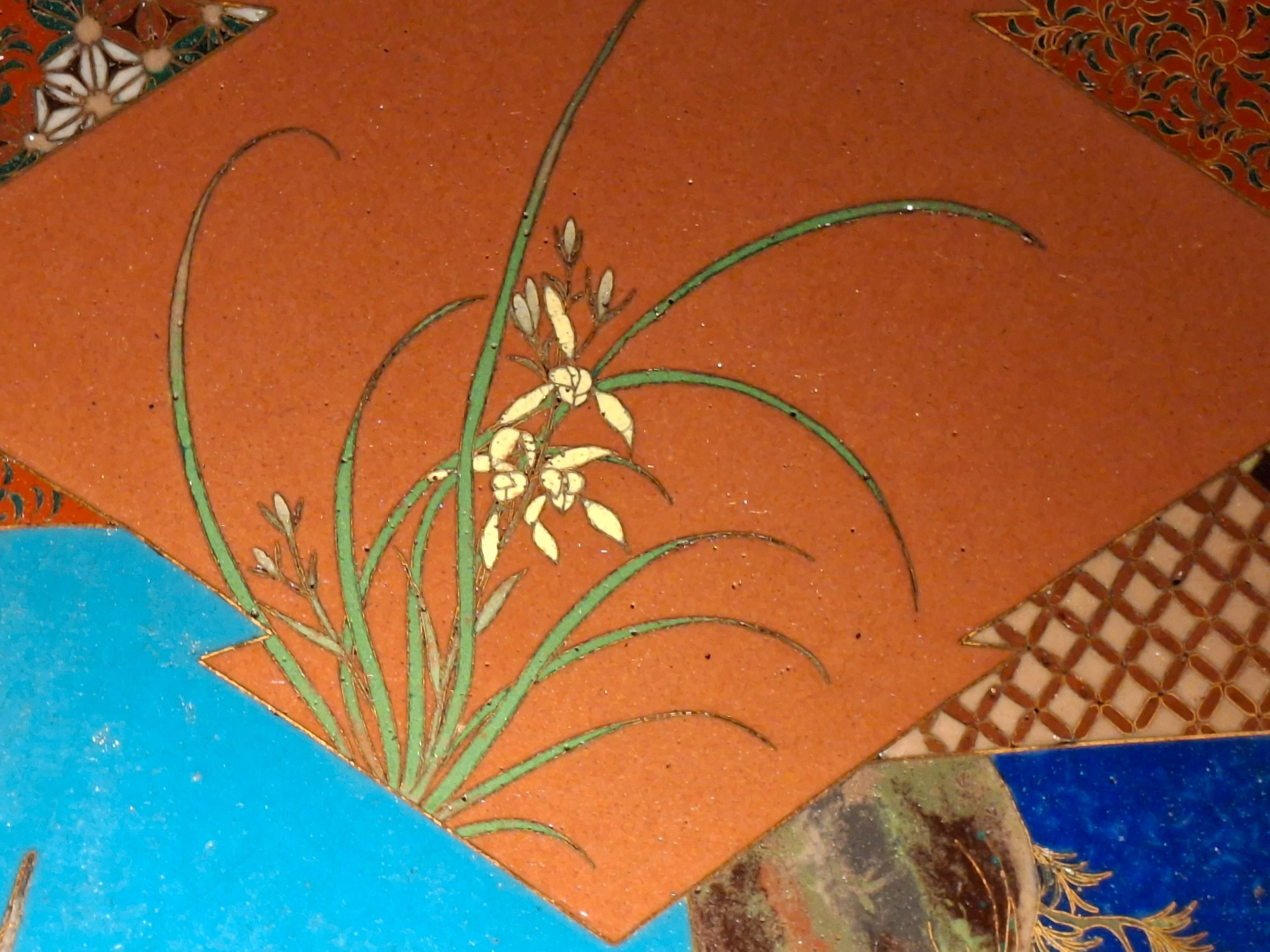
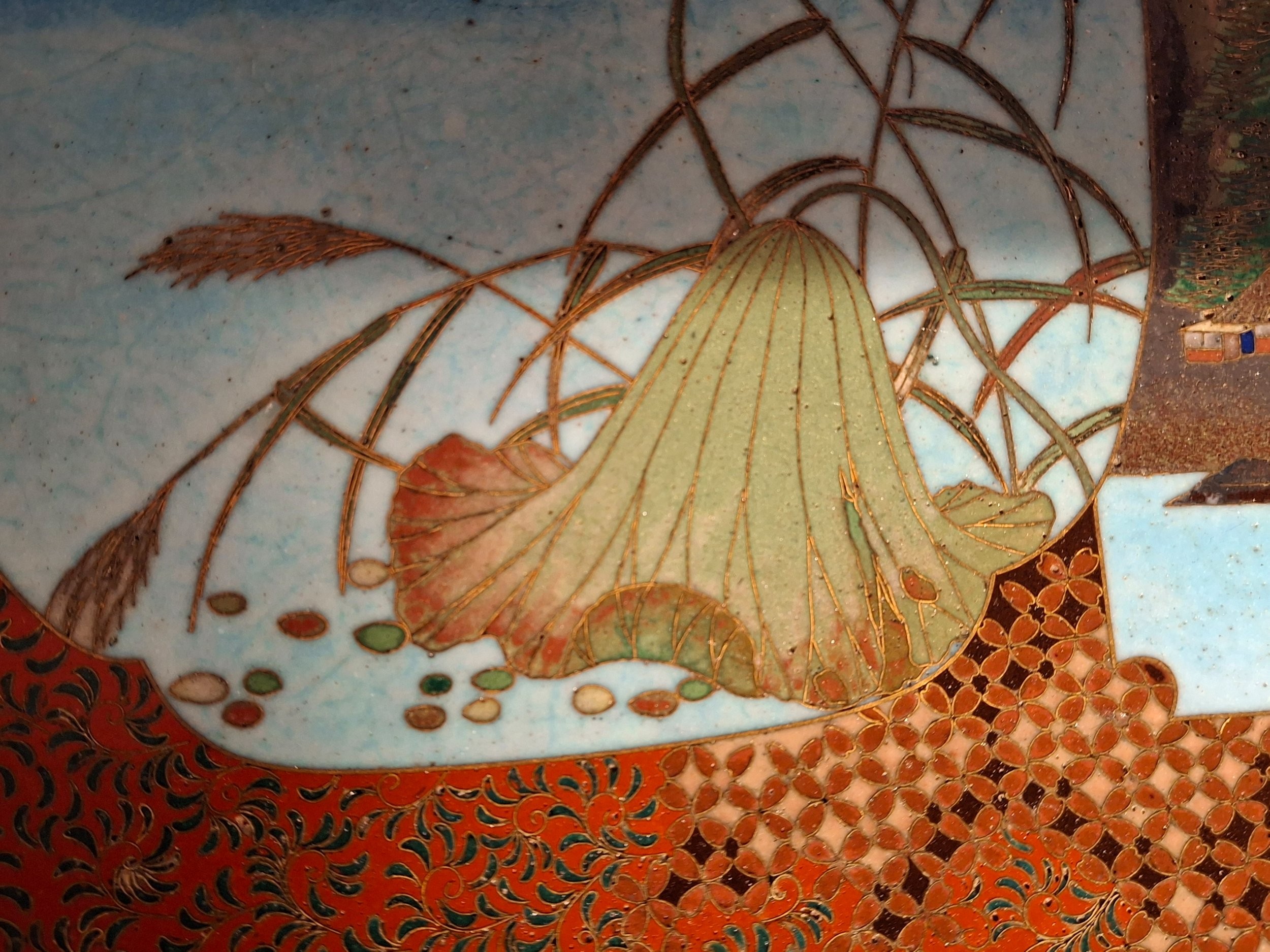
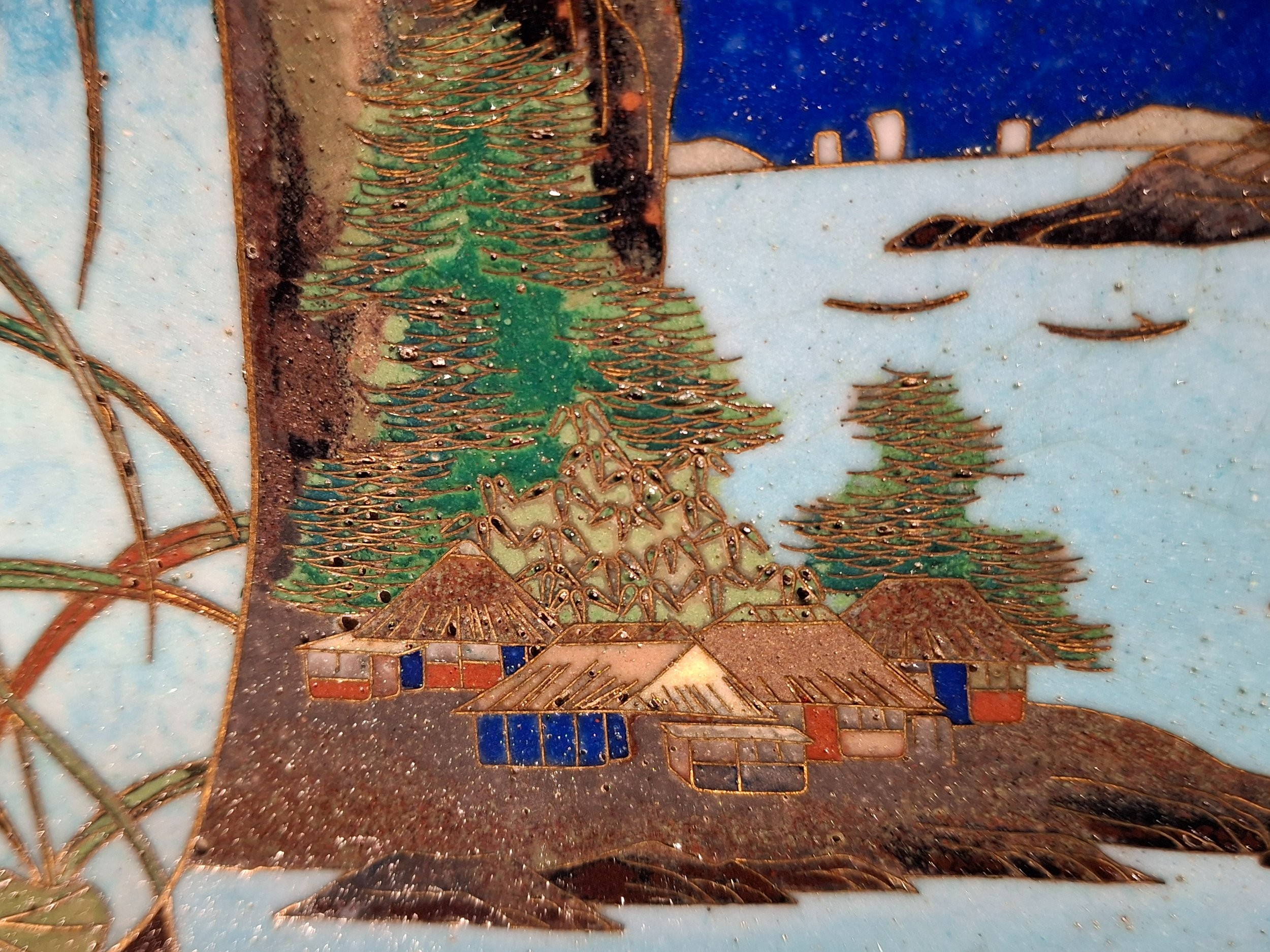
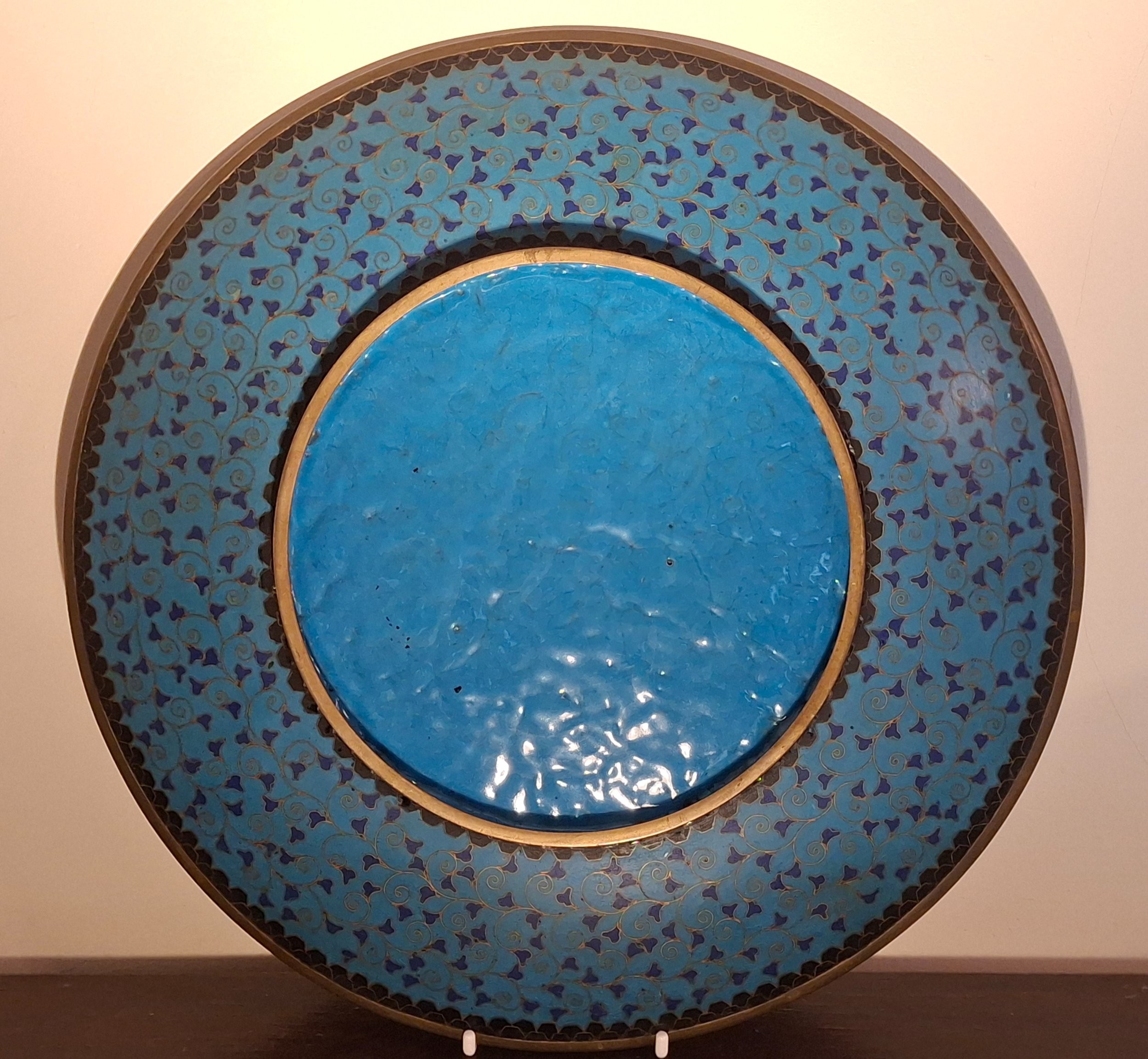
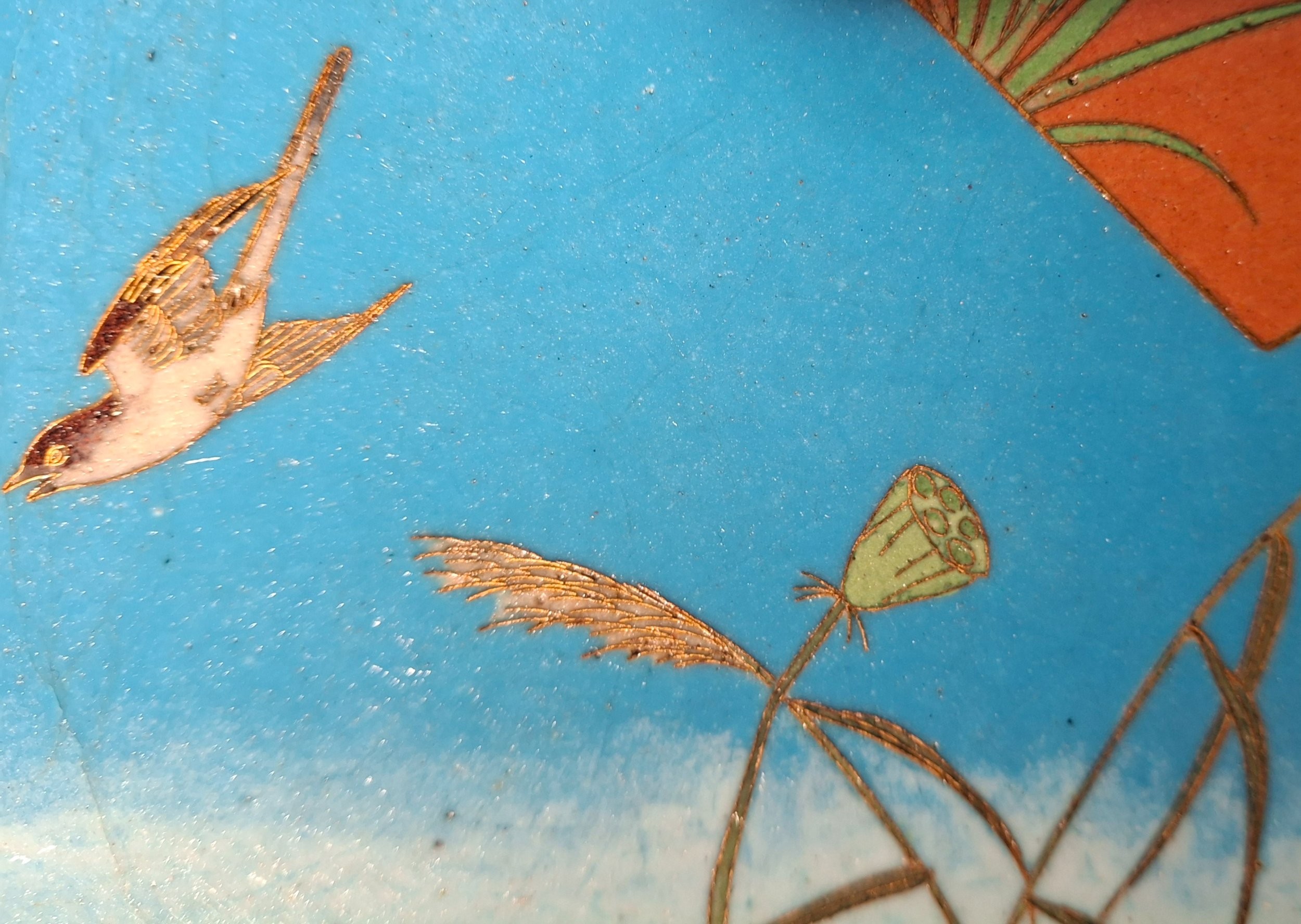
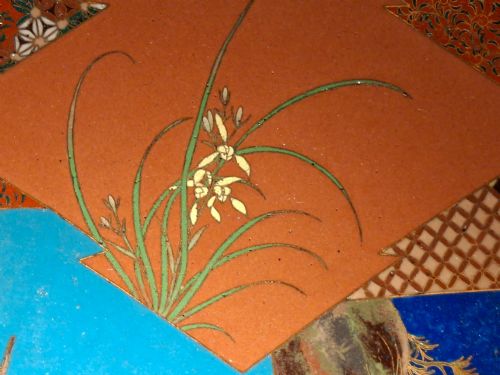
Fine execution of cloisonne wiring techniques, with realistic depiction of Japanese life, nature and culture. The execution of detail is exquisite with rendition of villages within an overall landscape with the sun setting. Adorned with foliage, flowers and a bird, and the natural withering of a plant. The wirework simulating natural form, with a multitude of cloisonne enamel colours. Bordered with mosaics of geometrical shapes, flowers, simulated blossom and grasses. Superb wirework and enamelling techniques.

Most likely made by the Nagoya Cloisonné Company. Highly skilled artistry. Unsigned. In the style and craftsmanship of Namikawa Yasuyuki workshop (Nagoya).*

Condition: Excellent condition with minor hairlines (see photos).

There are two distinct qualities or types expressed in Japanese art: one suggesting endless patience in the execution of minute detail, the other denoting a momentary conception of some fleeting idea carried out with boldness and freedom of expression in form and line – profuse complexity and extreme simplicity… the work on Japanese cloisonné ware generally exhibits the quality suggestive of unwearying labour and patience.
Dimensions:

Diameter = 30.5 cm

Depth = 3.5 cm

*Hayashi Kodenji (1831–1915), a craftsman who became one of the most influential cloisonne makers of his time. Hayashi set up an independent cloisonne workshop in Nagoya in 1862 and, like his teacher, began to train other craftsmen. He remained at the forefront of cloisonné manufacturing in the Nagoya region throughout his career. In 1871 the Nagoya Cloisonné Company was established at Toshima, just outside Nagoya, by Muramatsu Hikoshichi and Tsukamoto Jine’mon, the elder brother of Tsukamoto Kaisuke.

The technological advances they made resulted in the company winning a first prize at the Vienna Exhibition of 1873. Many cloisonne-manufacturing companies sprang up in and around Toshima and the area rapidly became Japan’s main centre of cloisonné production and became known as Shippo-cho (Cloisonné town). It has been estimated that at their peak the cloisonné manufactories of Toshima were producing ‘no less than seventy percent of the total cloisonné enamels produced in Japan.

With the introduction of more advanced enamelling techniques from Europe, notably those introduced by Gottfried Wagener, the previous reliance on background wires to retain the enamels was removed and the way was open for the possibility of using larger areas of clear bright enamels. These innovations took time to perfect, and the use of decorative wires remained integral to the cloisonné enamels of artists such as Namikawa Yasuyuki (1845-1927).

Physical Dimensions
Height
30.5cm (12.01")
Width
30.5cm (12.01")
Depth
3.5cm (1.38")
Declaration

Dragoncharger Antiques has dated this Japanese Cloisonne Enamel Plate to the 1900s.

Reference Numbers
Sellingantiques Reference
SA1204890
Dealers Internal Reference
D:007990
Description
Rare Japanese Cloisonne Medium Plate - Landscape. Nagoya. Circa 1900.
Fine execution of cloisonne wiring techniques, with realistic depiction of Japanese life, nature and culture.
Dragoncharger Antiques

The execution of detail is exquisite with rendition of villages within an overall landscape with the sun setting. Adorned with foliage, flowers and a bird, and the natural withering of a plant. The wirework simulating natural form, with a multitude of cloisonne enamel colours. Bordered with mosaics of geometrical shapes, flowers, simulated blossom and grasses. Superb wirework and enamelling techniques.

fig 1. A circular Japanese cloisonne enamel plate featuring geometric patterned borders around asymmetrical panels depicting flora, a bird, and a nocturnal coastal scene.
fig 1. Rare Japanese Cloisonne Medium Plate - Landscape. Nagoya. Circa 1900.

Most likely made by the Nagoya Cloisonné Company. Highly skilled artistry. Unsigned. In the style and craftsmanship of Namikawa Yasuyuki workshop (Nagoya).*

Condition: Excellent condition with minor hairlines (see photos).

fig 2. A circular Japanese cloisonne enamel plate featuring geometric patterned borders around asymmetrical panels depicting flora, a bird, and a nocturnal coastal scene.
fig 2. Rare Japanese Cloisonne Medium Plate - Landscape. Nagoya. Circa 1900.

There are two distinct qualities or types expressed in Japanese art: one suggesting endless patience in the execution of minute detail, the other denoting a momentary conception of some fleeting idea carried out with boldness and freedom of expression in form and line – profuse complexity and extreme simplicity… the work on Japanese cloisonné ware generally exhibits the quality suggestive of unwearying labour and patience.

fig 3. A circular Japanese cloisonne enamel plate featuring geometric patterned borders around asymmetrical panels depicting flora, a bird, and a nocturnal coastal scene.
fig 3. Rare Japanese Cloisonne Medium Plate - Landscape. Nagoya. Circa 1900.

Dimensions:

Diameter = 30.5 cm

Depth = 3.5 cm

Hayashi Kodenji (1831–1915), a craftsman who became one of the most influential cloisonne makers of his time. Hayashi set up an independent cloisonne workshop in Nagoya in 1862 and, like his teacher, began to train other craftsmen. He remained at the forefront of cloisonné manufacturing in the Nagoya region throughout his career. In 1871 the Nagoya Cloisonné Company was established at Toshima, just outside Nagoya, by Muramatsu Hikoshichi and Tsukamoto Jine’mon, the elder brother of Tsukamoto Kaisuke.

fig 4. A circular Japanese cloisonne enamel plate featuring geometric patterned borders around asymmetrical panels depicting flora, a bird, and a nocturnal coastal scene.
fig 4. Rare Japanese Cloisonne Medium Plate - Landscape. Nagoya. Circa 1900.

The technological advances they made resulted in the company winning a first prize at the Vienna Exhibition of 1873. Many cloisonne-manufacturing companies sprang up in and around Toshima and the area rapidly became Japan’s main centre of cloisonné production and became known as Shippo-cho (Cloisonné town). It has been estimated that at their peak the cloisonné manufactories of Toshima were producing ‘no less than seventy percent of the total cloisonné enamels produced in Japan.

fig 5. A circular Japanese cloisonne enamel plate featuring geometric patterned borders around asymmetrical panels depicting flora, a bird, and a nocturnal coastal scene.
fig 5. Rare Japanese Cloisonne Medium Plate - Landscape. Nagoya. Circa 1900.

With the introduction of more advanced enamelling techniques from Europe, notably those introduced by Gottfried Wagener, the previous reliance on background wires to retain the enamels was removed and the way was open for the possibility of using larger areas of clear bright enamels. These innovations took time to perfect, and the use of decorative wires remained integral to the cloisonné enamels of artists such as Namikawa Yasuyuki (1845-1927).

Height
30.5cm (12.01")
Width
30.5cm (12.01")
Depth
3.5cm (1.38")
Date of Manufacture

Dragoncharger Antiques has dated this Japanese Cloisonne Enamel Plate to the 1900s.

Reference Numbers
Sellingantiques Ref
SA1204890
Dealers Internal Ref
D:007990
Dragoncharger Antiques
Sellingantiques verified Since Aug 2024

Specialising in early japanese cloisonne, edo enamel artisan period.

Dealer Profile

You can view the stock and full dealer information on the Dragoncharger Antiques Profile Page
PDF SHARE
SAVE
A circular Japanese cloisonne enamel plate featuring geometric patterned borders around asymmetrical panels depicting flora, a bird, and a nocturnal coastal scene.
1 / 15
Archive I A circular Japanese cloisonne enamel plate featuring geometric patterned borders around asymmetrical panels depicting flora, a bird, and a nocturnal coastal scene.

Rare Japanese Cloisonne Medium Plate - Landscape. Nagoya. Circa 1900.
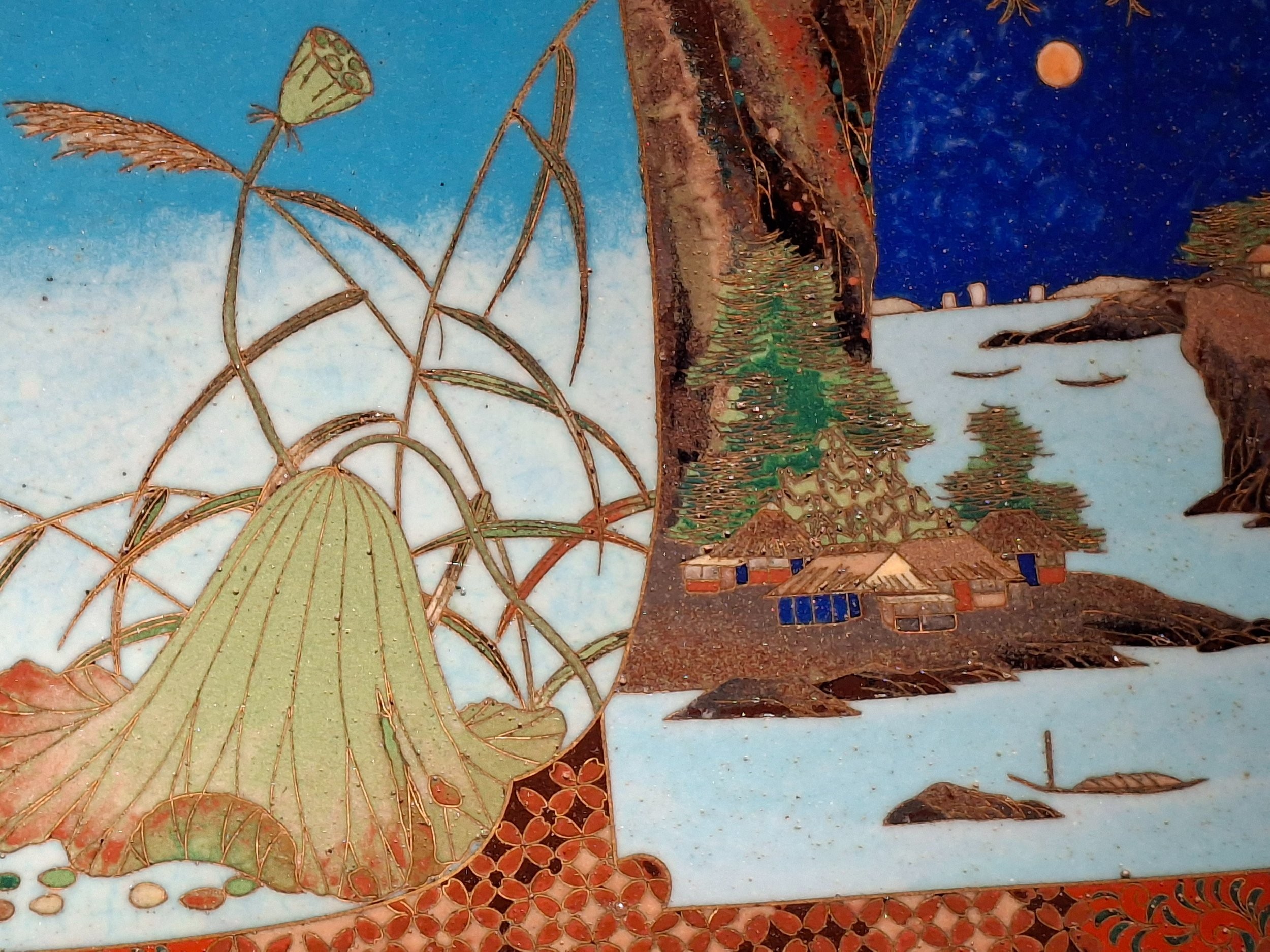
Archive II A circular Japanese cloisonne enamel plate featuring geometric patterned borders around asymmetrical panels depicting flora, a bird, and a nocturnal coastal scene. View II
Archive III A circular Japanese cloisonne enamel plate featuring geometric patterned borders around asymmetrical panels depicting flora, a bird, and a nocturnal coastal scene. View III
Archive IV A circular Japanese cloisonne enamel plate featuring geometric patterned borders around asymmetrical panels depicting flora, a bird, and a nocturnal coastal scene. View IV
Archive V A circular Japanese cloisonne enamel plate featuring geometric patterned borders around asymmetrical panels depicting flora, a bird, and a nocturnal coastal scene. View V
Archive VI A circular Japanese cloisonne enamel plate featuring geometric patterned borders around asymmetrical panels depicting flora, a bird, and a nocturnal coastal scene. View VI
Archive VII A circular Japanese cloisonne enamel plate featuring geometric patterned borders around asymmetrical panels depicting flora, a bird, and a nocturnal coastal scene. View VII
Archive VIII A circular Japanese cloisonne enamel plate featuring geometric patterned borders around asymmetrical panels depicting flora, a bird, and a nocturnal coastal scene. View VIII
Archive IX A circular Japanese cloisonne enamel plate featuring geometric patterned borders around asymmetrical panels depicting flora, a bird, and a nocturnal coastal scene. View IX
Archive X A circular Japanese cloisonne enamel plate featuring geometric patterned borders around asymmetrical panels depicting flora, a bird, and a nocturnal coastal scene. View X
Archive XI A circular Japanese cloisonne enamel plate featuring geometric patterned borders around asymmetrical panels depicting flora, a bird, and a nocturnal coastal scene. View XI
Archive XII A circular Japanese cloisonne enamel plate featuring geometric patterned borders around asymmetrical panels depicting flora, a bird, and a nocturnal coastal scene. View XII
Archive XIII A circular Japanese cloisonne enamel plate featuring geometric patterned borders around asymmetrical panels depicting flora, a bird, and a nocturnal coastal scene. View XIII
Archive XIV A circular Japanese cloisonne enamel plate featuring geometric patterned borders around asymmetrical panels depicting flora, a bird, and a nocturnal coastal scene. View XIV
Archive XV A circular Japanese cloisonne enamel plate featuring geometric patterned borders around asymmetrical panels depicting flora, a bird, and a nocturnal coastal scene. View XV
Enlarged Archival View
Telephone 07974 144321
Location
Bristol
United Kingdom
Verified Since Aug 2024
Items For Sale 150
Items Sold 17
Dragoncharger Antiques
Verified Since Aug 2024
View Dealer Info
Location: Bristol, United Kingdom
Verified
Aug 2024
For Sale
150
Sold
17
A circular Japanese cloisonne enamel plate featuring geometric patterned borders around asymmetrical panels depicting flora, a bird, and a nocturnal coastal scene.
Rare Japanese Cloisonne Medium Plate - Landscape. Nagoya. Circa 1900.

Ref: SA1204890
A circular Japanese cloisonne enamel plate featuring geometric patterned borders around asymmetrical panels depicting flora, a bird, and a nocturnal coastal scene.
Detail View 1
Detail View 2
Detail View 3
Detail View 4
Detail View 5
Detail View 6
Detail View 7
Detail View 8
Detail View 9
Detail View 10
Detail View 11
Detail View 12
Detail View 13
Detail View 14
Archival Detail
Every single antique dealer on our platform is individually approved by our internal team. We verify their professional trade history, ethical standards, and photographic quality to ensure a secure, high-standard buying environment. Upon joining, every dealer agrees to a strict 9-point code of conduct. While issues can occasionally arise, our dealers typically resolve them swiftly and directly with the buyer. In fact, since our founding in 2002, Sellingantiques has only had to step in to help resolve an issue on roughly five occasions—a true testament to the quality of our dealers and their dedication to your happiness.
Our dealers are highly experienced in packing and shipping fragile, high-value antiques. Because you are in direct contact with the dealer, you will be able to easily go through all available shipping and insurance options together to ensure your item arrives safely.
Antiques are the ultimate green purchase. By choosing historical pieces over newly manufactured goods, you completely eliminate the carbon footprint of modern mass production while preserving exceptional, timeless craftsmanship.

Japanese cloisonne enamel artwork from the late nineteenth and early twentieth centuries represents a period of technical refinement in enamel production, centred largely in regions like Nagoya and Kyoto. Artisans created detailed designs by soldering thin metal wires onto a metal base to form compartments, which were then filled with coloured glass enamels and polished smooth.

Traditional cloisonne dishes are constructed on a base of copper or brass metal. Fine ribbons of copper, silver, or brass wire are positioned onto the surface to delineate detailed patterns, after which mineral enamel powders mixed into paste are applied in multiple layers, fired in kilns, and polished to achieve a flush finish.

Authentic pieces from this period typically display exceptionally precise wirework, dark or complex copper undersides, and smooth surfaces polished to a uniform sheen. They frequently feature detailed decorative cartouches containing flora, fauna, or landscape motifs set against complex geometric brocade background patterns.

A Japanese cloisonne plate can be displayed upright on a plate stand atop a sideboard or mantelpiece to showcase its complex enamel patterns. Alternatively, it can be integrated into a gallery wall or positioned as a focal decorative object on a dark wood bookshelf.

Cloisonne enamel should be dusted gently with a soft, dry microfibre cloth to remove surface residue. Avoid using harsh chemical cleaners, abrasive pastes, or immersing the item in water, as moisture can compromise the metal wires and internal enamel structure over time.
items
Add keywords to the filter
Price
£100
£250000
Era
Movements
Material
Origin
Stock Location
Freshness
Online Payments
Categories