61,543  PAGES BROWSED TODAY PAGES TODAY 59 ANTIQUES UPLOADED TODAYNEW ARRIVALS
59 ITEMS ADDED TODAY
Sort Order
Items Per Page
Browse Categories
Sort order
Relevant Links
Items per page
ID #SA1111587
FOR SALE
£1,500
Email
Save
Pair Japanese Cloisonne Enamel Dragon Dishes. Circa 1870.
Dragoncharger Antiques
for sale €1,755     $1,905
£1,500

Dragoncharger Antiques

Sellingantiques Verified Since Aug 2024
View Dealers Stock Page
  • About Us
    Specialising in early japanese cloisonne, edo enamel artisan period.
Id #SA1111587
PDF SHARE
SAVE

Pair Japanese Cloisonne Enamel Dragon Dishes. Circa 1870.

19th century
Description

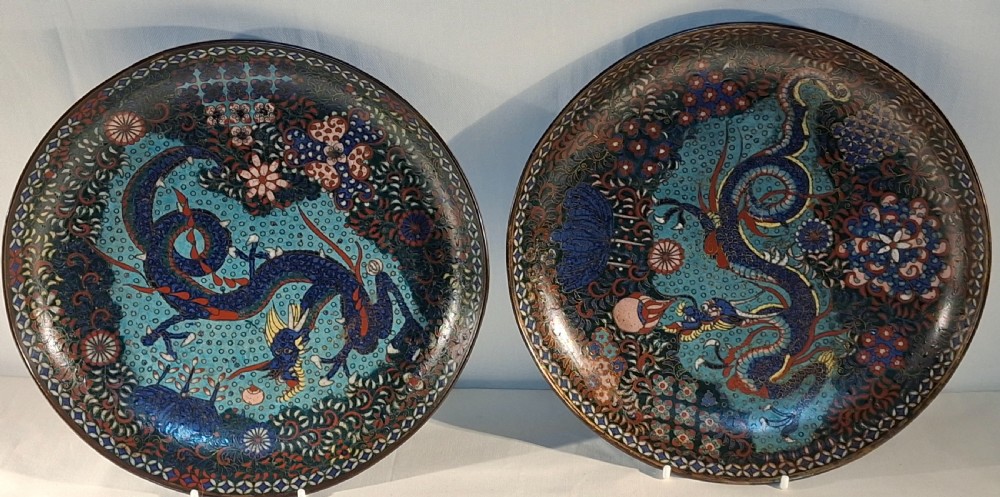
Pair Japanese Cloisonne Enamel Dishes. Circa 1870.

Superbly and finely decorated early Japanese cloisonne pieces (x2 and near matching). Central decoration with fierce dragon chasing / guarding a pearl within the clouds (of the heavens). Surrounded by elaborate brocades, stylised waves, mosaic crosshatching and grasses. High-quality cloisonné with tight brass wire work and multi- coloured enamels. Body is decorated with patterns of Karakusa flowers and geometrical patterns. The dark green enamel is unique to this era and came about through a botched attempt at recreating the turquoise blue of Ming Dynasty cloisonné. Substantial use of wires, both decorative and functional in anchoring the enamel in early Japanese cloisonne work. Attributed to workshop of Kaji Tsunekichi (1803–83) with fine wire work and enamelling technique of the period.

Condition: Excellent condition, form and good circular shape. (Display stands not part of the sale).

Dimensions: Height = 4cm; Diameter = 25cm (approx) of shallow dish form.

* In Japanese culture, dragons are often depicted carrying a pearl, which symbolizes power, wisdom, and spiritual energy. The pearl is said to give dragons the power to ascend into the heavens.

* In the 1830s, Kaji Tsunekichi of Nagoya obtained a piece of Cloisonné enamel and deconstructed it in order to examine how it had been made. He then reworked the piece to produce a small dish with wired enamel decoration. By the 1850s he had opened a workshop (Nagoya), taken on students and was appointed as the official maker of Cloisonné in the Owari Province.

Physical Dimensions
Height
4cm (1.57")
Width
25cm (9.84")
Depth
25cm (9.84")
Declaration

Dragoncharger Antiques has dated these Japanese Cloisonne Dragon Dishes to the 1870s.

Reference Numbers
Sellingantiques Reference
SA1111587
Dealers Internal Reference
D:02226
Description
Pair Japanese Cloisonne Enamel Dishes. Circa 1870.

Superbly and finely decorated early Japanese cloisonne pieces (x2 and near matching). Central decoration with fierce dragon chasing / guarding a pearl within the clouds (of the heavens). Surrounded by elaborate brocades, stylised waves, mosaic crosshatching and grasses. High-quality cloisonné with tight brass wire work and multi- coloured enamels. Body is decorated with patterns of Karakusa flowers and geometrical patterns.

The dark green enamel is unique to this era and came about through a botched attempt at recreating the turquoise blue of Ming Dynasty cloisonné.
Dragoncharger Antiques

Substantial use of wires, both decorative and functional in anchoring the enamel in early Japanese cloisonne work. Attributed to workshop of Kaji Tsunekichi (1803–83) with fine wire work and enamelling technique of the period.

fig 1. A pair of circular Japanese cloisonne enamel dishes featuring blue dragon motifs on turquoise patterned grounds with decorative borders.
fig 1. Pair Japanese Cloisonne Enamel Dragon Dishes. Circa 1870.

Condition: Excellent condition, form and good circular shape. (Display stands not part of the sale).

Dimensions: Height = 4cm; Diameter = 25cm (approx) of shallow dish form.

In Japanese culture, dragons are often depicted carrying a pearl, which symbolizes power, wisdom, and spiritual energy. The pearl is said to give dragons the power to ascend into the heavens.

fig 2. A pair of circular Japanese cloisonne enamel dishes featuring blue dragon motifs on turquoise patterned grounds with decorative borders.
fig 2. Pair Japanese Cloisonne Enamel Dragon Dishes. Circa 1870.

In the 1830s, Kaji Tsunekichi of Nagoya obtained a piece of Cloisonné enamel and deconstructed it in order to examine how it had been made. He then reworked the piece to produce a small dish with wired enamel decoration. By the 1850s he had opened a workshop (Nagoya), taken on students and was appointed as the official maker of Cloisonné in the Owari Province.

Height
4cm (1.57")
Width
25cm (9.84")
Depth
25cm (9.84")
Date of Manufacture

Dragoncharger Antiques has dated these Japanese Cloisonne Dragon Dishes to the 1870s.

Reference Numbers
Sellingantiques Ref
SA1111587
Dealers Internal Ref
D:02226
Dragoncharger Antiques
Sellingantiques verified Since Aug 2024

Specialising in early japanese cloisonne, edo enamel artisan period.

Dealer Profile

You can view the stock and full dealer information on the Dragoncharger Antiques Profile Page
PDF SHARE
SAVE
A pair of circular Japanese cloisonne enamel dishes featuring blue dragon motifs on turquoise patterned grounds with decorative borders.
1 / 13
Archive I A pair of circular Japanese cloisonne enamel dishes featuring blue dragon motifs on turquoise patterned grounds with decorative borders.

Pair Japanese Cloisonne Enamel Dragon Dishes. Circa 1870.

Archive II A pair of circular Japanese cloisonne enamel dishes featuring blue dragon motifs on turquoise patterned grounds with decorative borders. View II
Archive III A pair of circular Japanese cloisonne enamel dishes featuring blue dragon motifs on turquoise patterned grounds with decorative borders. View III
Archive IV A pair of circular Japanese cloisonne enamel dishes featuring blue dragon motifs on turquoise patterned grounds with decorative borders. View IV
Archive V A pair of circular Japanese cloisonne enamel dishes featuring blue dragon motifs on turquoise patterned grounds with decorative borders. View V
Archive VI A pair of circular Japanese cloisonne enamel dishes featuring blue dragon motifs on turquoise patterned grounds with decorative borders. View VI
Archive VII A pair of circular Japanese cloisonne enamel dishes featuring blue dragon motifs on turquoise patterned grounds with decorative borders. View VII
Archive VIII A pair of circular Japanese cloisonne enamel dishes featuring blue dragon motifs on turquoise patterned grounds with decorative borders. View VIII
Archive IX A pair of circular Japanese cloisonne enamel dishes featuring blue dragon motifs on turquoise patterned grounds with decorative borders. View IX
Archive X A pair of circular Japanese cloisonne enamel dishes featuring blue dragon motifs on turquoise patterned grounds with decorative borders. View X
Archive XI A pair of circular Japanese cloisonne enamel dishes featuring blue dragon motifs on turquoise patterned grounds with decorative borders. View XI
Archive XII A pair of circular Japanese cloisonne enamel dishes featuring blue dragon motifs on turquoise patterned grounds with decorative borders. View XII
Archive XIII A pair of circular Japanese cloisonne enamel dishes featuring blue dragon motifs on turquoise patterned grounds with decorative borders. View XIII
Enlarged Archival View
Telephone 07974 144321
Location
Bristol
United Kingdom
Verified Since Aug 2024
Items For Sale 150
Items Sold 17
Dragoncharger Antiques
Verified Since Aug 2024
View Dealer Info
Location: Bristol, United Kingdom
Verified
Aug 2024
For Sale
150
Sold
17
A pair of circular Japanese cloisonne enamel dishes featuring blue dragon motifs on turquoise patterned grounds with decorative borders.
Pair Japanese Cloisonne Enamel Dragon Dishes. Circa 1870.
Ref: SA1111587
A pair of circular Japanese cloisonne enamel dishes featuring blue dragon motifs on turquoise patterned grounds with decorative borders.
Detail View 1
Detail View 2
Detail View 3
Detail View 4
Detail View 5
Detail View 6
Detail View 7
Detail View 8
Detail View 9
Detail View 10
Detail View 11
Detail View 12
Archival Detail
Every single antique dealer on our platform is individually approved by our internal team. We verify their professional trade history, ethical standards, and photographic quality to ensure a secure, high-standard buying environment. Upon joining, every dealer agrees to a strict 9-point code of conduct. While issues can occasionally arise, our dealers typically resolve them swiftly and directly with the buyer. In fact, since our founding in 2002, Sellingantiques has only had to step in to help resolve an issue on roughly five occasions—a true testament to the quality of our dealers and their dedication to your happiness.
Our dealers are highly experienced in packing and shipping fragile, high-value antiques. Because you are in direct contact with the dealer, you will be able to easily go through all available shipping and insurance options together to ensure your item arrives safely.
Antiques are the ultimate green purchase. By choosing historical pieces over newly manufactured goods, you completely eliminate the carbon footprint of modern mass production while preserving exceptional, timeless craftsmanship.

Japanese cloisonne enamel, known as shippo-yaki, reached high levels of technical precision during the Meiji period (18681912). Artisans used thin metal wires to form delicate compartments on metal bases, filling them with coloured glass enamels before firing and polishing.

These items were crafted using a copper or bronze base, onto which brass or silver wires were fixed to outline complex designs. Mineral-based glass enamels were applied into the wire cells, fired multiple times to set, and ground smooth to achieve a flat finish.

Authentic pieces generally exhibit fine wirework, complex geometric or mythical motifs such as dragons, and a distinct weight due to the underlying bronze or copper structure. Minor surface pitting or slight variations near wire edges are typical indicators of historical hand craftsmanship.

Position the pair on plate stands atop a sideboard or shelf, or display them as mounted wall accents. The turquoise and dark blue tones integrate well with dark timber furniture and neutral architectural backdrops.

Dust gently using a soft, dry, lint-free cloth. Avoid chemical cleaning agents, abrasive compounds, or immersion in liquid, as water can penetrate fine fractures in the enamel and cause corrosion to the internal metal core.
items
Add keywords to the filter
Price
£100
£250000
Era
Movements
Material
Origin
Stock Location
Freshness
Online Payments
Categories