
16,038  PAGES BROWSED TODAY PAGES TODAY • 26 ANTIQUES UPLOADED TODAYNEW ARRIVALS
GIFTS
26 ITEMS ADDED TODAY
Sort Order
Items Per Page
Browse Categories
Sort order
Relevant Links
Items per page
ID #SA1103980
SOLD
Email Phone
Save
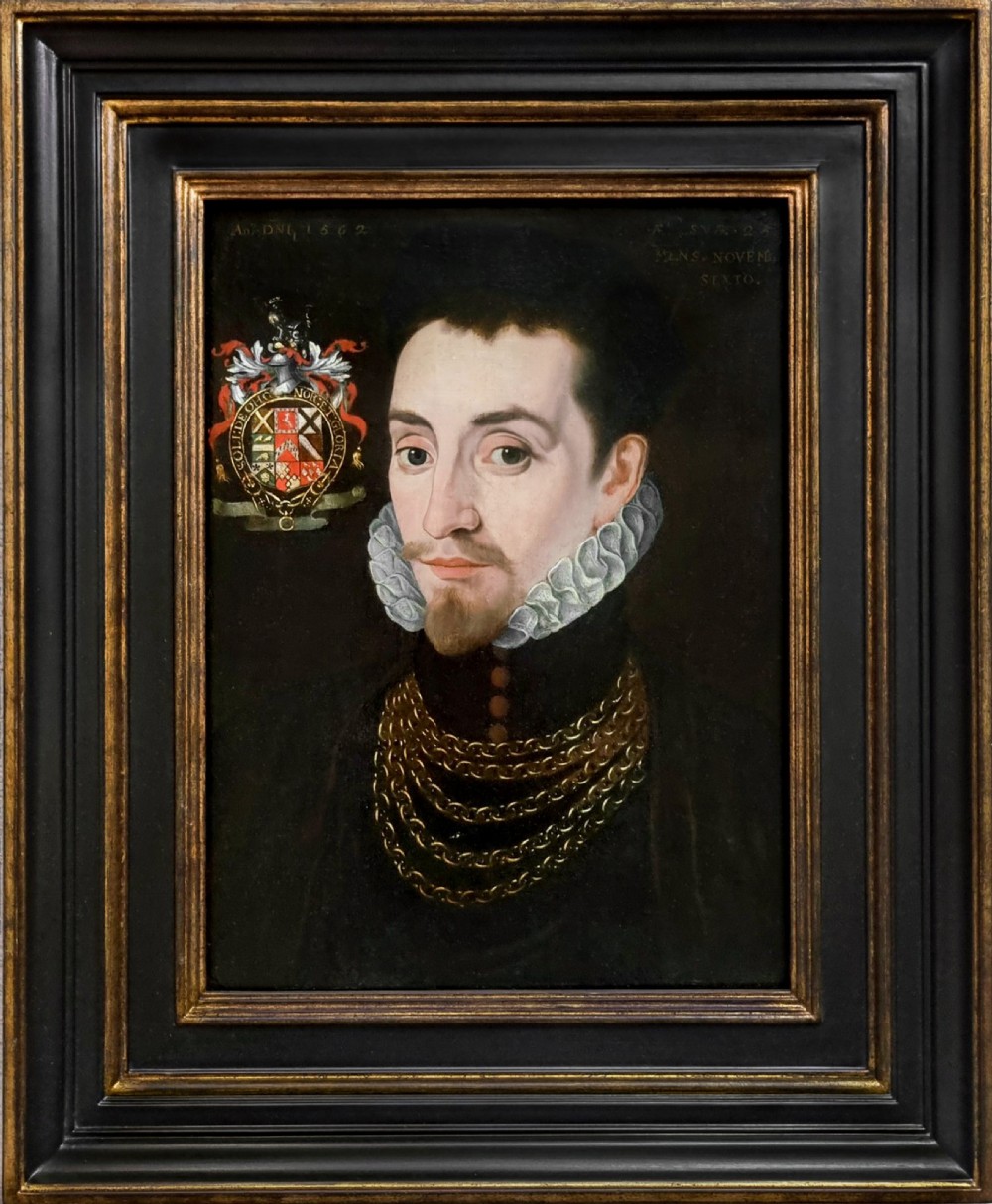
Portrait of an Elizabethan Gentleman, Edmund Huddleston, Dated 1562; Follower of George Gower (1540-1596), Oil on Panel Painting
Sold by Titan Fine Art
sold SA1103980
Sorry, but this item has been sold.
Titan Fine Art

Titan Fine Art

Sellingantiques Verified Since Jul 2016
Browse dealers 24 items
  • About Us
    Specialist in 17th & 18thc portraits. Highly curated selection, museum-level research & pro conservation. Exceptional art, expertly vetted.
Id #SA1103980
PDF SHARE
SAVE

Portrait of an Elizabethan Gentleman, Edmund Huddleston, Dated 1562; Follower of George Gower (1540-1596), Oil on Panel Painting

16th century
Sold 21 November 2024 · Titan Fine Art
This “Portrait of an Elizabethan Gentleman, Edmund Huddleston, Dated 1562; Follower of George Gower (1540-1596), Oil on Panel Painting” found a buyer.

It was listed by Titan Fine Art. Sold pieces stay on Sellingantiques as a record of what has passed through, and the next one is rarely far away.

Description

This oil on panel work formed part of a collection of family pictures and heirlooms of the Whythes family at Copped Hall, an English country house in Epping close to London. Copped Hall was built in 1758 but it replaced a much earlier dwelling from the 12th century built by the Fitzaucher family, who served the king as huntsmen. The portrait passed through several generations of the family until it was sold recently.

The sitter is Sir Edmund Huddleston of Sawston Hall (c.1537–1606), who was from a family of personal soldiers to Queen Mary I of England, however the Huddleston’s trace their lineage back much further, to the time of William the Conqueror when the family resided at the manor or Huddleston (or Hodylston) in Yorkshire.

Sir Edmund was born in 1537, in Droitwich, Worcestershire, England, and he was the eldest son of Sir John Huddleston (1516-1557), of Sawston Hall and Bridget Cotton. Sir John was a friend and protector of the Princess Mary, later Mary I and he received his knighthood on her ascension to the throne and was made a Privy Councillor and Vice Chamberlain to her husband, Philip of Spain. He was also related to Robert Dudley, the favourite of Queen Elizabeth I.

Our sitter married the heiress Dorothy Beaconsall about 1556; this marriage brought him manors in Lancashire and Essex, and through his wife’s connection in Essex, he became Sherrif of Essex and was knighted in 1578. The couple gave birth to at least one son and one daughter. The couple lived for a time at Weald Hall near Brentford and then at Sawston Hall where he died having lived there for close to half a century.

The Latin inscription on the coat of arms: “Soli Deo Honor Et Gloria” (to the one God honour and glory) was the motto used for centuries by all main branches of the Huddleston family. The inscription: “ANO DNI 1562 AE. SVAE. 25, MENS. NOVEMB / SEXTO” states that the sitter was 25 years of age when the portrait was painted in 1562.

The portrait as in the collection of the Whythes family at Copped Hall, Essex, near London, which was built in 1758 to replace at least two earlier buildings that originated as far back as the 12th century. At that time Copped Hall belonged to the Fitzaucher family, who served the king as huntsmen and later it came into the possession of Henry VIII. In 1548 Henry's son, Edward VI, allowed the future Queen Mary I to live at Copped Hall as a prisoner. In 1564 Queen Elizabeth I granted Copped Hall to one of her closest friends—Sir Thomas Heneage.

In the grounds of Copped Hall there was an avenue of yew trees, with a statue of Henry at one end and his son Edward VI at the other. Allegedly on the morning of May 19th 1536, Henry paced up and down this walk, waiting for the distant sound of a cannon from the Tower of London to signal that his second wife Anne Boleyn had been executed. As the cannon sounded Henry is said to have mounted his horse and ridden off to Theobald’s at Waltham Cross where Jane Seymour waited. The couple were married soon after.

In 1739 Edward Conyers purchased the estate and his son, John Conyers I, replaced the mansion with the present one in 1758. George Wythes Sr. (1811-83) purchased the estate in 1869. He was an extremely wealthy man who had made his fortune as a developer and in the construction of railroads. In 1917 the main 18th century block of the house was largely burned-out in a disastrous fire one; much of the contents were saved and moved to Wood House, another large house on the estate where the family relocated to. Mr Wythes died in 1949, followed by his wife died in 1951.

Physical Dimensions
Height
60cm (23.62")
Width
49cm (19.29")
Depth
7cm (2.76")
Declaration

Titan Fine Art has dated this Elizabethan Oil Painting to the 16th Century.

Reference Numbers
Sellingantiques Reference
SA1103980
Dealers Notes

Much more info about this item at: www.titanfineart.com

In a market saturated with available paintings, Titan Fine Art offers a specially curated selection. Each piece is meticulously chosen based on technical merit, provenance, and decorative appeal, professionally conserved and researched, ensuring our clients view only the finest examples of British and European art.

With over 20 years of expertise and 1,000+ works placed with collectors and institutions, we are one of the most prolific specialists in 17th and 18th-century portraiture. We combine a scholarly approach with museum-level rigor to replace the uncertainty of the open market with absolute confidence.

Why Buy From Titan Fine Art?

• Expertly Curated Selection

We act as your expert eye, selecting only high-quality works that offer genuine historical and artistic value.

• Museum-Level Research

Each portrait is supported by extensive academic research, often exceeding 40 hours, to establish attribution, sitter identity, and historical context.

• Professional Conservation

All paintings are carefully cleaned and stabilised by professional conservators, and are presented ready to hang.

• Transparent Pricing

No buyer’s premium or hidden fees—unlike auction houses, where additional costs can add 25–35%.

• Export Pricing Advantage

Reduced pricing is available for works exported outside the UK.

• Specialist Global Shipping

We manage the entire process, including custom crating, export documentation, and fully tracked delivery worldwide.

• Buy with Confidence

A 7-day return policy and the option to pay in GBP, USD, or EUR for convenience and transparency.

• Original Period Frames

Many works retain their original carved and gilded frames, which are works of art in their own right and enhance both historical authenticity and decorative impact.

• Personal Advisory Service

We work directly with collectors and interior designers, offering guidance on selection, scale, and placement—including bespoke room mock-ups on request.

Subscribe to our monthly 'new item alert' to be the first to hear about new works

Description
This oil on panel work formed part of a collection of family pictures and heirlooms of the Whythes family at Copped Hall, an English country house in Epping close to London.
“
Copped Hall was built in 1758 but it replaced a much earlier dwelling from the 12th century built by the Fitzaucher family, who served the king as huntsmen.
Titan Fine Art

The portrait passed through several generations of the family until it was sold recently.

fig 1. A framed oil on panel portrait of an Elizabethan gentleman wearing a ruff and heavy gold chains against a dark background with a coat of arms.
fig 1. Portrait of an Elizabethan Gentleman, Edmund Huddleston, Dated 1562; Follower of George Gower (1540-1596), Oil on Panel Painting

The sitter is Sir Edmund Huddleston of Sawston Hall (c.1537–1606), who was from a family of personal soldiers to Queen Mary I of England, however the Huddleston’s trace their lineage back much further, to the time of William the Conqueror when the family resided at the manor or Huddleston (or Hodylston) in Yorkshire.

fig 2. A framed oil on panel portrait of an Elizabethan gentleman wearing a ruff and heavy gold chains against a dark background with a coat of arms.
fig 2. Portrait of an Elizabethan Gentleman, Edmund Huddleston, Dated 1562; Follower of George Gower (1540-1596), Oil on Panel Painting

Sir Edmund was born in 1537, in Droitwich, Worcestershire, England, and he was the eldest son of Sir John Huddleston (1516-1557), of Sawston Hall and Bridget Cotton. Sir John was a friend and protector of the Princess Mary, later Mary I and he received his knighthood on her ascension to the throne and was made a Privy Councillor and Vice Chamberlain to her husband, Philip of Spain. He was also related to Robert Dudley, the favourite of Queen Elizabeth I.

fig 3. A framed oil on panel portrait of an Elizabethan gentleman wearing a ruff and heavy gold chains against a dark background with a coat of arms.
fig 3. Portrait of an Elizabethan Gentleman, Edmund Huddleston, Dated 1562; Follower of George Gower (1540-1596), Oil on Panel Painting

Our sitter married the heiress Dorothy Beaconsall about 1556; this marriage brought him manors in Lancashire and Essex, and through his wife’s connection in Essex, he became Sherrif of Essex and was knighted in 1578. The couple gave birth to at least one son and one daughter. The couple lived for a time at Weald Hall near Brentford and then at Sawston Hall where he died having lived there for close to half a century.

fig 4. A framed oil on panel portrait of an Elizabethan gentleman wearing a ruff and heavy gold chains against a dark background with a coat of arms.
fig 4. Portrait of an Elizabethan Gentleman, Edmund Huddleston, Dated 1562; Follower of George Gower (1540-1596), Oil on Panel Painting

The Latin inscription on the coat of arms: “Soli Deo Honor Et Gloria” (to the one God honour and glory) was the motto used for centuries by all main branches of the Huddleston family. The inscription: “ANO DNI 1562 AE. SVAE. 25, MENS. NOVEMB / SEXTO” states that the sitter was 25 years of age when the portrait was painted in 1562.

The portrait as in the collection of the Whythes family at Copped Hall, Essex, near London, which was built in 1758 to replace at least two earlier buildings that originated as far back as the 12th century. At that time Copped Hall belonged to the Fitzaucher family, who served the king as huntsmen and later it came into the possession of Henry VIII. In 1548 Henry's son, Edward VI, allowed the future Queen Mary I to live at Copped Hall as a prisoner. In 1564 Queen Elizabeth I granted Copped Hall to one of her closest friends—Sir Thomas Heneage.

In the grounds of Copped Hall there was an avenue of yew trees, with a statue of Henry at one end and his son Edward VI at the other. Allegedly on the morning of May 19th 1536, Henry paced up and down this walk, waiting for the distant sound of a cannon from the Tower of London to signal that his second wife Anne Boleyn had been executed. As the cannon sounded Henry is said to have mounted his horse and ridden off to Theobald’s at Waltham Cross where Jane Seymour waited. The couple were married soon after.

In 1739 Edward Conyers purchased the estate and his son, John Conyers I, replaced the mansion with the present one in 1758. George Wythes Sr. (1811-83) purchased the estate in 1869. He was an extremely wealthy man who had made his fortune as a developer and in the construction of railroads. In 1917 the main 18th century block of the house was largely burned-out in a disastrous fire one; much of the contents were saved and moved to Wood House, another large house on the estate where the family relocated to. Mr Wythes died in 1949, followed by his wife died in 1951.

Height
60cm (23.62")
Width
49cm (19.29")
Depth
7cm (2.76")
Date of Manufacture

Titan Fine Art has dated this Elizabethan Oil Painting to the 16th Century.

Reference Numbers
Sellingantiques Ref
SA1103980
Titan Fine Art
Titan Fine Art
Sellingantiques verified Since Jul 2016

Specialist in 17th & 18thc portraits. Highly curated selection, museum-level research & pro conservation. Exceptional art, expertly vetted.

Dealer Profile

You can view the stock and full dealer information on the Titan Fine Art Profile Page
PDF SHARE
SAVE
A framed oil on panel portrait of an Elizabethan gentleman wearing a ruff and heavy gold chains against a dark background with a coat of arms. SOLD6+ MONTHS AGO
1 / 5
Archive I A framed oil on panel portrait of an Elizabethan gentleman wearing a ruff and heavy gold chains against a dark background with a coat of arms. SOLD6+ MONTHS AGO

Portrait of an Elizabethan Gentleman, Edmund Huddleston, Dated 1562; Follower of George Gower (1540-1596), Oil on Panel Painting

Archive II A framed oil on panel portrait of an Elizabethan gentleman wearing a ruff and heavy gold chains against a dark background with a coat of arms. View II
Archive III A framed oil on panel portrait of an Elizabethan gentleman wearing a ruff and heavy gold chains against a dark background with a coat of arms. View III
Archive IV A framed oil on panel portrait of an Elizabethan gentleman wearing a ruff and heavy gold chains against a dark background with a coat of arms. View IV
Archive V A framed oil on panel portrait of an Elizabethan gentleman wearing a ruff and heavy gold chains against a dark background with a coat of arms. View V
Enlarged Archival View
Telephone 07875 412 111
Location
London
United Kingdom
Dealer Profile Page sellingantiques.co.uk/titan
Verified Since Jul 2016
Items For Sale 24
Items Sold 402
Titan Fine Art
Titan Fine Art
Verified Since Jul 2016
View Dealer Info
Location: London, United Kingdom
Verified
Jul 2016
For Sale
24
Sold
402
A framed oil on panel portrait of an Elizabethan gentleman wearing a ruff and heavy gold chains against a dark background with a coat of arms.
Portrait of an Elizabethan Gentleman, Edmund Huddleston, Dated 1562; Follower of George Gower (1540-1596), Oil on panel painting
Ref: SA1103980
A framed oil on panel portrait of an Elizabethan gentleman wearing a ruff and heavy gold chains against a dark background with a coat of arms.
Detail View 1
Detail View 2
Detail View 3
Detail View 4
Archival Detail
Every single antique dealer on our platform is individually approved by our internal team. We verify their professional trade history, ethical standards, and photographic quality to ensure a secure, high-standard buying environment. Upon joining, every dealer agrees to a strict 9-point code of conduct. While issues can occasionally arise, our dealers typically resolve them swiftly and directly with the buyer. In fact, since our founding in 2002, Sellingantiques has only had to step in to help resolve an issue on roughly five occasions—a true testament to the quality of our dealers and their dedication to your happiness.
Our dealers are highly experienced in packing and shipping fragile, high-value antiques. Because you are in direct contact with the dealer, you will be able to easily go through all available shipping and insurance options together to ensure your item arrives safely.
Antiques are the ultimate green purchase. By choosing historical pieces over newly manufactured goods, you completely eliminate the carbon footprint of modern mass production while preserving exceptional, timeless craftsmanship.
Written by Sellingantiques from the dealer’s photographs and listing
  • ObjectPaintings
  • Period16th century
  • StyleElizabethan
  • MaterialOil, Wood, Gilt Wood
  • ColourDark Brown
  • MotifsRuff collar, Coat of arms, Gold chain necklaces, Inscribed lettering
  • SizeH 60 cm (24 in) x W 49 cm (19 in) x D 7 cm (3 in)

Elizabethan portraiture is characterised by flat perspective, linear precision, elaborate costume detailing, and often the inclusion of heraldry or inscriptions denoting status.

Artists during this period typically painted with oil colours on prepared wooden panels, most commonly oak, before the widespread adoption of canvas.

Authenticity is assessed through dendrochronology on the wood panel, pigment analysis, craquelure patterns, and examination of historical construction techniques on the reverse.

An antique portrait adds gravity and historical contrast when hung against dark, moody walls or paired with minimalist, clean-lined furnishings to highlight its traditional craftsmanship.

Preservation requires stable indoor humidity and temperature levels, protection from direct sunlight, and avoiding harsh chemical cleaners on both the painted surface and the historic frame.
items
Add keywords to the filter
Price
£100
£250000
Era
Period
Style
Material
Origin
Stock Location
Recently Added
Online Payments
Categories