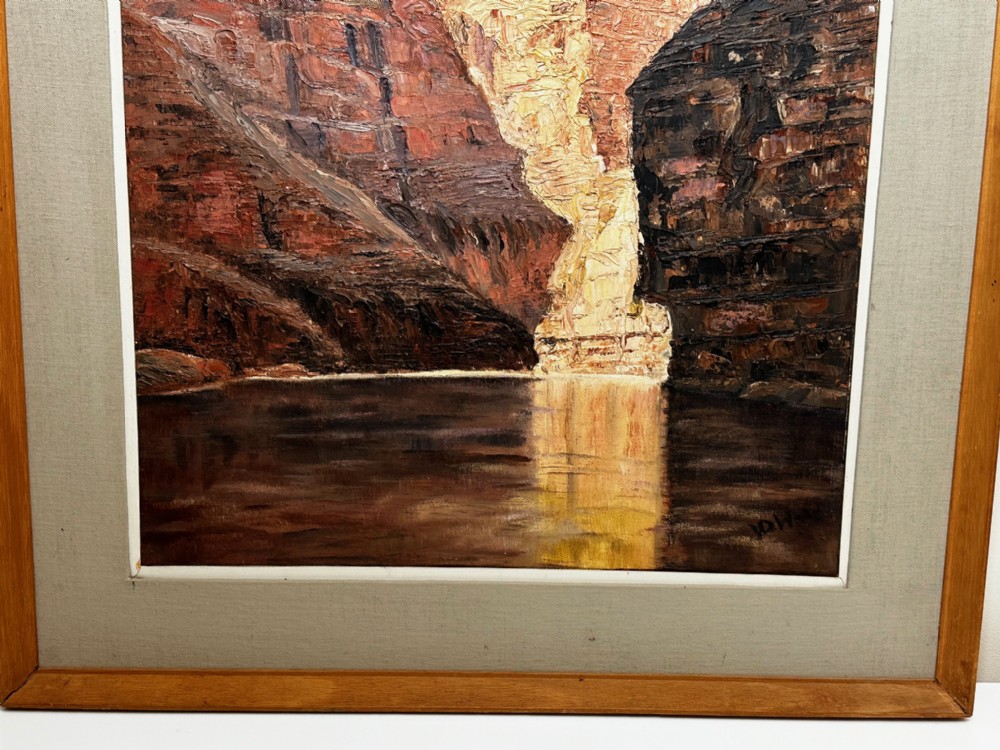
Cheshire Antiques Consultant Ltd has dated this piece to the 1960s.
This is an awe inspiring American landmark view that will impress your clients and guests in your office or home living room wall space, you will love the feel of the thick surface textures that you can actually touch on this painting.

Title verso "No 3 Aqua Carvings Grand Canyon."
Signed lower left on the front bt the British artist Doreen Wade.

In our opinion this is one of her finest works.
Impressive size with the frame being 68 cm wide and 78 cm high.
Oil on board.
The Grand Canyon (Hopi: Öngtupqa, Yavapai: Wi:ka'i:la, Navajo: Bidáá' Ha'azt'i' Tsékooh,Southern Paiute language: Paxa’uipi,Spanish: Gran Cañón or Gran Cañón del Colorado) is a steep-sided canyon carved by the Colorado River in Arizona, United States. The Grand Canyon is 277 miles (446 km) long, up to 18 miles (29 km) wide and attains a depth of over a mile (6,093 feet or 1,857 meters).

The canyon and adjacent rim are contained within Grand Canyon National Park, the Kaibab National Forest, Grand Canyon–Parashant National Monument, the Hualapai Indian Reservation, the Havasupai Indian Reservation and the Navajo Nation. The surrounding area is contained within the Baaj Nwaavjo I'tah Kukveni – Ancestral Footprints of the Grand Canyon National Monument. President Theodore Roosevelt was a major proponent of the preservation of the Grand Canyon area and visited it on numerous occasions to hunt and enjoy the scenery.

Nearly two billion years of Earth's geological history have been exposed as the Colorado River and its tributaries cut their channels through layer after layer of rock while the Colorado Plateau was uplifted. While some aspects about the history of incision of the canyon are debated by geologists, several recent studies support the hypothesis that the Colorado River established its course through the area about 5 to 6 million years ago. Since that time, the Colorado River has driven the down-cutting of the tributaries and retreat of the cliffs, simultaneously deepening and widening the canyon.

For thousands of years, the area has been continuously inhabited by Native Americans, who built settlements within the canyon and its many caves. The Pueblo people considered the Grand Canyon a holy site, and made pilgrimages to it. The first European known to have viewed the Grand Canyon was García López de Cárdenas from Spain, who arrived in 1540.

An exceptional fine example of her work.
Provenance labels verso Exhibition 1966, James Bourlet & Sons Ltd N370909 & inscribed exhibited Royal Institute 1966 also exhibited Royal Academy 1967.
Set in the original frame.

Circa mid 20th century 1960's.
Such a delightful historical scene to the eye.
Highly sought after due to the collectible nature of honeypot scenic landscape subject matter such elaborate detail.
With hanging thread on the back ready for immediate home wall display.

Incredible conversation piece for your guests.
We only select & sell paintings based upon subject, quality & significance.
We provide our clients with friendly professional customer service.
Condition report.

Offered in fine used condition.
Front painting surface is in good overall order. Having foxing staining, craquelure in areas. The frame which has various general wear, scuffs, chips, cracking, stains, losses in areas commensurate with usage & age.

International buyers worldwide shipping is available please ask for a quote.
Checkout our exciting other available Fine Arts, antiques & collectibles in our shop gallery.
Dimensions in centimetres of the frame
High (78 cm)
Wide (68 cm)
Depth thickness of frame (3.2 cm)
Cheshire Antiques Consultant Ltd has dated this piece to the 1960s.
Source the historic in 17th, 18th, 19th & 20th century fine arts, painting, sculptures & collectibles
You can view the stock and full dealer information on the Cheshire Antiques Consultant Ltd Profile Page

Impressionist Oil Painting USA Arizona Landscape Grand Canyon