

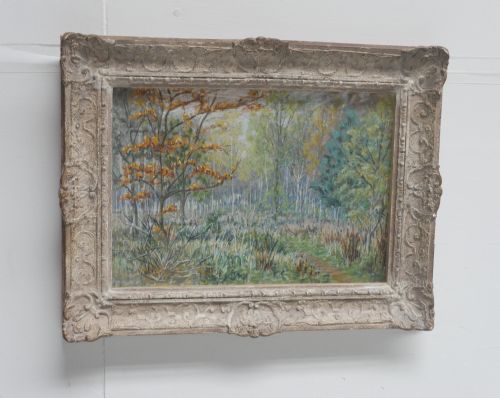


Woodland Landscape Wall Art
Woodland landscape wall art brings the quiet depth of trees, rivers, and shaded paths directly into a room through historic paintings and textiles.
Woodland Landscape Wall Art
Woodland landscape wall art encompasses centuries of painted and woven depictions of forests, quiet country paths, and tree-lined rivers. These pieces capture the changing moods of nature, from bright summer glades to misty autumn woods, reflecting the artistic priorities of their respective periods.
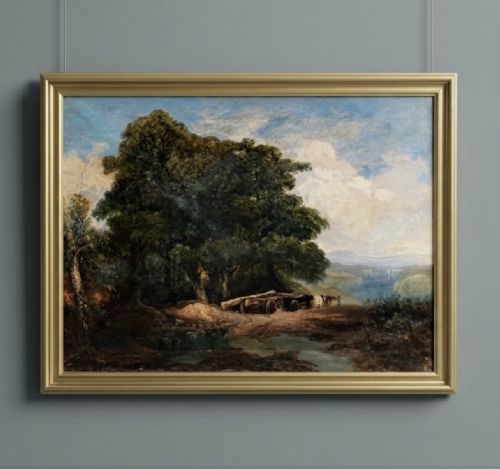
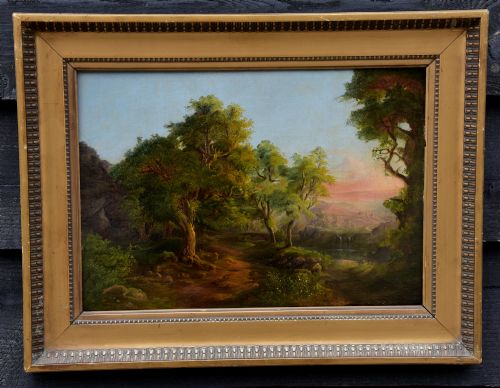
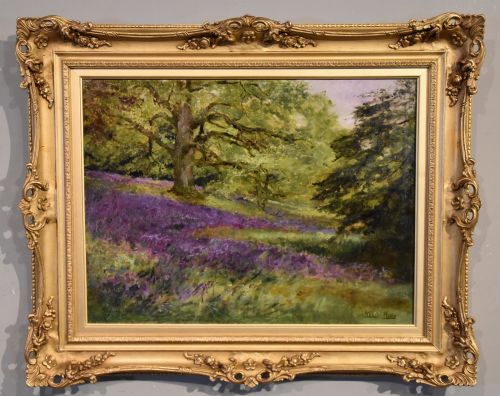
On this page, buyers will most frequently encounter 19th-century and early 20th-century oils and watercolours, alongside mid-century canvases and older tapestries. British impressionism and Victorian realism dominate the selection, offering detailed observations of trees, cattle paths, and figures gathered beneath boughs.
Materials and construction
The works rely primarily on oil paint applied to canvas or board, alongside delicate watercolours on paper and woven wool or silk in tapestries. Artists built depth through layered brushwork, capturing light filtering through branches using rich pigments and occasional gold leaf accents.
Several woodland scenes quietly hide grazing sheep, wandering cattle, and children gathering firewood deep beneath the boughs.
What separates the finest pieces
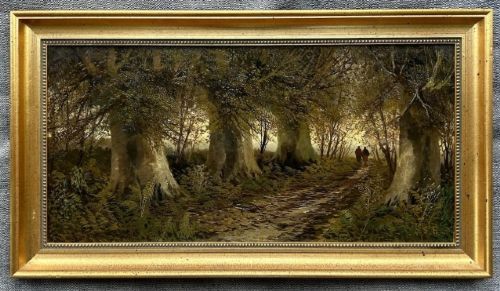
Quality in these works rests upon the artist's command of light, shadow, and atmospheric perspective within the woodland setting. Superior pieces demonstrate confident brushwork and a balanced composition that draws the eye naturally along a wooded path or river glen.
The handling of natural light and seasonal mood distinguishes master painters from lesser copyists. Works by established named artists retain stronger compositional harmony, capturing the specific textures of bark, foliage, and earth with enduring clarity.
Richard Sebastian Bond·William H Myers·Thomas W Lascelles·Henry Yeen King·Arthur Herbert Rigg·Thomas Bromley Blacklock·James Mallard Bromley·William Mellor·Alfred Grey·John Wright Oakes·Rowland Henry Hill·Abraham Hulk Jnr·Harold Swanwick·Charles James Adams·Edward H Holder·George F Wetherbee·J McIntyre·John Falconar Slater·Hans Kappel Øvre·Frederick Bartman·Charles Edmond Rene His
The Woodland Landscape Wall Art Glossary
- Oil on canvas
- Pigment mixed with drying oil applied to a stretched woven fabric support. This combination allows for rich colour blending and textured brushwork.
- Watercolour
- Paint made with water-soluble pigments on paper, valued for its luminous transparency. It was frequently used for spontaneous field sketches and finished landscapes.
- Verdure tapestry
- A large wall hanging dominated by stylized foliage, trees, and landscape elements. These textiles often depicted dense woodland scenes populated by animals or figures.
- Impressionism
- An art style focusing on accurate depiction of light and its shifting qualities. Artists used visible brushstrokes to capture the immediate visual impression of a scene.
- Collotype
- A photomechanical printing process used to produce high-detail reproductions. It results in continuous tones without a visible dot matrix.
Woodland Landscape Wall Art: Frequently Asked Questions
What periods do these pieces span?
The collection spans from 17th-century verdure tapestries through 19th-century Victorian works up to mid-century post-war canvases. Each period introduces distinct framing choices and painting techniques.
Victorian and Edwardian naturalism form a significant core, alongside earlier Dutch school influences and later 20th-century watercolours and oils.
How should I hang heavy oil paintings?
Large canvases in wood frames require secure wall anchors and proper picture-hanging wire rated for the weight of the piece. Ensure the wall structure can support the combined weight of canvas and frame.
Position paintings away from direct sunlight and strong heat sources to protect the oil paint and canvas from drying out or warping over time.
Are watercolours different from oil paintings?
Watercolours use water-soluble pigments on paper and must be displayed behind glass with protective mounts to prevent moisture damage. They offer a lighter, more translucent quality compared to heavier oils.
Oil paintings on canvas or board are sturdier and do not strictly require glass protection, relying instead on varnished surfaces to guard against dust and environmental wear.
How do I identify a Victorian landscape?
Victorian landscapes often feature detailed realism, romantic countryside views, rivers, and woodland paths populated by cattle or figures. The brushwork tends to be precise and descriptive.
Signatures, artist plaques, and period framing styles provide further context for dating, supported by the specific tonal palette characteristic of 19th-century British art.